What Is Local Search Optimization? Algorithms vs. Local SEO
Search for "what is local search optimization" and you'll land in two very different worlds. One belongs to computer science, a class of algorithms used to solve complex optimization problems in artificial intelligence. The other belongs to marketing, the practice of improving a business's visibility in location-based search results . Same phrase, completely different meanings.
The confusion is understandable. Both deal with "searching" for optimal outcomes, and both use the word "local" to describe scope. But an AI researcher solving a scheduling problem and a franchise owner trying to rank each location on Google Maps are doing fundamentally different things . If you've stumbled across algorithm-heavy explanations when you really wanted marketing answers (or vice versa), this article sorts it out for you .
We'll break down local search optimization on both sides: how it works as a computational method and what it means as a business strategy. At Multi Web Team, we build and manage websites for multi-location businesses and franchises, so local SEO is core to what we do every day . We'll bring that hands-on experience into the conversation, especially when we get to the marketing side. But first, we'll give the algorithm its fair treatment so you walk away with a complete picture , no matter which definition brought you here.
Two meanings of local search optimization
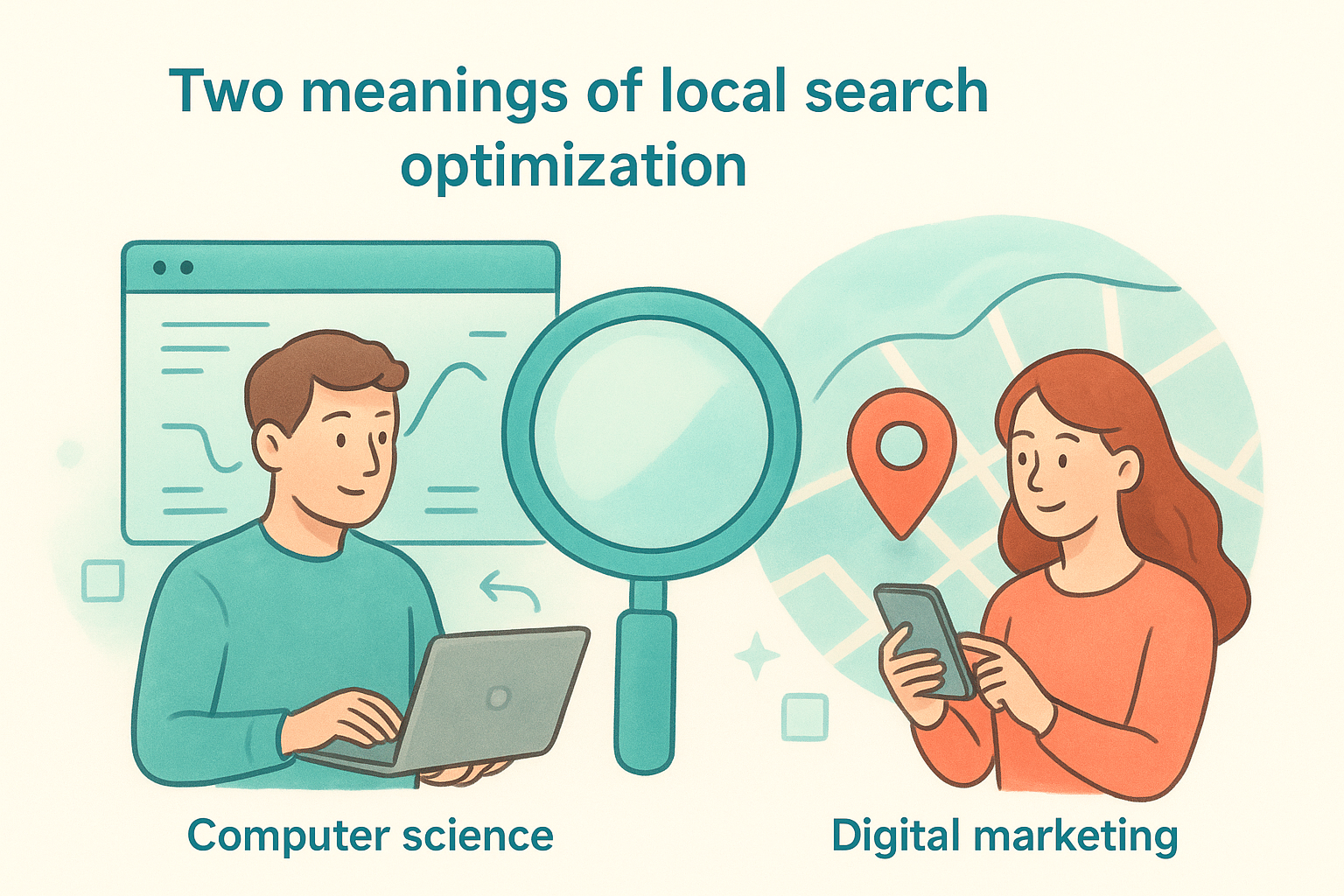
When you ask "what is local search optimization," the answer depends entirely on context. In computer science, it refers to a family of algorithms that iteratively improve a candidate solution by examining nearby states in a problem space. In digital marketing, it refers to making a business more visible in geographically relevant search engine results. Both definitions are legitimate , and both appear in technical literature, academic courses, and everyday conversation. Knowing which one applies to your situation saves you from reading the wrong material for the wrong purpose.
The computer science definition
In algorithm design, local search is a heuristic method used to solve complex optimization problems. The core idea is straightforward: start with a candidate solution, then make small incremental changes to explore neighboring solutions. If a neighboring solution is better, move to it. You keep doing this until no improvement is possible within your immediate neighborhood, at which point you've reached what researchers call a local optimum . This approach appears across artificial intelligence, operations research, scheduling, and logistics, anywhere you need a good answer to a problem with far too many possible solutions to check one by one.
The word "local" in local search algorithms refers to the neighborhood of a current solution in a solution space, not a geographic location.
The algorithm doesn't scan every possible answer. Instead, it navigates the solution space step by step , evaluating nearby options at each position. This makes it computationally fast and practical for large, complex problems. The real tradeoff is getting stuck: if every neighboring solution looks worse than your current position, the algorithm stops, even when a far superior solution exists somewhere else in the space entirely.
The marketing definition
In digital marketing, local search optimization describes something completely different. Here, "local" refers to geography, not algorithm neighborhoods. When someone searches for "dentist near me" or "tire shop in Denver," they're running a local search. The results they see depend on proximity, relevance, and the quality of a business's online profile. Local SEO is the work businesses do to appear prominently in those results, specifically in Google's local pack, on Google Maps, and in location-specific organic listings.
For a single-location business, local SEO typically involves building out a Google Business Profile, gathering customer reviews, and targeting keywords tied to a specific city or neighborhood. For multi-location businesses and franchises , the complexity scales up fast. Each location needs its own optimized presence while still fitting inside a consistent brand structure. That's a real operational challenge, and growing businesses frequently underestimate it until they've already fallen behind competitors in local rankings.
The two definitions share almost nothing beyond the phrase itself. One lives in computer science textbooks and AI research; the other lives in marketing dashboards and search engine reports. Both are worth understanding, and the rest of this article covers each one in depth.
How local search algorithms work
To understand what local search optimization means in the algorithm context, you need to picture a search space : a massive collection of all possible solutions to a given problem. Your goal is to find the solution with the best possible score, whether that's the shortest travel route, the most efficient schedule, or the lowest error rate. Because most real-world problems have billions of possible combinations , checking every option is not feasible. Local search sidesteps that problem by starting from one point and moving strategically.
Starting point and neighborhood moves
Every local search algorithm begins with an initial candidate solution , which is often generated randomly or through a simple rule. From that starting point, the algorithm examines a set of neighboring solutions. These neighbors are solutions you can reach by making one small change to your current answer, swapping two items in a list, flipping a single variable, or shifting one element to a different position. The algorithm evaluates each neighbor using an objective function , a formula that scores how good a solution is, and then moves to the best one it finds.

The neighborhood structure you define largely determines how well a local search algorithm performs. A poorly designed neighborhood can trap the algorithm early.
Think of it like standing on hilly terrain and taking one step at a time toward higher ground. You evaluate the elevation of adjacent spots , step to the highest one, and repeat. The problem is that you might climb to a small hill without ever realizing a much taller peak exists across the valley.
The stopping condition
A local search algorithm stops when no neighboring solution improves on the current one . That stopping point is called a local optimum , and it represents both the strength and the weakness of the method. You get a result quickly, but that result is not always the globally best answer available.
Researchers address this limitation through modifications like random restarts (running the algorithm multiple times from different starting points) or adding controlled randomness to occasionally accept a worse move. These variations help the algorithm escape local optima and explore more of the solution space before settling on a final answer.
Examples of local search algorithms
When you study what is local search optimization in the algorithm sense, concrete examples make the concept click faster than any abstract definition. Several well-known algorithms fall under this umbrella, each using a distinct strategy to navigate the solution space. Three of the most widely applied are hill climbing, simulated annealing, and tabu search , and understanding each one shows how different design choices lead to different trade-offs.
Hill climbing
Hill climbing is the simplest local search algorithm and the easiest to picture. You start at an initial solution, evaluate all neighboring solutions, and move to whichever neighbor scores best. You repeat this process until no neighbor improves on your current position. The algorithm is fast and straightforward to implement , which makes it a natural starting point for learning local search. Its core weakness is stopping at the first local optimum it reaches, even when far better solutions exist elsewhere in the space.
Hill climbing performs well on smooth, well-structured problem landscapes but struggles when the solution space is uneven and full of competing local peaks.
Simulated annealing
Simulated annealing borrows its logic from the physical process of cooling metal slowly to reduce structural defects. Unlike hill climbing, it occasionally accepts a worse neighboring solution with a probability that decreases as the algorithm runs. This controlled randomness allows it to escape local optima during the early stages and explore more of the space before narrowing in. Researchers apply simulated annealing to problems like circuit layout optimization and vehicle routing , where the solution space is large and the stakes of a poor answer are high.
Tabu search
Tabu search handles the local optimum problem through memory rather than randomness. It maintains a short-term structure called a tabu list that records recently visited solutions and blocks the algorithm from returning to them. This forces exploration into new regions of the solution space even when every available neighbor looks worse than the current position. Tabu search performs well on constrained combinatorial problems like employee scheduling and supply chain planning , where you need a near-optimal arrangement across many interdependent variables.
When local search works well and fails
Understanding when to apply local search algorithms versus when to avoid them matters as much as knowing how they work. These algorithms are not universal solutions. They shine under specific conditions and break down in others, so matching the algorithm to the problem structure is the real skill.
When local search algorithms perform well
Local search algorithms excel on large combinatorial problems where finding a perfect solution within a reasonable timeframe is mathematically impossible. Problems like vehicle routing, job scheduling, and network layout fit this profile well. The solution space is enormous, any reasonable answer beats an exhaustive search that never finishes, and small incremental changes consistently produce meaningful improvements. When you encounter a problem where a good answer fast beats a perfect answer never, local search is often your strongest option.
Local search performs best when the problem landscape is relatively smooth, meaning small changes to a solution produce predictably small changes in quality.
These algorithms also work well when you can clearly define a neighborhood structure and an objective function . If you can describe what a "small change" looks like and how to score any given solution, you have everything a local search algorithm needs to operate.
Where local search algorithms struggle
The core failure mode of local search is getting trapped at a local optimum. This happens when the algorithm lands on a solution that looks better than all its immediate neighbors but sits far from the best possible answer overall. You don't see this problem coming because the algorithm has no view of the broader solution space , only the solutions reachable in one step.
Highly irregular or deceptive problem landscapes make this failure more likely. If the space contains many competing peaks of similar height, a basic hill climbing approach stops at whichever peak it reaches first. Problems where the objective function is noisy or expensive to evaluate add another layer of difficulty, since the algorithm may waste moves chasing measurement error rather than genuine improvement. When you're researching what is local search optimization for algorithmic purposes, recognizing these failure conditions helps you decide whether a base local search method is enough or whether you need modifications like random restarts or tabu lists layered in.
Local SEO: local search optimization for businesses
When people search for "what is local search optimization" from a marketing angle, they're asking how businesses show up in location-based search results . Local SEO is the set of practices that make this happen. It directly affects whether a potential customer sees your business or your competitor's when they search for a service in their area.
What local SEO actually involves
Local SEO centers on three core signals : relevance, distance, and prominence. Google uses these factors to decide which businesses appear in the local pack, the map-based results block that appears at the top of many location-specific searches. You influence relevance by matching your content and business category to what searchers need, distance through your physical location , and prominence through reviews, citations, and the overall quality of your online presence.
The most foundational step is building out your Google Business Profile. This free listing controls how your business appears in Google Maps and local search results. You need an accurate business name, address, phone number , category, and hours. Customer reviews on this profile carry significant weight in both rankings and whether searchers click through to your site. You also want to select the right primary category , since it determines which types of searches your listing is eligible to appear in. Keeping all of this updated when details change is not optional; outdated information damages both rankings and customer trust.
Why multi-location businesses face unique challenges
Running more than one location makes local SEO considerably more complex. Each location needs its own optimized profile , its own set of reviews, and its own dedicated landing page on your website. A franchise with twelve locations isn't just managing one profile; it's managing twelve, all of which need consistent information and individual attention.
Inconsistent business information across locations is one of the fastest ways to lose ground in local search rankings.
This is where businesses frequently run into trouble. Keeping name, address, and phone number data accurate and consistent across every profile, directory, and page takes real ongoing effort. At Multi Web Team, we handle exactly this type of work for multi-location businesses , managing each location's web presence so you can focus on running operations rather than auditing listings.
Quick recap
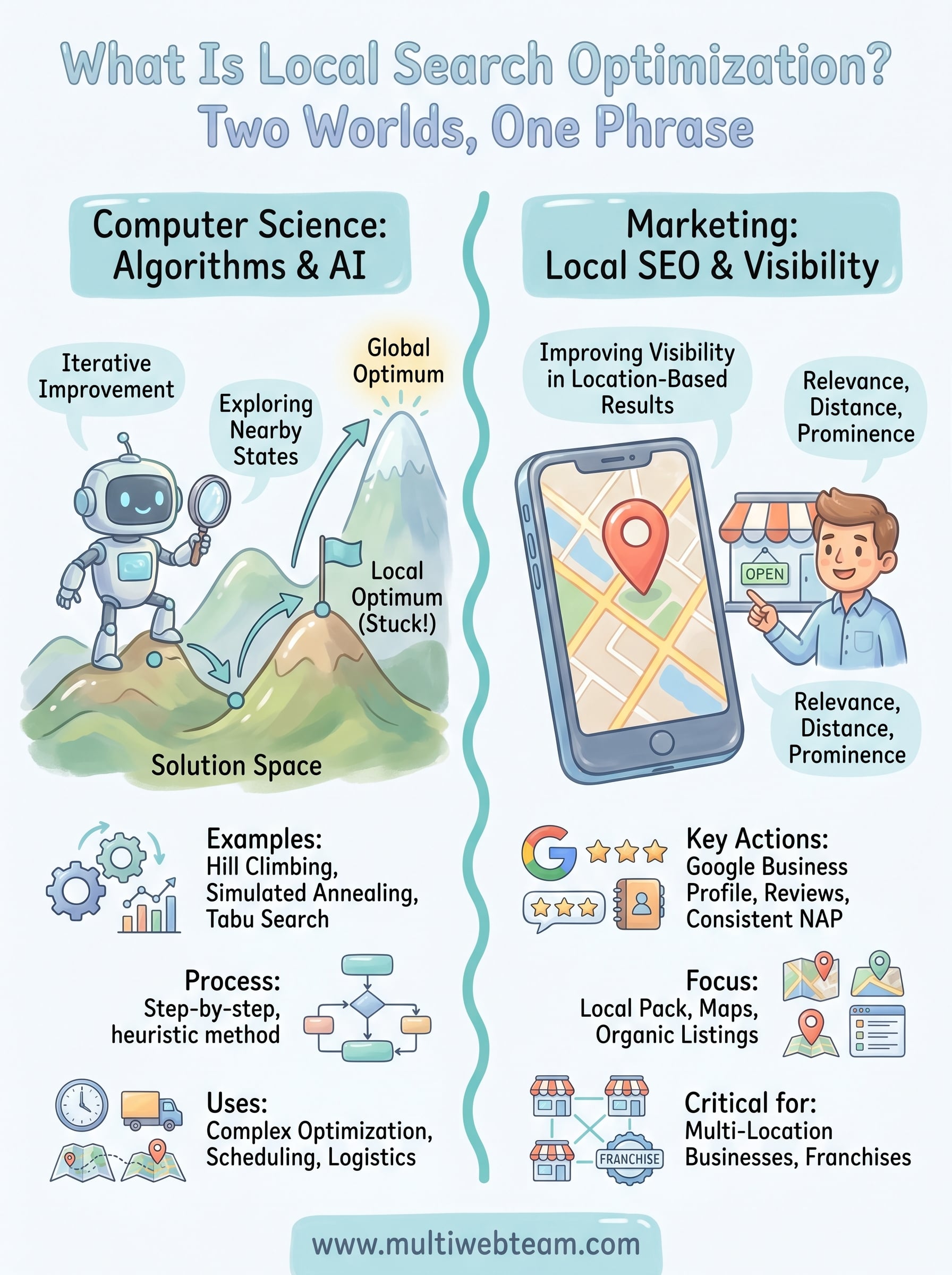
What is local search optimization comes with two separate answers depending on who's asking. In computer science , it describes a family of algorithms that iteratively improve a candidate solution by exploring neighboring options in a solution space. Methods like hill climbing, simulated annealing, and tabu search all fall under this definition, each with its own strategy for handling local optima and large combinatorial problems.
In digital marketing , local search optimization means improving a business's visibility in geographically relevant search results. You do this by managing your Google Business Profile, building consistent location data, earning customer reviews, and creating dedicated pages for each location you operate.
Both definitions are valid, and both reward understanding the core mechanics before jumping into application. If your business runs multiple locations and you need a team that handles this work for you every day, Multi Web Team's multi-location web management covers design, updates, and local SEO under one subscription.