
May 11, 2026

Local SEO vs National SEO: Which Is Right For You In 2026?

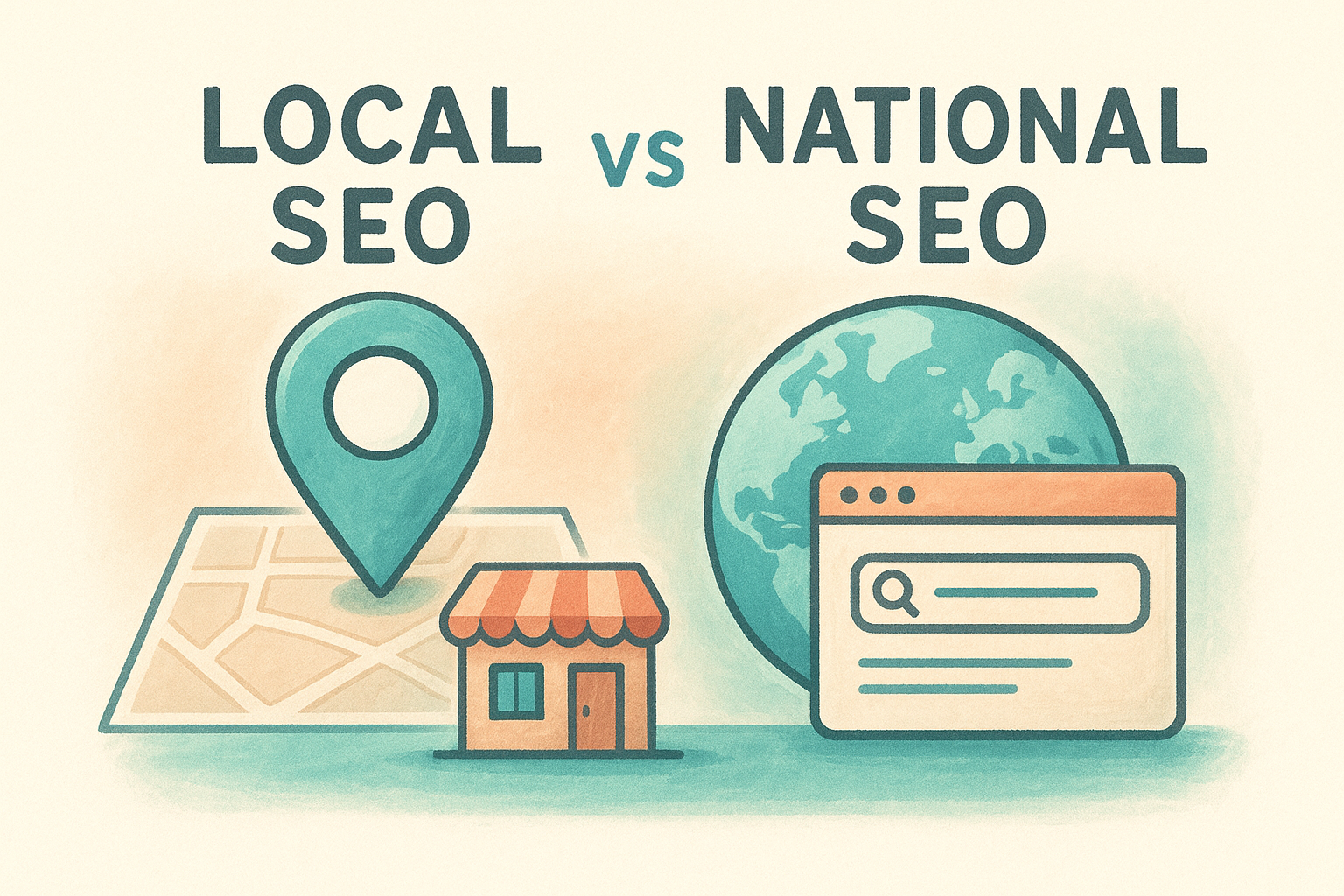
If you run a business with multiple locations, you've probably hit the point where someone asks: should we focus on local SEO vs national SEO ? It's a fair question, and the answer directly affects how customers find you, whether that's at a specific storefront or across the country. Getting this wrong means spending money on a strategy that doesn't match how your customers actually search.

Here's the short version: local SEO targets customers in specific geographic areas, while national SEO aims for visibility across the entire country. But the real differences go deeper, they require different tactics, different budgets , and different timelines. A franchise with 20 locations has very different needs than a single-product e-commerce brand, and treating them the same is a costly mistake .

At Multi Web Team, we build and manage websites for multi-location businesses and franchises, with location-specific SEO baked into every site we handle. So this isn't abstract theory for us, it's work we do daily. This guide breaks down the key differences between local and national SEO, what each costs, and how to figure out which approach actually fits your business in 2026.

Local SEO and national SEO defined

Before you can meaningfully compare local SEO vs national SEO , you need a clear picture of what each one actually does. Both strategies aim to improve your visibility in search results, but they target completely different audiences and rely on different signals to get there. Understanding the distinction at a foundational level saves you from building a strategy that misses your actual customers entirely.

What local SEO actually means

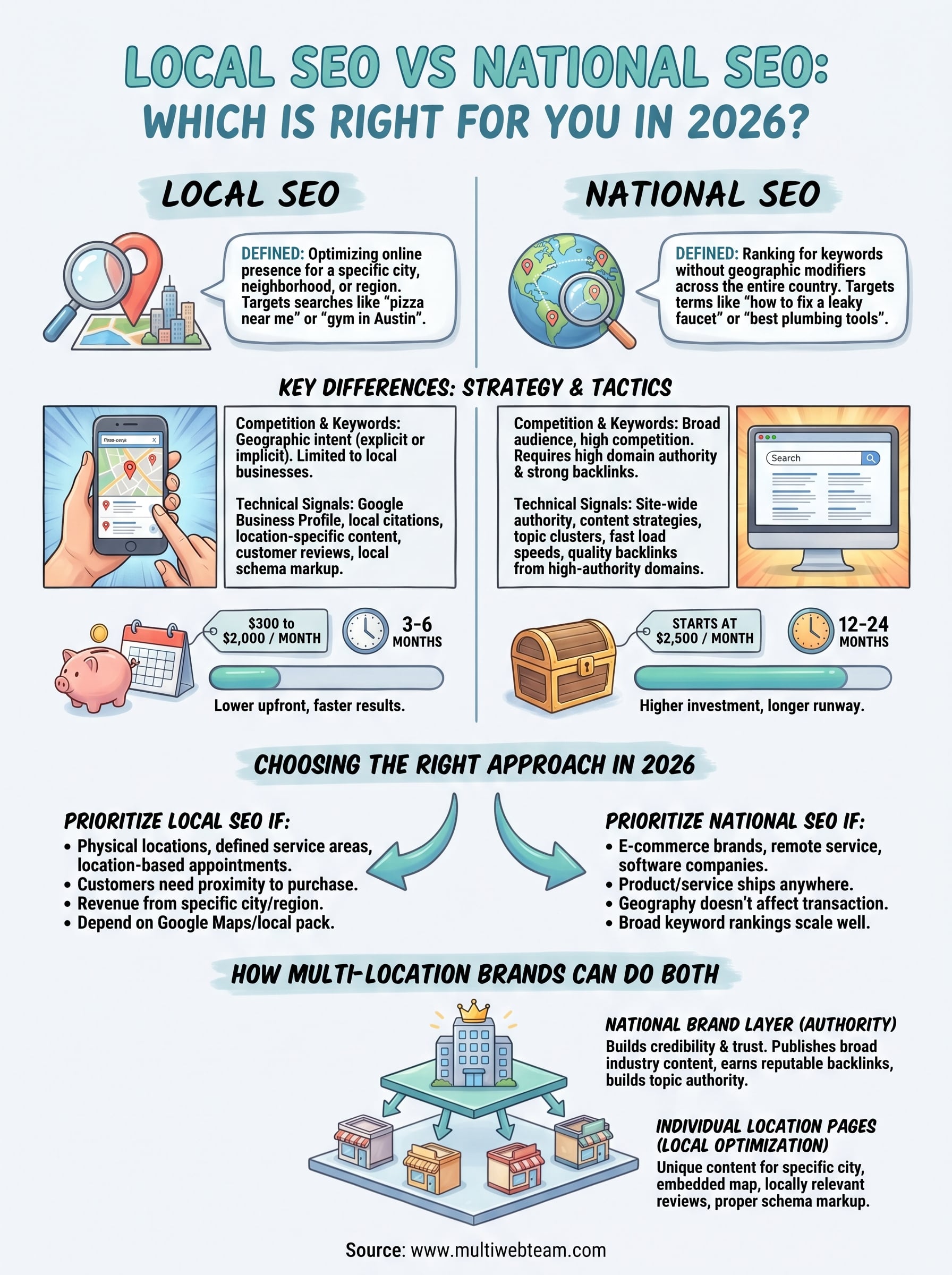
Local SEO is the process of optimizing your online presence so that people searching in a specific city, neighborhood, or region can find your business. When someone searches "pizza near me" or "gym in Austin," Google's algorithm pulls from a combination of proximity, relevance, and prominence to decide which businesses to show. Local search results , including the map pack that appears at the top of many location-based searches, are almost entirely driven by local SEO factors.

The signals that matter most for local SEO include your Google Business Profile , local citations (consistent mentions of your name, address, and phone number across directories), location-specific content on your website, and customer reviews. If you run a brick-and-mortar business or serve customers in a defined geographic area, these factors determine whether you show up when someone nearby is ready to buy.

Getting your Google Business Profile fully optimized is often the single highest-impact action a local business can take to improve visibility in local search results.

What national SEO actually means

National SEO focuses on ranking for keywords without geographic modifiers , targeting searchers across the entire country regardless of where they're located. Instead of ranking for "plumber in Denver," a national SEO strategy targets terms like "how to fix a leaky faucet" or "best plumbing tools." The audience is broader, but so is the competition.

This approach relies heavily on domain authority, backlink profiles, and content strategies that build credibility across a wide range of topics and search queries. E-commerce brands, software companies, publishers, and service businesses that operate remotely tend to invest in national SEO because their revenue isn't tied to a customer's physical location. Your content competes against every other site in the country targeting the same terms, which raises the bar considerably compared to local competition. Ranking nationally takes more resources, more time, and a fundamentally different game plan than ranking in a single city or metro area.

Key differences that change your strategy

The gap between local SEO vs national SEO isn't just about geography. The two approaches require fundamentally different keyword strategies, technical setups, and content priorities . If you mix signals meant for one approach into the other, your results will reflect that confusion. Knowing exactly where the strategies diverge gives you a cleaner path to where you actually want to rank.

Competition and keyword targeting

Local SEO targets terms that include geographic intent , either explicitly ("coffee shop in Nashville") or implicitly ("coffee shop near me"). Your competition is limited to businesses in the same area, which makes ranking more achievable for most businesses with a focused effort. National SEO puts you up against every website in the country targeting the same broad terms, which means higher domain authority and significantly stronger backlink profiles are required just to get on the first page. The competitive gap between a local keyword and a national one is often enormous, even when the words look similar.

Winning locally requires depth in one market. Winning nationally requires breadth across many, and both take consistent work to maintain.

Technical signals that differ

Your website structure reflects your strategy. For local SEO, individual location pages with unique content, embedded maps, and local schema markup signal to Google exactly where you operate and who you serve. National SEO prioritizes site-wide authority signals , like earning backlinks from high-authority domains, building topic clusters that cover a subject comprehensively, and maintaining fast load speeds across a large content library. Running a multi-location business means you likely need both structures working in parallel, which is why the setup phase matters so much. Getting the technical foundation wrong early creates problems that compound over time.

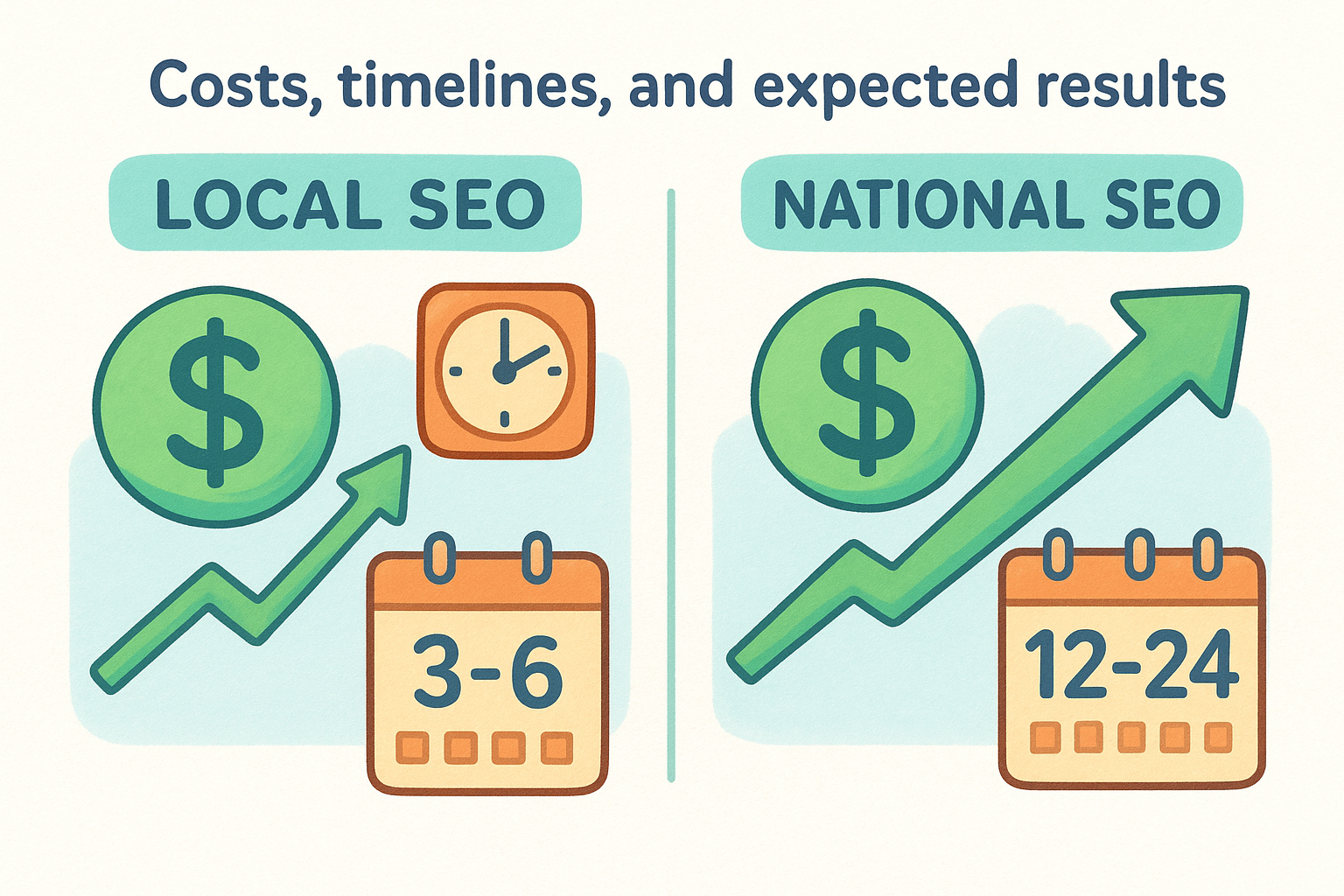
Costs, timelines, and expected results

Understanding the cost and timeline differences between local SEO vs national SEO helps you set realistic expectations before you commit a budget. Local SEO generally costs less upfront and produces results faster, while national SEO requires a longer runway and larger investment before you see meaningful returns. The gap between the two isn't just about price, it reflects the actual scale of competition you're entering and the audience size you're trying to reach.

What local SEO costs and how fast it works

Local SEO campaigns typically range from $300 to $2,000 per month depending on how competitive your market is and how many locations you're optimizing. A single-location business in a mid-sized city can often start seeing measurable ranking improvements within three to six months if the fundamentals are solid, meaning a complete Google Business Profile, consistent citations, and location-specific content on the website. Businesses with multiple locations need to multiply that effort across each market, which is where a subscription-based management service pays for itself rather than hiring separately for each site.

What national SEO costs and how fast it works

National SEO campaigns typically start at $2,500 per month and scale up sharply depending on the industry and keyword difficulty you're targeting. Timelines are longer because you're building domain authority and backlink equity that take sustained effort to accumulate.

Most businesses targeting competitive national keywords shouldn't expect significant traction in under 12 months, and many wait 18 to 24 months before seeing consistent first-page rankings . The slow burn is frustrating, but it's the reality of competing against brands that have been building their online authority for years .

Budget misalignment is one of the biggest reasons SEO fails, so set your expectations based on the actual scope of what you're trying to rank for, not what you hope to spend.

How to choose the right approach in 2026

Choosing between local SEO vs national SEO comes down to one core question: where do your customers come from? If your revenue depends on people walking through a door or booking a service in a specific city, local SEO is the right priority. If your business serves customers anywhere in the country and geography doesn't affect the transaction, national SEO fits better. Most businesses know which camp they're in, but the answer gets less obvious as you start scaling across multiple markets.

Signs you should prioritize local SEO

If your business depends on physical visits, defined service areas, or location-based appointments , local SEO will deliver the fastest return on your investment. In 2026, Google continues to weight local signals heavily for searches with clear geographic intent, which means businesses that nail local optimization win the phone calls, walk-ins, and bookings that competitors with weak profiles miss entirely. Here are the clearest indicators that local SEO deserves your focus:

  • You operate one or more physical locations
  • Your customers need to be near you to complete a purchase
  • Most of your revenue comes from a specific city or region
  • You depend on Google Maps or the local pack for inbound leads

If most of your customers find you by searching for businesses near them, local SEO is your highest-leverage channel in 2026.

Signs you should prioritize national SEO

E-commerce brands, remote service providers, and software companies are the strongest candidates for a national SEO strategy. When your product ships anywhere or your service is delivered entirely online, ranking for geographic terms adds little value to your bottom line.

Broad keyword rankings let you capture demand across every market at once, which scales well for businesses that aren't limited by zip code. The tradeoff is a longer timeline and a larger monthly investment before consistent results appear.

How multi-location brands can do both

Multi-location businesses sit in a unique position in the local SEO vs national SEO debate because they actually need both. Your brand needs national-level authority to build credibility and trust across markets, while each individual location needs its own local signals to show up when nearby customers search. Treating this as an either/or choice leaves real revenue on the table.

Build a strong brand layer at the top

Your main website should function as the national SEO foundation for your brand. This means publishing content that answers broad industry questions, earning backlinks from reputable sources, and building topic authority that lifts your entire domain. When your domain carries real weight, every location page beneath it benefits from that authority. Think of the brand layer as the engine and your location pages as the wheels.

A strong national brand presence makes your local pages more competitive, because Google factors domain authority into local rankings too.

Optimize each location page individually

Below that brand layer, each location page needs to function as its own local SEO asset . That means unique content written for the specific city, an embedded map, locally relevant customer reviews, and proper schema markup that tells Google exactly where that location operates. Thin or duplicated location pages are one of the most common mistakes multi-location brands make, and they actively hurt your ability to rank in each market.

Running this dual structure requires consistent effort across every location . Franchise owners and growing chains rarely have the internal bandwidth to maintain that level of detail at scale, which is exactly why purpose-built management services exist to handle it on their behalf.

Next steps

By now, the core differences in the local SEO vs national SEO debate should be clear. Your strategy comes down to where your customers are, how your business generates revenue, and whether geography plays a role in the transaction. If you run multiple locations or a franchise , the answer is rarely one or the other. You need both layers working together, with a strong brand foundation at the top and individually optimized location pages underneath.

Pulling that off consistently takes real effort. Most multi-location businesses don't have the internal bandwidth to maintain location-specific SEO across every market while also running day-to-day operations. That's exactly the problem we solve at Multi Web Team. We handle the design, content, updates, and location-level SEO so you don't have to manage any of it in-house.

If you're ready to get your locations ranking where your customers actually search, talk to the Multi Web Team today.

By cinchweb May 11, 2026
Master your small business seo strategy with our 2026 blueprint. Learn to rank in AI search, dominate local SEO, and turn more visitors into customers.
By cinchweb May 11, 2026
Learn what is local search optimization in both computer science and marketing. Compare iterative algorithms with SEO tactics for better local visibility.
By cinchweb May 10, 2026
Stop losing leads to poor design. Learn how to create a high converting landing page using message match, social proof, and mobile-first optimization.
By cinchweb May 7, 2026
Compare the 6 top healthcare website design services for 2026. Find the best agency for HIPAA compliance, multi-location SEO, and patient acquisition.
By cinchweb May 7, 2026
Compare the best wordpress maintenance services of 2026. Find the right support for security and updates, from single sites to multi-location franchises.
By cinchweb May 7, 2026
Compare 15 website design services for small businesses. Find the right agency or platform for SEO, custom branding, and flexible subscription models.
By cinchweb May 4, 2026
Learn how to improve website speed with 9 proven fixes. Optimize images, leverage caching, and reduce server response times to boost performance.
By cinchweb May 3, 2026
Learn how to optimize google business profile to boost local rankings. Master NAP consistency, reviews, and photos to win more customers in 2026.
By cinchweb May 3, 2026
Compare the 9 best local citation building service options for 2026. Find the right tool to manage your listings and rank higher in local search results.
By cinchweb May 3, 2026
Compare 11 small business seo packages for 2026. Find the right pricing and service features for your single-location shop or multi-location franchise.
SHOW MORE