How Much Does Website Maintenance Cost? 2026 Pricing Guide
Website maintenance isn't optional, it's what keeps your site secure, functional, and visible in search results. But figuring out how much does website maintenance cost can be frustrating when every provider prices things differently. Some charge flat monthly fees, others bill by the hour, and a few bundle everything into a subscription. The range is wide , and the answer depends on your site's complexity, your industry, and how many locations you're managing.
For multi-location businesses and franchises, these costs multiply fast. Each location may need its own landing pages, local SEO updates, content refreshes, and security monitoring. That's exactly why we built Multi Web Team around a subscription-based model , so franchise owners and growing businesses get unlimited updates, SEO management, and ongoing maintenance without nickel-and-dime invoices. We've seen firsthand what businesses actually spend on website upkeep, and what they get (or don't get) for that money.
This guide breaks down real 2026 pricing for website maintenance across different business types and sizes. You'll see what's included at each price tier , which services are worth paying for, and where businesses commonly overspend. Whether you manage two locations or two hundred, this breakdown will help you budget with confidence and avoid surprise costs.
What website maintenance includes in 2026
Before you can answer how much does website maintenance cost , you need to know what you're actually paying for . Website maintenance in 2026 covers a broader set of tasks than most business owners expect. It's not just renewing your domain or updating a plugin once a quarter. It's an ongoing collection of technical, content, and security work that keeps your site running properly, ranking in search results, and converting visitors into customers. The more locations you manage, the more this list grows.
Hosting, security, and backups
Web hosting is the foundation of every maintenance plan. You pay for server space to keep your site live, and in 2026, prices range from $5 per month for shared hosting to $300 or more per month for dedicated servers . Most small businesses land somewhere in the middle with managed hosting plans that cost between $25 and $100 per month.
Security is non-negotiable on any functioning site. Every site needs an SSL certificate to encrypt data between your server and your visitors. Most hosting providers include SSL in their plans now, but you still need active monitoring for malware, unauthorized logins, and software vulnerabilities. Automated daily or weekly backups protect you from data loss when something breaks or gets compromised. Without reliable backups, a single hack or server failure can wipe out your site entirely, and rebuilding costs far more than any monthly maintenance plan.
A site without active security monitoring isn't "low maintenance." It's just an undetected problem waiting to become an expensive one.
Software updates and performance monitoring
Your content management system, plugins, and themes all require regular updates to stay secure, compatible, and fast. If you run WordPress, for example, the platform releases core updates regularly, and skipping them leaves known security vulnerabilities open on your site. The same logic applies to every plugin in your library. A neglected plugin stack is one of the most common entry points for site attacks.
Performance monitoring tracks your site's load speed, uptime, and error logs. Google factors page speed into search rankings, which means a slow site costs you visibility and conversions at the same time. With Core Web Vitals still influencing organic performance in 2026, ongoing speed checks aren't optional if you depend on search traffic. Most managed maintenance plans include performance audits, but if you go the DIY route, you'll need to run these tests yourself on a consistent schedule.
Content updates and SEO maintenance
Your website content doesn't stay accurate on its own. Menu changes, updated service pages, new staff photos, and seasonal promotions all require someone to log in and make those edits. For multi-location businesses, this work compounds quickly. Each location may need separate landing pages, updated business hours, and fresh location-specific content refreshed throughout the year.
Local SEO maintenance includes keeping your Google Business Profile current, auditing local citations, and making sure each location page targets the right geographic keywords. This ongoing work is what keeps individual locations visible in local map results and "near me" searches. Skipping SEO maintenance rarely means your rankings hold steady; it typically means they slip as competitors continue making updates while your pages stagnate.
Typical costs by website type
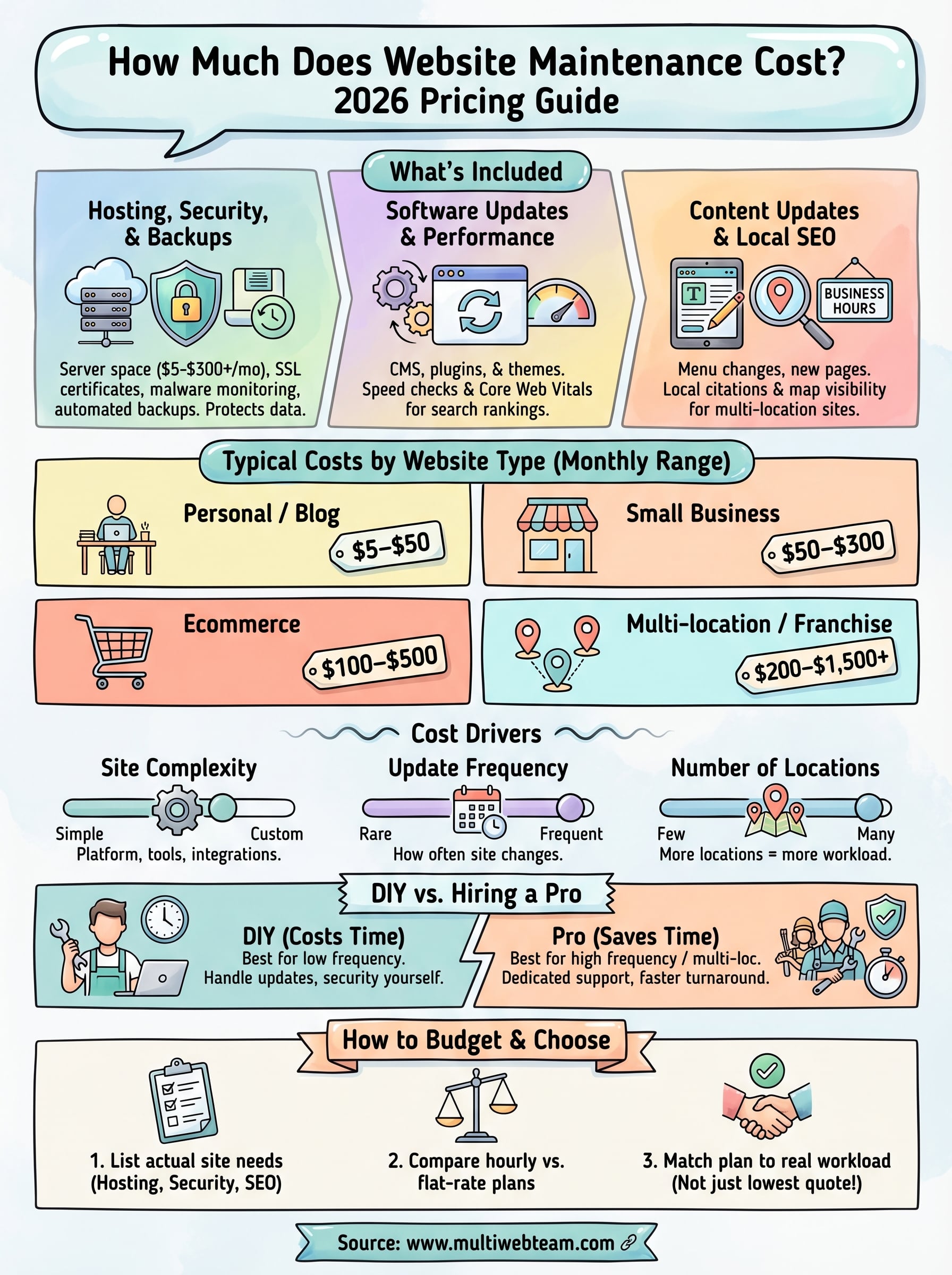
Website type is the single biggest factor that shapes your maintenance budget. A simple informational site and a multi-location franchise can both be called "websites," but their ongoing costs look nothing alike. The table below gives you a ballpark before the breakdowns:
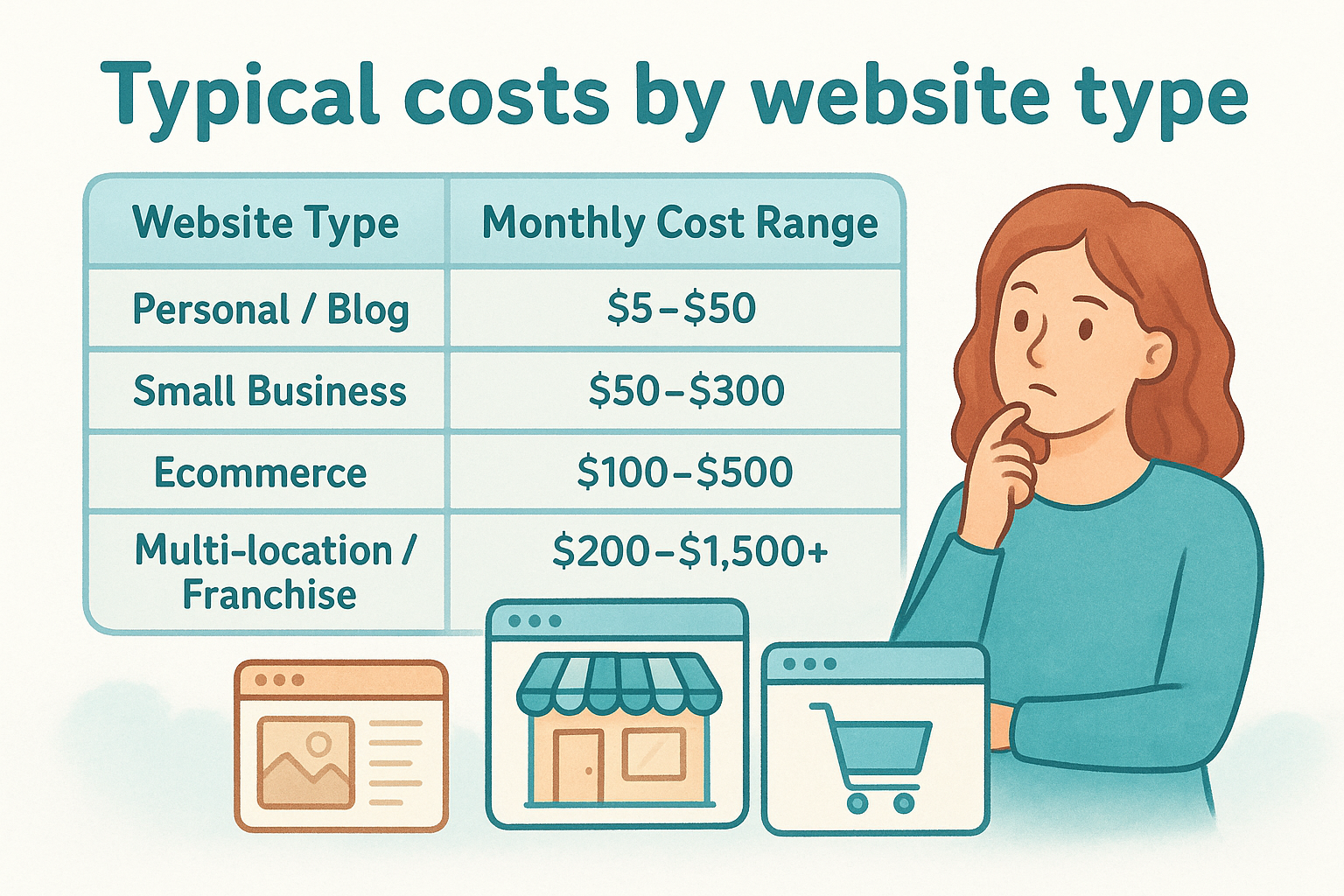
| Website Type | Monthly Cost Range |
|---|---|
| Personal / Blog | $5–$50 |
| Small Business | $50–$300 |
| Ecommerce | $100–$500 |
| Multi-location / Franchise | $200–$1,500+ |
Personal and small business sites
Personal blogs and small informational sites sit at the low end of the maintenance cost spectrum. If you run a basic site with a few static pages and minimal plugin requirements, you can handle maintenance yourself for as little as $5 to $50 per month , mostly covering hosting and a security tool. Hiring a freelancer or small agency to manage updates and keep your site current typically runs $50 to $300 per month , depending on how often your content changes and whether local SEO is included in the work.
Ecommerce sites
Ecommerce sites cost more to maintain because the stakes are higher. Payment processing, product catalog updates, and PCI compliance all require consistent oversight. A security failure on an ecommerce site doesn't just pull your pages offline; it exposes customer payment data and opens you to legal exposure. Expect to budget $100 to $500 per month for professional ecommerce maintenance. Platforms like Shopify push costs toward the lower end of that range, while custom-built stores with large inventories regularly exceed it.
If your site processes transactions, security monitoring isn't optional. It's the cost of operating responsibly.
Multi-location and franchise sites
Multi-location businesses face the most demanding maintenance workload of any website type. Each location typically needs its own landing page , accurate business hours, local SEO citations, and fresh location-specific content updated throughout the year. Managing that across dozens or hundreds of locations manually adds significant time and labor costs. Professional maintenance for multi-location sites runs $200 to $1,500 or more per month , depending on location count and SEO scope. Many franchise operators move to an all-inclusive subscription model specifically to avoid tracking individual hours spent on each location's updates.
The cost drivers that move your price
Understanding how much does website maintenance cost for your specific situation requires looking at the variables that push prices up or down. Your final monthly number isn't random. It reflects real decisions you've made about your site's technology, how often it changes, and how many locations you're running. These three factors do most of the work in determining where your maintenance budget lands.
Site complexity and technology stack
Your platform and the tools built on top of it directly affect how much time maintenance takes each month. A simple five-page site built on a managed platform requires far less upkeep than a custom-coded site with dozens of plugins, third-party integrations, and a complex database. WordPress sites with large plugin libraries need more frequent update cycles, compatibility checks, and security patches than leaner setups. If your developer built something heavily customized, expect to pay for specialized expertise every time something breaks or needs adjustment.
The more custom your site, the fewer providers can maintain it correctly, and the more leverage they have on your pricing.
Update frequency and content volume
How often your site needs to change is one of the clearest cost signals in any maintenance quote. A static brochure site that rarely changes costs far less to maintain than a site with weekly promotions, rotating menus, seasonal campaigns, or frequent staff and location updates. Businesses that change pricing, add services, or refresh photos regularly are essentially running a content operation on top of a technical one. Some providers charge per update, which gets expensive fast. Others offer unlimited updates under a flat monthly fee, which rewards businesses that need frequent changes without worrying about per-task invoices.
Number of locations
For multi-location businesses and franchises, every location you add increases the maintenance workload . Each location typically needs its own landing page, accurate contact details, local SEO citations, and content updates throughout the year. Multiply that across ten, twenty, or fifty locations and the labor hours stack up quickly. Agencies that specialize in multi-location management can spread that work more efficiently than generalist freelancers, which often makes their flat-rate pricing more economical than it looks at first glance. If you manage multiple locations, your maintenance costs will almost always land above the small business range.

DIY vs hiring a pro for maintenance
Deciding between managing your own site and hiring someone else is one of the most practical questions tied to how much does website maintenance cost for your business. Both options work, but they work for different types of businesses. Your technical comfort level, how often your site changes, and how many locations you manage all factor into which choice actually saves you money in the long run.
What you can handle yourself
Solo site owners and very small businesses with low update frequency can manage basic maintenance without outside help. Running plugin updates, renewing your domain, and checking site speed are all tasks you can learn and schedule yourself. Tools like Google Search Console give you free visibility into indexing issues, crawl errors, and performance data that would otherwise require a paid audit. If your site rarely changes and you're comfortable logging into a dashboard once or twice a month, DIY maintenance costs you mostly time rather than money , which keeps your monthly expenses near the low end of the range.
The real cost of DIY maintenance isn't the software; it's the hours you pull away from running your business.
Where hiring a professional pays off
For businesses with frequent updates, ecommerce functionality, or multiple locations, professional maintenance quickly justifies its price . A professional handles security patching, performance optimization, and content updates faster than most business owners can, and they catch problems before those problems affect your traffic or revenue. Broken forms, outdated landing pages, and slow load times cost you customers every day they go unaddressed, and those losses rarely show up on an invoice.
Multi-location businesses see the clearest return from professional support. Managing location-specific landing pages, keeping local SEO citations accurate, and pushing seasonal content updates across every location requires consistent labor that compounds with each location you add . Freelancers can work for smaller operations, but they come with variable availability and hourly billing that gets unpredictable during busy seasons. A dedicated agency or subscription service that specializes in multi-location websites gives you predictable pricing and reliable turnaround without tracking billable hours every time you need a change made.
How to budget and choose a plan
Answering how much does website maintenance cost for your specific business starts with an honest look at what your site actually requires, not what sounds like the cheapest option upfront. Choosing the wrong plan often costs more over time than paying a higher monthly rate, because unaddressed maintenance needs lead to broken features, security gaps, and lost organic visibility.
Start with your actual site needs
Before comparing providers, list every maintenance task your site needs on a regular basis . This includes hosting, security monitoring, software updates, content changes, and any local SEO work across your locations. Once you have that list, you can match it against what each plan actually covers. A plan that excludes content updates or SEO will charge you extra every time you need either one, which adds up fast.
If you manage multiple locations, factor in how often each location page needs updating throughout the year. Seasonal promotions, updated hours, and staff changes all add to the workload. A flat-rate plan that covers unlimited updates will almost always outperform hourly billing once your locations start making frequent changes.
A plan that doesn't cover what your site actually needs isn't a budget decision; it's a delayed expense.
Compare plan types before committing
Not all maintenance plans are structured the same way. Hourly billing works for sites with rare, unpredictable needs, but costs become hard to forecast when you need changes more than once or twice a month. Flat monthly subscriptions give you predictable expenses and fit better when your site changes frequently or spans multiple locations.
When evaluating providers, ask specifically what is included in the quoted price. Security monitoring, backups, software updates, and content changes should all be clearly listed in writing. If a plan doesn't specify what's covered, assume it excludes what you need and ask for clarification before signing anything.
Reliability matters as much as price. A provider who takes two weeks to update a promotion or fix a broken page isn't actually maintaining your site in a useful way. Ask about standard turnaround times for common tasks so you know what to expect before you commit to a plan.
Final takeaways
Website maintenance isn't a one-size-fits-all expense, and how much does website maintenance cost depends entirely on what your site actually needs. Personal sites can stay under $50 per month with the right setup, while multi-location businesses routinely invest $500 or more to keep every location visible and current. The businesses that get the most value from their maintenance spend are the ones that match their plan to their real workload rather than chasing the lowest quote.
If you manage multiple locations, the math changes fast. Unlimited updates and local SEO management matter far more than saving $50 a month on a plan that leaves you chasing your provider every time you need a page changed. A subscription that covers all your locations under one flat rate removes that friction entirely. To see how that model works in practice, explore what Multi Web Team offers and find out if it fits your business.