May 31, 2026

Local SEO for Small Business: A 2026 Step-by-Step Playbook

When someone nearby searches for a service you offer, your business either shows up, or it doesn't. That's the reality of local SEO for small business in 2026. Google's local pack, map results, and location-based rankings drive a massive share of foot traffic and phone calls. If your business isn't optimized for these results, you're handing customers to competitors who are.

The good news? You don't need a massive budget or a marketing degree to get this right. What you do need is a clear, step-by-step plan that covers every piece of the local SEO puzzle, from your Google Business Profile to on-page optimization to managing reviews and citations. That's exactly what this guide delivers, built from the hands-on experience our team at Multi Web Team brings to optimizing websites across multiple locations every day.

Below, you'll find a practical playbook you can follow whether you run one storefront or ten. Each step is actionable, current for 2026, and designed to help you rank higher in local search results , so the right customers find you first. Let's get into it.

What local SEO means in 2026

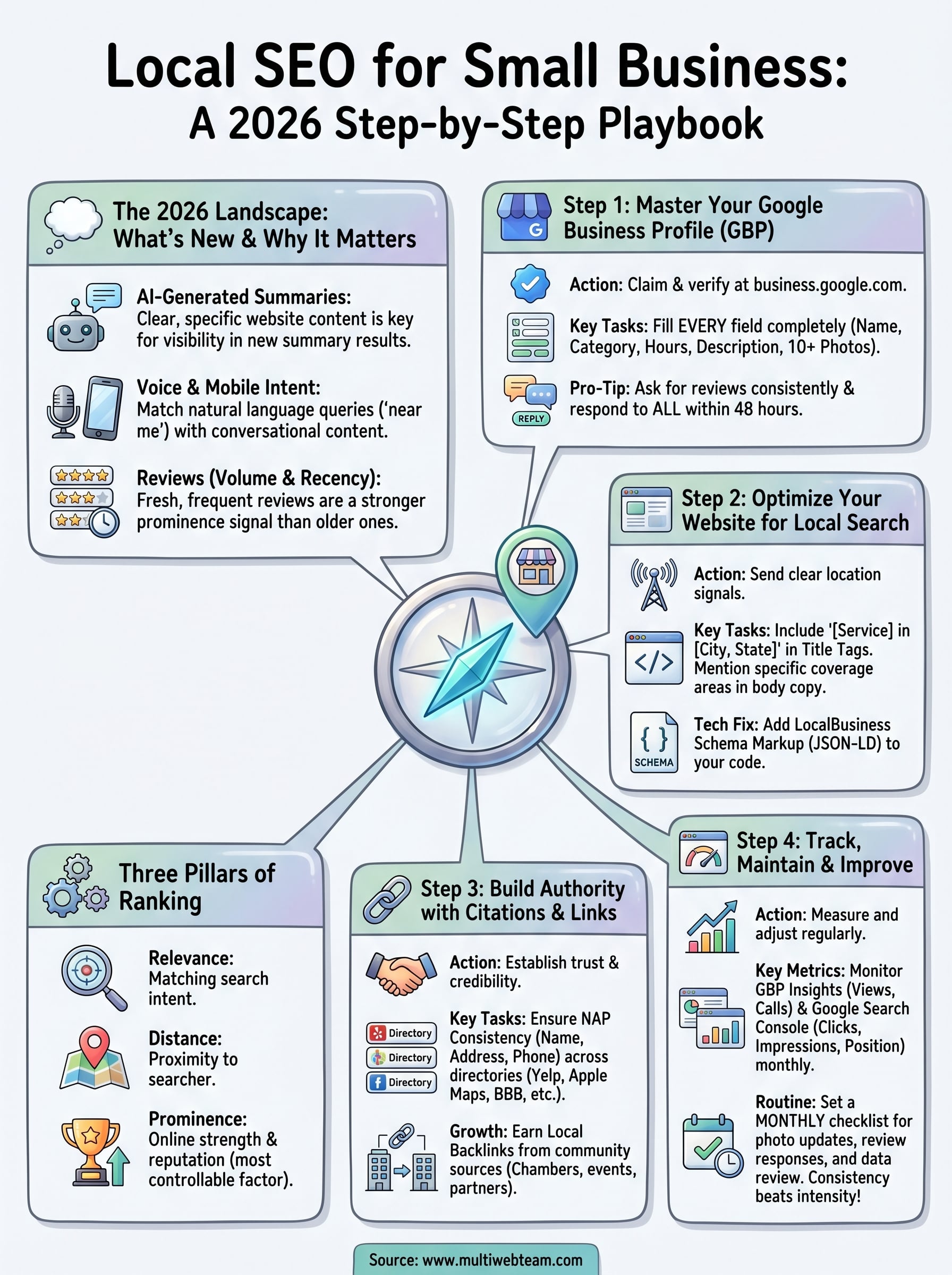
Local SEO is the process of optimizing your online presence so your business appears when people nearby search for what you offer. That sounds straightforward, but the mechanics behind it have shifted significantly over the past few years. In 2026, Google pulls from multiple signals, including your Google Business Profile , your website content, review quantity and recency, and how consistently your business information appears across the web, to decide which businesses earn a spot in the local pack and map results. Understanding what feeds those signals is the first step toward improving where you rank.

The three factors Google uses to rank local results

Google's local ranking algorithm relies on three core factors: relevance , distance , and prominence . Relevance measures how well your business matches what the searcher is looking for. Distance accounts for how far your location is from the searcher. Prominence reflects how well-known and credible your business appears online, based on reviews, citations, backlinks, and the overall strength of your web presence. You can find Google's own explanation of these factors in their Google Business Profile Help documentation.

Prominence is the factor you have the most control over, and it's where most small businesses leave the most ranking potential untouched.

These three factors work together, not in isolation. A business five miles away with strong prominence and clear relevance can outrank a business one block from the searcher that has a thin, inconsistent online presence. That's why a structured approach to local SEO for small business matters more than proximity alone.

What has shifted in 2026

AI-generated search summaries now appear above traditional results for many local queries. Google's systems pull information directly from business profiles, review content, and website copy to build these summaries. This means how clearly and specifically you describe your services and location on your site carries more weight than it did two years ago. If your website says "we fix things" instead of "we repair HVAC systems in Austin, TX," you become invisible to those AI-pulled responses.

Voice and mobile queries have also pushed local intent higher up the search funnel. People ask questions like "best plumber open now near me" while standing in their kitchen. Your content needs to match how real people phrase those questions, not just mirror generic keyword patterns buried in a title tag.

Reviews have grown into a stronger ranking signal as well. Google's systems increasingly weigh both the volume and recency of your reviews when evaluating prominence. A business with 180 reviews collected over the past year will routinely outperform a competitor sitting on 60 older reviews, even if that competitor has been operating longer. Fresh, frequent, and specific reviews signal to Google that your business is active, trusted, and worth surfacing to searchers right now.

Step 1. Set up Google Business Profile right

Your Google Business Profile (GBP) is the single most important asset in local SEO for small business . It controls what appears in the local pack, map results, and the knowledge panel that shows up on the right side of a Google search. If you haven't claimed your listing yet, start at Google Business Profile and claim or create your entry. Verification typically happens by postcard, phone, or video, and it usually takes less than a week.

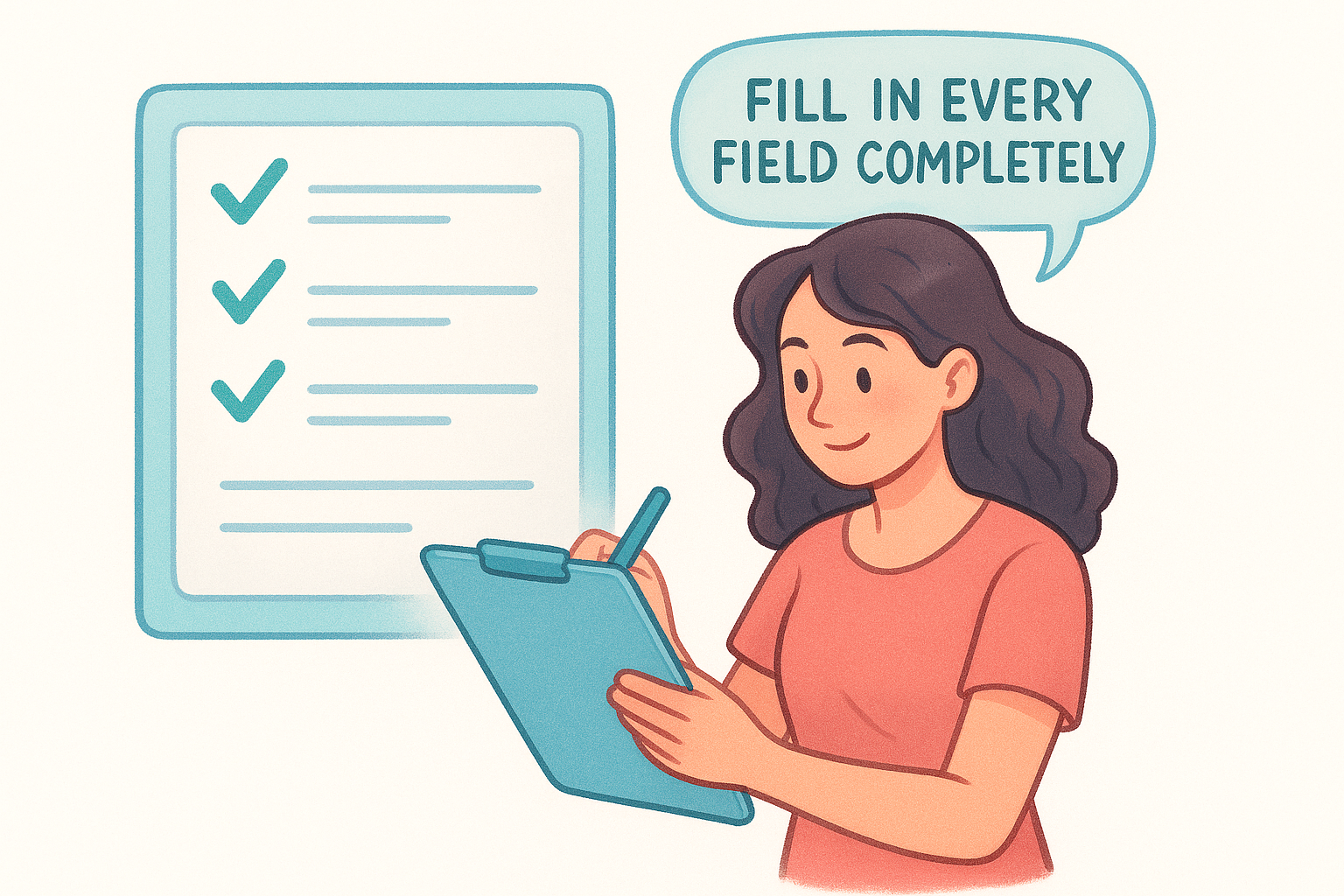
Fill in every field completely

Most business owners claim their profile and stop after entering a phone number and an address. That's not enough. Google uses every field you complete to determine relevance, so a half-finished profile costs you ranking potential. Work through each section methodically:

  • Business name : Use your exact legal name. No keyword stuffing.
  • Primary category : Pick the most specific option that fits your main service (e.g., "Pizza Restaurant," not just "Restaurant").
  • Secondary categories : Add relevant ones, but only for services you actually offer.
  • Business hours : Keep these current and update them for holidays.
  • Description : Write 250-300 words covering what you do, where you operate, and what makes your business worth visiting. Be specific.
  • Services and products : List individual offerings with prices where applicable.
  • Photos : Upload at least 10 high-quality images showing your location, staff, and finished work.

An incomplete profile signals to Google that your business is not a priority, and Google treats it exactly that way in rankings.

Ask for reviews consistently

Reviews directly influence your prominence score , and prominence is one of the three core factors Google uses to rank local results. After every completed job or customer visit, ask for a Google review and make it easy by sending a direct link to your review form, which you can generate inside your GBP dashboard under "Get more reviews." Respond to every review , positive or negative, within 48 hours to show Google and future customers that your business is active and trustworthy.

Step 2. Fix your website for local search

Your website needs to send clear location signals to Google on every key page. Many small business sites are built without any local context beyond a contact page listing an address, and that's not enough in 2026. Google crawls your pages looking for geographic relevance , and if your content doesn't provide it, your site won't compete in local results no matter how strong your Google Business Profile is. This step covers the two most impactful on-site changes you can make right now.

Optimize your title tags and page content

Your title tags and on-page body copy are the first places Google looks for local relevance signals. Each core page should include your city or service area in the title tag. Use this template as your starting point:

[Service] in [City, State] | [Business Name]

Example: HVAC Repair in Denver, CO | Colorado Comfort Systems

Beyond the title tag, your service pages should also mention your specific coverage area naturally throughout the body copy, not just once in a buried footer. Write at least one paragraph per service page naming the cities, neighborhoods, or regions you actually serve. This is a foundational piece of local seo for small business that most site owners skip entirely.

Avoid forcing location keywords into every sentence. Google's systems recognize unnatural repetition, and it hurts both readability and ranking.

Add LocalBusiness schema markup

Schema markup gives Google a machine-readable summary of your business details. Adding LocalBusiness structured data to your site's code reinforces your name, address, phone number, and URL in a format Google processes directly. Here's a working example you can adapt:

 {
  "@context": "https://schema.org",
  "@type": "LocalBusiness",
  "name": "Colorado Comfort Systems",
  "address": {
    "@type": "PostalAddress",
    "streetAddress": "123 Main St",
    "addressLocality": "Denver",
    "addressRegion": "CO",
    "postalCode": "80201"
  },
  "telephone": "+1-303-555-0100",
  "url": "https://www.yoursite.com"
} 

Paste this into the <head> section of your page inside a <script type="application/ld+json"> tag. Then validate it using Google's Rich Results Test to confirm Google can read it without errors before you publish.

Step 3. Build authority with citations and links

Citations and backlinks are the two external signals Google weighs most heavily when evaluating your prominence score. Citations are any online mention of your business name, address, and phone number (NAP) , even without a link. Backlinks are direct links from other websites pointing to yours. Together, they tell Google that your business exists, operates where you say it does, and is recognized by other sources. Building these consistently is a core part of local seo for small business that many owners skip, and that skipping shows up directly in rankings.

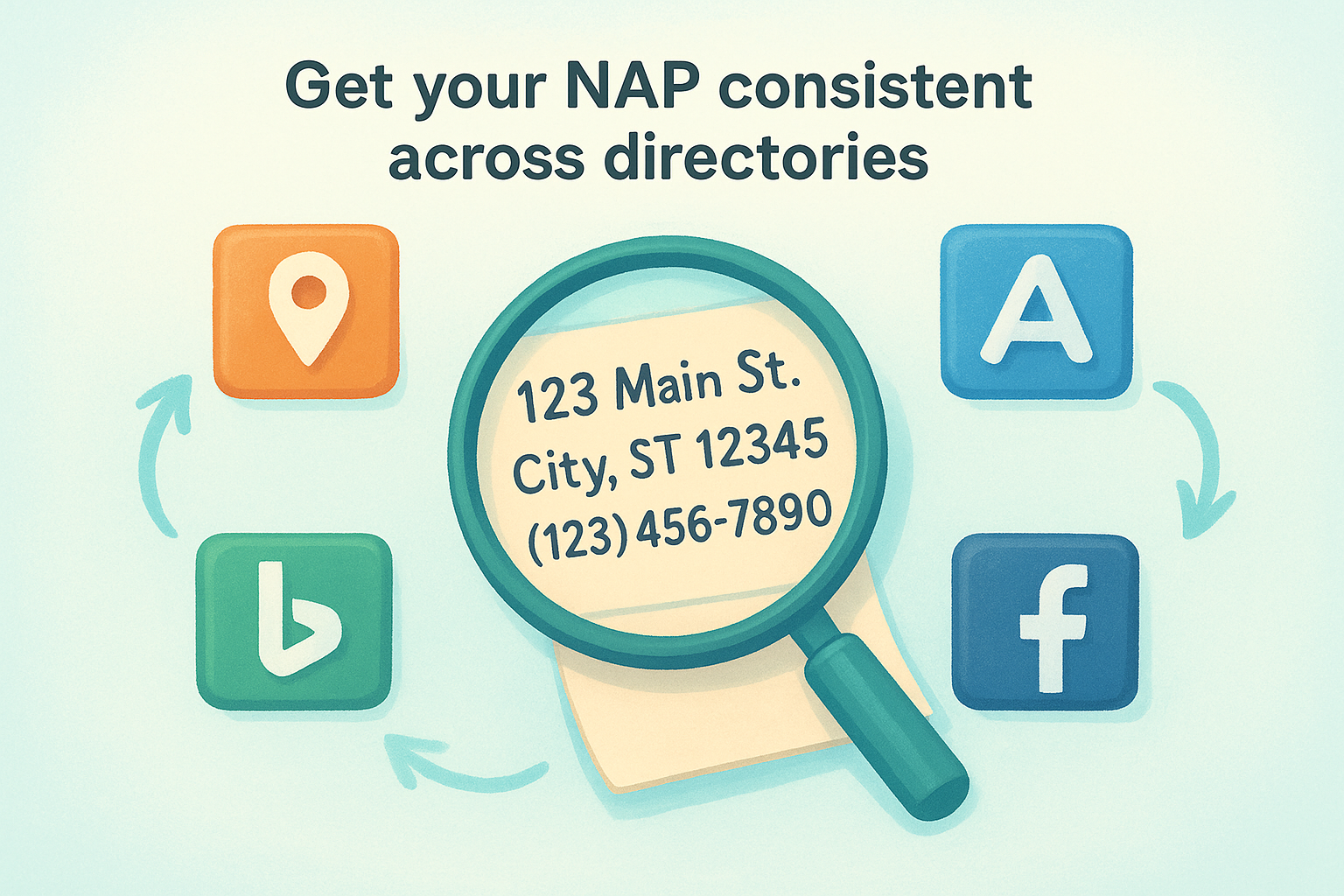
Get your NAP consistent across directories

Inconsistent business information across the web confuses Google's systems and dilutes your authority. If your address appears differently on Yelp, Facebook, and Apple Maps, Google cannot confidently connect those mentions to your business. Claim and verify your listings on these core platforms as a starting point:

  • Google Business Profile (business.google.com)
  • Yelp (biz.yelp.com)
  • Apple Maps (mapsconnect.apple.com)
  • Bing Places (bingplaces.com)
  • Facebook Business Page
  • Better Business Bureau (bbb.org)

Your NAP must appear character-for-character identical on every platform. If your street address is "123 Main Street" on your website, do not list it as "123 Main St." anywhere else. Small differences compound into a weaker overall signal.

Consistency is not just about accuracy. It's the signal Google needs to confidently surface your business over a competitor with fragmented listings.

Earn local backlinks that move rankings

Local backlinks carry more weight than generic directory links because they show Google that your community recognizes your business. Reach out to your local chamber of commerce and request a listing on their member directory. Sponsor a neighborhood event and ask for a link on the event page. Partner with complementary local businesses for a mutual mention on each other's sites. None of these require a large budget, but each link you earn from a trusted local source strengthens your site's authority and pushes your rankings higher in the map results that drive real foot traffic.

Step 4. Track results and keep it consistent

None of the steps above will deliver lasting results if you don't measure what's working and adjust based on what you find. Tracking gives you a clear picture of whether your efforts are moving the needle, and it stops you from repeating tactics that aren't producing results. For local seo for small business , the most important metrics live inside two free tools: Google Business Profile Insights and Google Search Console.

Monitor your rankings and profile performance

Google Business Profile Insights shows you exactly how customers are finding your listing, whether through direct searches (people typing your business name) or discovery searches (people searching for a service or category). Check these numbers monthly and watch for shifts after you update your profile or website. Google Search Console shows which queries your site ranks for, how many clicks you receive, and which pages Google is actively indexing.

A consistent drop in impressions or clicks after a profile update tells you something changed, and catching it early lets you fix it before it compounds.

Track these specific data points each month:

  • Profile views : Are more people seeing your listing?
  • Direction requests and calls : Are those views converting to real actions?
  • Keyword impressions in Search Console : Are you ranking for your target service and city terms?
  • Average position : Is your site moving up or holding steady?

Set a monthly maintenance routine

Consistency beats intensity in local SEO. A large push followed by months of inactivity sends a weaker signal to Google than steady, regular updates do. Build a simple monthly checklist: add at least two new photos to your Google Business Profile, respond to any new reviews, confirm your business hours are accurate, and review your Search Console data for new keyword opportunities or any ranking drops.

Run through this checklist on the same day each month . Forty-five minutes of focused maintenance every month builds a stronger local presence over time than any single optimization sprint will.

Keep improving after you launch

Local SEO for small business is not a one-time project you complete and walk away from. The businesses that hold strong positions in local search results keep updating their profiles, earning new reviews, and refreshing their content on a regular schedule. Every step in this guide builds on the one before it, and maintaining that momentum is what separates businesses that rank consistently from those that slip back after a short burst of effort.

Your competition is not standing still, and neither should you . New competitors enter your market, Google updates its ranking factors, and customer behavior shifts throughout the year. Treat local SEO as an ongoing system, not a one-time checklist. If managing your website and local presence feels like more than you can handle alongside running your business, Multi Web Team handles exactly that for multi-location businesses every day.

By cinchweb June 2, 2026
Rank higher in Google Maps with these 10 google business profile best practices. Learn to manage reviews, ensure NAP consistency, and optimize locations.
By cinchweb June 2, 2026
Boost your map rankings with this 15-step local business seo checklist. Learn to optimize profiles, fix NAP data, and drive more traffic to every location.
By cinchweb June 2, 2026
Boost your Google Maps rankings with these 11 affordable local seo services. Compare top tools and managed agencies to find the right fit for your budget.
By cinchweb May 31, 2026
Learn how to make a website mobile friendly with 13 practical tips. Optimize your layout, improve speed, and refine tap targets to boost search rankings.
By cinchweb May 28, 2026
Learn how to optimize a landing page to boost conversions. Use A/B testing, improve page speed, and simplify your message to turn more visitors into leads.
By cinchweb May 28, 2026
Find the right affordable seo services for small business to grow your rankings. We review 11 top agencies specializing in local search and multi-location SEO.
By cinchweb May 28, 2026
Find the best seo services for small business in 2026. We compare top agencies for local SEO, ecommerce, and lead gen to help you choose the right partner.
By cinchweb May 25, 2026
Compare your site to industry benchmarks and learn what is a good website conversion rate for e-commerce, B2B, and multi-location service businesses.
By cinchweb May 25, 2026
What does website maintenance include? Use our practical checklist to manage security, software updates, and SEO to keep your site fast and secure.
By cinchweb May 25, 2026
Rank every branch with these 10 local seo best practices. Learn to optimize Google Business Profiles, fix NAP data, and build authority in every market.
SHOW MORE