How To Market A Franchise Business: National + Local Plan
Franchise marketing pulls you in two directions at once. Corporate needs brand consistency across every location, while each franchisee needs to show up in their own local market, with real relevance, not copy-paste messaging. Figuring out how to market a franchise business means building a system that handles both, without one side undermining the other. That's a coordination problem most franchise owners underestimate until they're already spending money in the wrong places.
The good news: it's very solvable. You need a national brand strategy that sets the tone and a local marketing engine that drives foot traffic and calls to each individual location. The franchises that grow fastest are the ones that nail this balance early and keep it running without burning out their operators. That means the right mix of digital presence, local SEO, paid media, content, and community-level tactics working together , not a pile of disconnected efforts.
At Multi Web Team, we build and manage websites specifically for multi-location businesses and franchises, handling everything from local SEO optimization to ongoing content updates across every location. We see firsthand what separates franchise marketing that works from the kind that just drains budgets. This guide breaks down a complete national + local marketing plan, step by step , so you can build a strategy that actually scales with your franchise.
What franchise marketing includes and who owns what
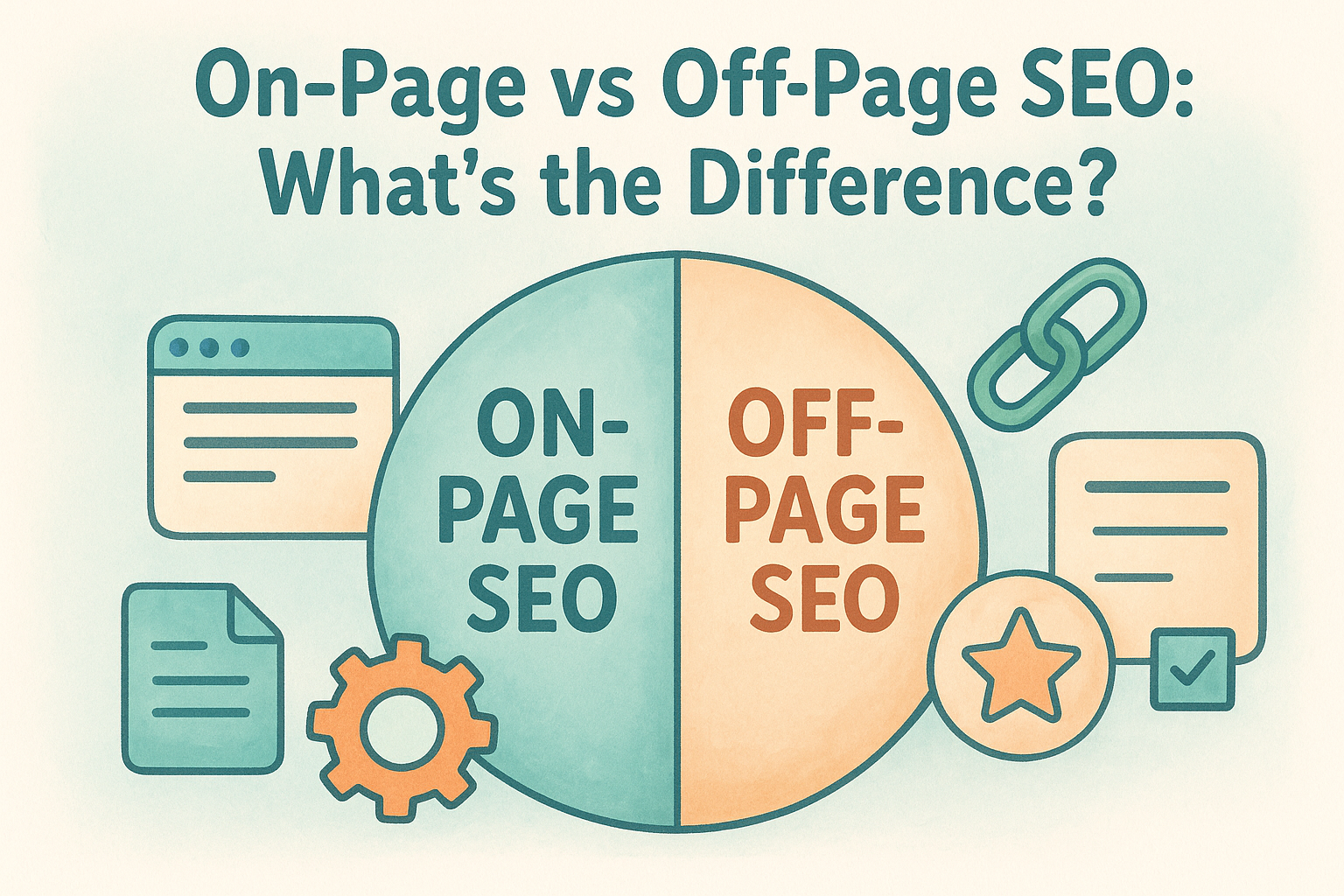
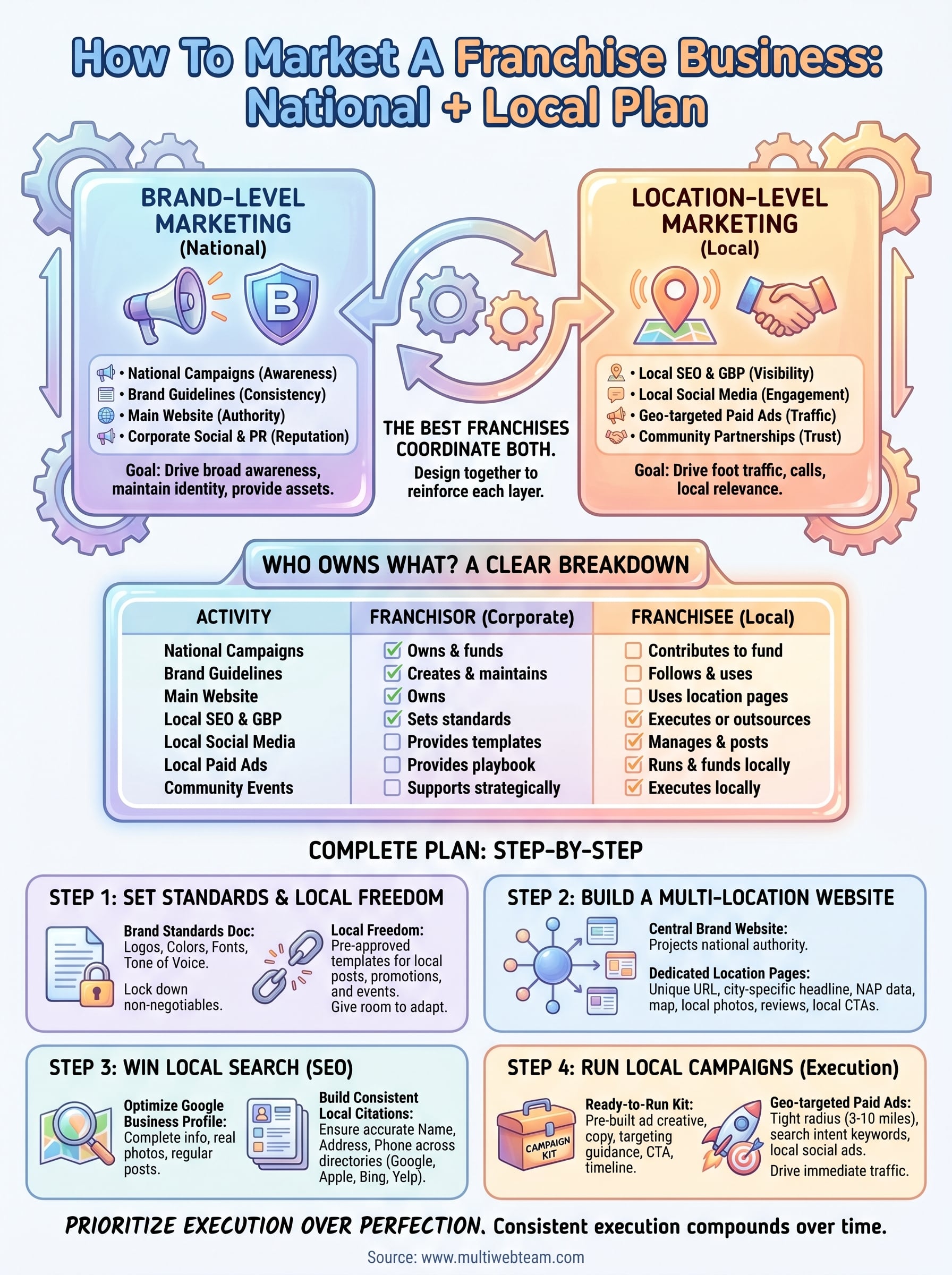
Franchise marketing operates on two distinct layers : brand-level marketing managed at the corporate level, and location-level marketing executed by individual franchisees. Both layers have to work in sync, but they serve different goals, reach different audiences, and use different tactics. Understanding this split is the foundation of figuring out how to market a franchise business effectively, because when responsibilities blur, you end up with inconsistent messaging, duplicated spend, and franchisees taking matters into their own hands in ways that quietly damage the brand.
The two layers: brand and location
Brand-level marketing covers everything that builds the franchise's overall reputation and recognition. This includes national advertising campaigns, the main brand website, brand guidelines, corporate-run social media accounts, and PR efforts. The franchisor owns this layer and typically funds it through a marketing fund that franchisees contribute to as part of their franchise agreement. The goal at this level is to drive broad awareness, maintain a consistent brand identity, and give franchisees a library of assets they can actually use without starting from scratch.
Location-level marketing is what puts a specific location in front of people who are ready to buy nearby. This includes local SEO, Google Business Profile management, local social media pages, community partnerships, geo-targeted paid ads, and location-specific promotions. Franchisees typically own this layer, though the level of support they receive from corporate varies widely. Some franchisors hand franchisees a complete marketing playbook with ready-to-run campaigns. Others leave them largely on their own, which leads to inconsistent execution across the system and locations that underperform despite a strong brand behind them.
The franchises that market best don't treat brand and local as separate programs. They design them together so each layer reinforces the other.
Who owns what: a clear breakdown
Before you build any campaigns, you need a clear, written agreement on who handles which marketing responsibilities. Without it, tasks fall through the cracks and franchisees either do too little or go off-brand in ways that are hard to walk back. Here is how the split typically looks across a franchise system:
| Marketing Activity | Franchisor | Franchisee |
|---|---|---|
| National brand campaigns | Owns and funds | Contributes to marketing fund |
| Brand guidelines and creative assets | Creates and maintains | Follows and uses |
| Main brand website | Owns | Uses location-specific pages |
| Local SEO and Google Business Profile | Sets standards | Executes or outsources |
| Local social media pages | Provides templates and guidance | Manages and posts |
| Local paid ads (search and social) | Provides playbook | Runs and funds locally |
| Community events and partnerships | Supports strategically | Executes at the location level |
| Review management | Monitors brand-wide trends | Responds at individual location |
This breakdown is a starting point, not a fixed rule. Larger franchise systems often centralize more of these activities to protect brand consistency and reduce the burden on operators. Smaller or growing franchises may ask franchisees to handle more independently while corporate focuses on building foundational brand infrastructure. Whatever the split looks like for your system, the key is documenting it clearly in your franchise operations manual and marketing guidelines so both sides know exactly what they're accountable for and what resources they'll have access to.
Why the ownership question matters more than most franchisors admit
When franchisees are unclear on their marketing responsibilities, two things tend to happen : they either do nothing because they assume corporate is handling it, or they run their own campaigns with no brand alignment and erratic results. Both outcomes hurt the system. Defining ownership also protects your marketing fund, because franchisees are far more likely to execute consistently when they understand exactly what they're expected to do and have templates or tools to do it without needing to invent everything from scratch.
Step 1. Set brand standards and local freedom
Every franchise system needs a clear line between what franchisees must follow and what they can adapt. Without that line, brand consistency breaks down fast, and local marketing either gets ignored or goes completely off-brand. The first real step in learning how to market a franchise business is building a brand standards document that locks down the non-negotiables while giving franchisees enough flexibility to connect with their actual local communities .
What goes in your brand standards document
Your brand standards document is the single source of truth for every franchisee who runs any kind of marketing. It should cover logos, color codes, typography, photography style, and approved messaging. Beyond visuals, it should define tone of voice guidelines so that a franchisee-run social media page in Denver sounds like the same brand as one in Dallas. Keep it practical: include downloadable asset libraries, approved ad templates, and example copy for common scenarios like grand openings, promotions, and local events.
Here is a simple framework for what to include:
- Logo usage: approved variations, minimum sizes, clear space rules, and prohibited uses
- Color palette: primary and secondary hex codes with CMYK and Pantone equivalents
- Typography: approved fonts, hierarchy rules, and fallback options for web use
- Photography style: guidelines for lighting, composition, and subjects to feature or avoid
- Tone of voice: three to five adjectives that define how the brand communicates, with real examples
- Approved templates: social post layouts, email designs, flyer formats, and ad creatives
- Prohibited actions: off-brand usage examples shown with side-by-side comparisons
Where to give franchisees room to adapt
Franchisees need latitude on local content, community involvement, and location-specific promotions . A rigid approval process that requires corporate sign-off for every Instagram post or local sponsorship will kill franchisee engagement with marketing entirely.
The best franchise systems define tight brand guardrails but leave the creative territory inside those guardrails wide open for franchisees to use.
Give franchisees a defined list of activities they can run without submitting for approval. These typically include posting on their local social pages, running location-specific promotions within pre-approved design templates, and joining community events using branded materials. Make the approved path easy enough that franchisees actually follow it instead of working around it.
Step 2. Build a multi-location website that converts
Your website is the foundation of how to market a franchise business at scale. A single generic homepage won't cut it when you have multiple locations competing in different markets. You need a central brand website that projects authority at the national level, plus dedicated location pages that speak directly to people in each specific area, giving both search engines and visitors a clear reason to choose that particular location over a competitor down the street.
Give each location its own dedicated page
Every franchise location deserves its own URL with unique, location-specific content. Sharing one page across multiple locations, or listing all locations in a directory-style format, kills your local search visibility and gives visitors no reason to feel like you're actually their neighborhood option. Each location page should treat that single location as if it's the whole business, with its own address, phone number, hours, and locally relevant details that are specific to that community , not pulled from a template and swapped with a different city name.
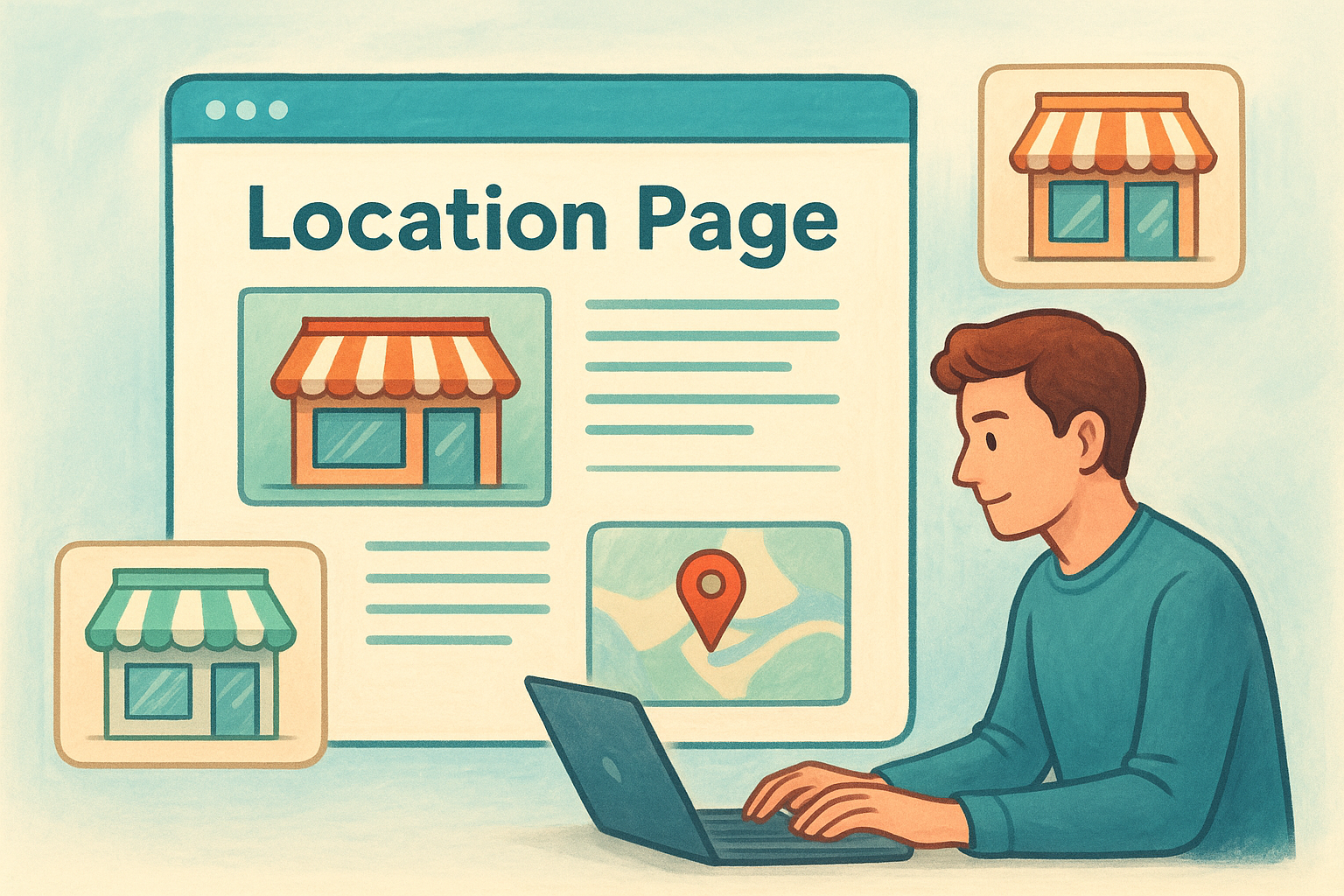
The pages that convert best make a local visitor feel like they found exactly what they were looking for, not a corporate listing.
Here's what each location page should include:
- Location-specific headline with the city or neighborhood name in the title tag and H1
- Unique introductory paragraph written for that market, not copied from another location
- NAP data (name, address, phone number) in a consistent, crawlable format
- Embedded Google Map showing the exact location
- Location-specific photos of the actual storefront or interior
- Calls to action tied directly to that location (call, book, get directions)
- Local reviews or testimonials from customers in that area
Design your site structure to scale with new locations
Your URL structure
matters more than most franchise owners realize. Keep it clean and consistent
across all locations so adding new ones doesn't create a navigation problem. A structure like /locations/[city-name]
works well and signals to search engines that each page is a distinct, location-specific destination. Avoid burying location pages under multiple navigation levels where visitors and search engines struggle to reach them
.
Build your main navigation to surface locations prominently. A " Find a Location" link in the header improves both crawlability and user experience, making sure every location page gets indexed and visited consistently as your franchise network grows.
Step 3. Win local search for every franchise location
Local search is where how to market a franchise business shifts from strategy into real revenue. When someone searches "pizza franchise near me" or "[your service] in [city]," your location pages and Google Business Profiles determine whether you show up or get skipped. Every location needs its own optimized presence in local search, not a shared profile or a half-filled listing that gives Google no reason to rank it over a well-established competitor nearby.
Optimize every Google Business Profile
Your Google Business Profile is often the first thing a nearby customer sees before they ever reach your website. Each franchise location needs its own verified profile with complete, accurate information that matches exactly what's on its location page. Fill in every field: business name, address, phone number, hours, category, and service descriptions. Upload real photos of the actual location, not stock images, because Google rewards profiles with original photo content and customers trust them more.
Use the Posts feature inside Google Business Profile to publish location-specific updates at least twice a month. Promote a local event, a limited-time offer, or a community partnership. This signals to Google that the profile is active and locally relevant , which directly improves how often it surfaces in the local pack results.
Build local citations that match your NAP data
A citation is any online mention of your location's name, address, and phone number (NAP). Search engines use citation consistency to verify that a location is legitimate and accurately represented. If your NAP data varies across directories, such as an abbreviated street name in one place and a full name in another, it introduces conflicting signals that can suppress your local rankings .
Consistent NAP data across every directory and platform is one of the simplest, highest-impact fixes in local SEO for franchises.
Audit your citations for each location across the major directories. Here are the ones to prioritize first:
- Google Business Profile (most critical)
- Apple Maps
- Bing Places
- Yelp
- Facebook Business Page
- Foursquare
Fix any inconsistencies by claiming each listing and updating the details manually. Once your core citations are clean, every new location you open should follow the same citation-building checklist from day one to avoid playing catch-up later.
Step 4. Run local campaigns franchisees can execute
Local campaigns are where how to market a franchise business gets practical for individual operators. If you hand franchisees a brand guidelines document and expect them to build campaigns from scratch, most won't. Execution rates drop sharply when franchisees have to figure out creative, targeting, and copy on their own. The solution is to build a campaign kit they can pick up and run with minimal effort, using pre-built assets that still leave room for local context.
Give franchisees a ready-to-run campaign kit
Your franchise marketing system only works as well as your least-resourced franchisee can execute it. That means your campaign kit needs to be simple enough for someone with no marketing background to launch within a day. Each kit should cover one specific campaign type , such as a grand opening, a seasonal promotion, or a referral drive, with everything inside pre-built and clearly labeled.
Here is a template for a standard local campaign kit:
| Component | What to Include |
|---|---|
| Campaign goal | One clear objective (e.g., drive calls, increase bookings) |
| Ad creative | 3 to 5 pre-designed images in correct platform sizes |
| Ad copy | 2 to 3 headline options and body copy variations |
| Targeting guidance | Recommended radius, audience type, and budget range |
| Call to action | Exact CTA language tied to the location page URL |
| Timeline | Suggested run dates and duration |
| Performance benchmark | What a good result looks like (clicks, calls, conversions) |
A campaign kit that takes longer than one hour to launch will sit unused in most franchisees' inboxes.
Use geo-targeted paid ads to drive location traffic
Paid ads give each franchisee immediate visibility in their specific market without waiting for organic rankings to build. The most effective approach for franchise locations is a tight geographic radius , typically three to ten miles depending on your business type, paired with search intent keywords that signal the person is ready to act. Set up a Google Ads call campaign for each location that routes directly to that location's phone number, not a central corporate line.
Beyond search ads, local social ads on Facebook and Instagram let you target by zip code and demographics that match your customer profile. Each franchisee should run at least one active campaign at all times, because even a modest daily budget of ten to twenty dollars keeps the location visible during local searches and fills gaps when organic rankings fluctuate between algorithm updates.
Next steps to put this plan to work
You now have a complete framework for how to market a franchise business at both the national and local level. The next move is to prioritize execution over perfection and start with the steps that have the most immediate impact: your brand standards document, your location pages, and your Google Business Profiles. Get those three things right before you layer in paid campaigns or advanced local tactics.
From there, build your campaign kits so franchisees can run local promotions without waiting on corporate approval each time they want to advertise. Consistent execution across every location is what compounds over time and turns a solid franchise system into a dominant local presence in each market you operate in. If you want a team that handles your location pages, local SEO, and ongoing website updates without adding internal overhead, Multi Web Team is built specifically for franchise businesses like yours.