
April 28, 2026

How Much Does Website Management Cost? 2026 Price Breakdown

If you're running a business, especially one with multiple locations, you've probably asked yourself how much does website management cost and whether you're overpaying. It's a fair question. Between hosting fees, security updates, content changes, and SEO work, the numbers add up quickly. And the answers you'll find online range from $50/month to well over $5,000/month , which isn't exactly helpful without context.

The truth is, website management costs depend on what you actually need done, who's doing it, and how many moving parts your site has. A single-page portfolio site and a multi-location business website with dozens of landing pages are two very different animals. At Multi Web Team, we manage websites for franchises and multi-location businesses every day, so we see the full spectrum, from bare-bones maintenance to all-inclusive management that covers design, updates, and SEO .

This article breaks down real pricing for 2026 across freelancers, agencies, and automated tools. You'll get specific cost ranges by website type , a look at what's typically included (and what isn't), and enough detail to figure out what makes sense for your budget and business model.

What website management covers in plain English

When people ask how much does website management cost , they often don't realize how many separate tasks that phrase includes. Website management isn't a single service. It's a collection of ongoing work that keeps your site secure, fast, visible, and accurate. Skip any piece of it, and you'll start losing visitors, search rankings, or in the worst case, customer trust.

The technical side: keeping things running

Your website runs on software, and software breaks, gets outdated, and attracts security threats. Technical website management covers the maintenance work that keeps your site from going down or getting compromised. This includes updating your content management system and any plugins, monitoring uptime, running security scans, managing SSL certificates, and backing up your files on a regular schedule. Hosting sits in this category too, since your site needs a server to run on at all times.

If your website goes offline during peak business hours and no one catches it for several hours, you've already lost real customers and search ranking signals.

For a multi-location business , the technical layer gets more complicated fast. More pages, more integrations, and more location-specific data mean more points of failure. A problem on one location page can quietly affect the whole site without anyone flagging it.

The content and marketing side: staying visible

Technical upkeep keeps the lights on, but content management is what brings customers to your site. This covers updating location details, swapping promotional banners, publishing new pages, adjusting pricing or menus , and making copy edits as your business changes. How often this work happens matters. A site that looks the same for months signals to both visitors and search engines that the business isn't active.

SEO management fits here too. That means optimizing existing pages, building out location-specific landing pages, monitoring keyword performance, and fixing issues that drag down your visibility in local search results. For multi-location businesses, this work never really stops because each location needs its own consistent attention.

What gets bundled and what gets billed separately

Most managed website plans combine some version of technical maintenance, content updates, and SEO into a monthly fee. What typically stays outside that bundle includes paid advertising, full redesigns, and custom development work. Those usually carry separate costs that can catch you off guard.

When you compare plans , check exactly what's included in writing. Some providers advertise a low base rate but charge hourly for every content change. Others bundle unlimited updates into a flat subscription so you're not penalized for keeping your site current. That difference has a real impact on your annual spend.

Website management costs in 2026 by site type

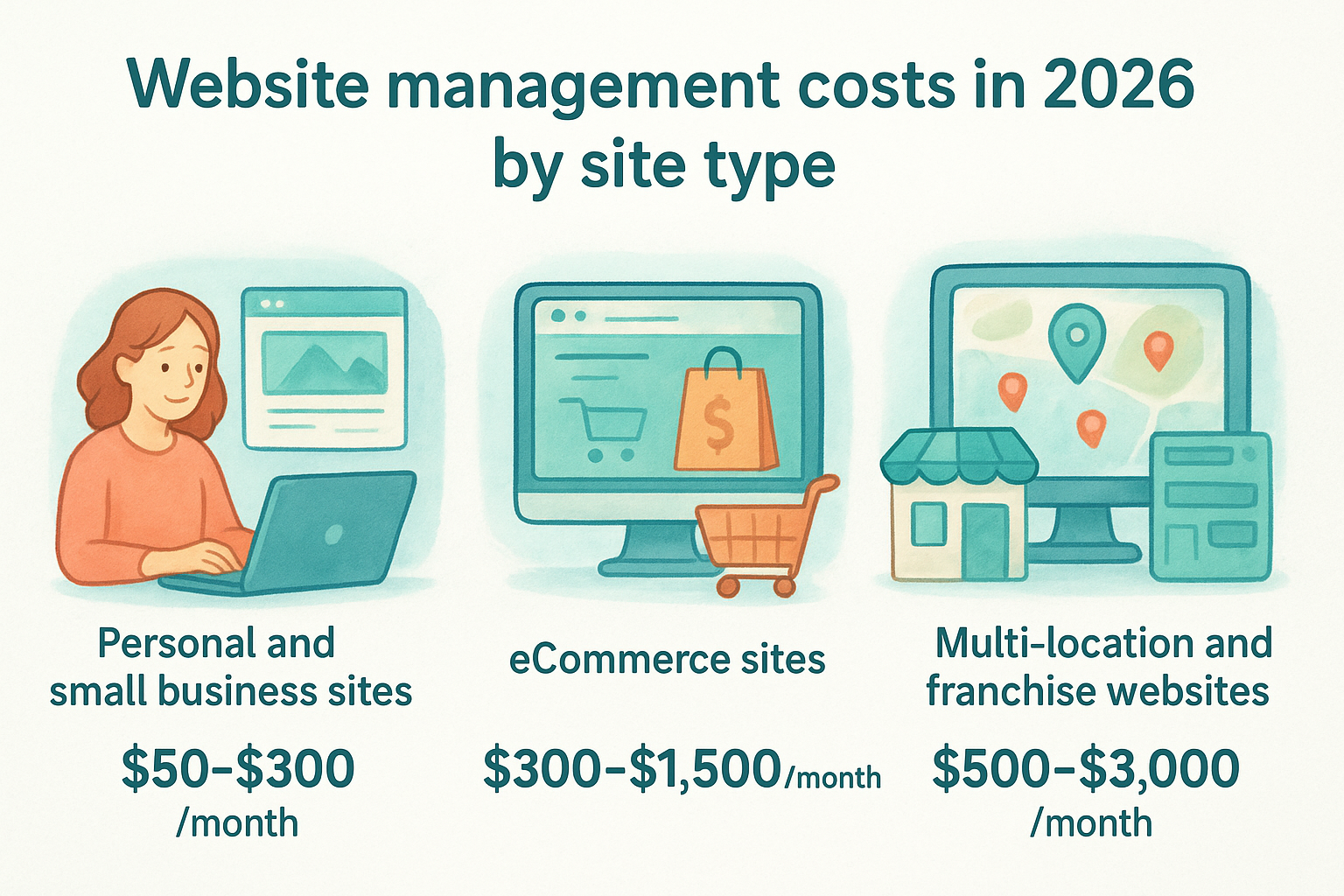
Before you can answer how much does website management cost for your situation, you need a realistic baseline by site type. A brochure site for a single-location service business and a franchise network with 30 location pages have almost nothing in common when it comes to ongoing work, and the pricing reflects that gap directly.

Personal and small business sites

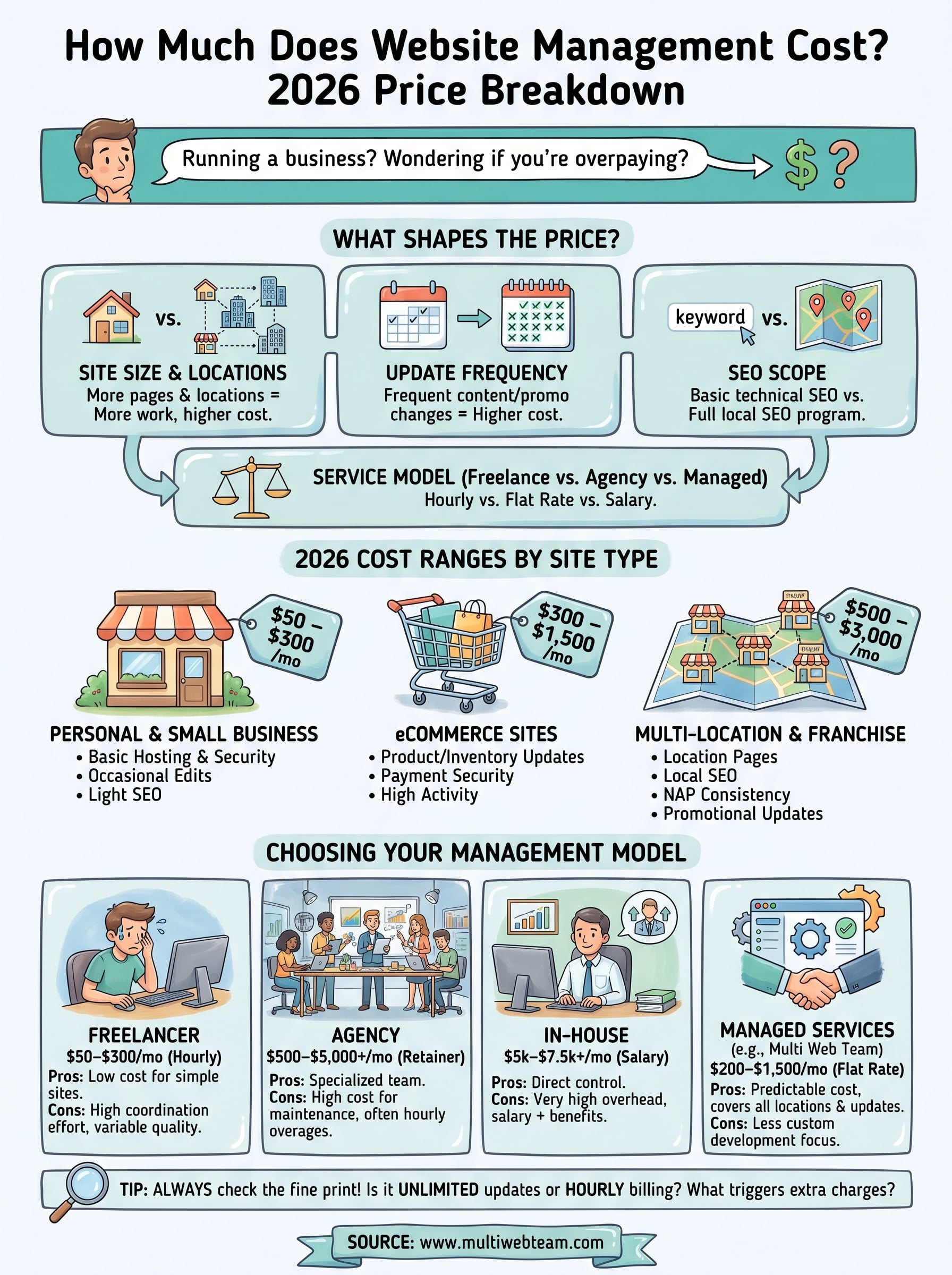
If you run a single-location business or a personal portfolio site with a handful of pages, your monthly management costs typically land between $50 and $300 per month . At the lower end, you're usually paying for basic hosting, security monitoring, and occasional plugin updates. At the higher end, you're adding regular content edits and light SEO work. These sites don't require heavy ongoing attention, which keeps costs predictable and manageable for smaller budgets.

If your only goal is keeping a simple site live and secure, a basic managed hosting plan can cover most of what you need for under $100 per month.

eCommerce sites

Online stores carry significantly higher management costs because product pages, inventory updates, payment processing integrations, and security compliance all need active attention. Most eCommerce sites run between $300 and $1,500 per month for full management. Larger stores with hundreds of SKUs or regular promotions sit toward the top of that range, since content changes happen constantly and any technical issue can directly cut into revenue.

Multi-location and franchise websites

This is where pricing scales the most. Multi-location sites need ongoing work at both the central site level and the individual location level simultaneously. You're managing location pages, local SEO signals, NAP consistency, and promotional updates across every market you operate in. Managed service plans for this type of site typically run $500 to $3,000 per month , depending on the number of locations, how frequently content changes, and how competitive your local search markets are.

The biggest factors that change the monthly price

Two businesses can have nearly identical sites and pay completely different monthly rates because the actual scope of work drives pricing more than anything else. Understanding what moves the needle on cost helps you ask the right questions when comparing plans and avoid paying for work you don't need.

Site size and the number of locations

The more pages your site has, the more work it takes to keep everything accurate, optimized, and up to date. A five-page brochure site requires a fraction of the attention that a 30-location franchise website demands. Each location page needs its own content, SEO signals, and regular updates . More locations means more labor, and that shows up directly in your monthly bill.

How often your content changes

If you run a business with seasonal promotions, rotating menus, or frequent pricing updates , your site needs more hands-on attention than a company whose pages rarely change. Providers that charge hourly for updates will cost you significantly more over time if your site changes frequently. That's why understanding how much does website management cost often comes down to update volume as much as anything else.

A subscription plan with unlimited updates can save multi-location businesses hundreds of dollars per month compared to hourly billing models.

The scope of SEO work included

Basic technical SEO like fixing broken links and optimizing page titles costs far less than a full local SEO program that targets keyword rankings across multiple cities. If you operate in competitive local markets , expect SEO to represent a meaningful portion of your monthly cost. Providers that include active SEO management in their base rate typically charge more upfront but deliver more long-term value than plans that treat it as a separate add-on.

Freelancer vs agency vs in-house vs managed services

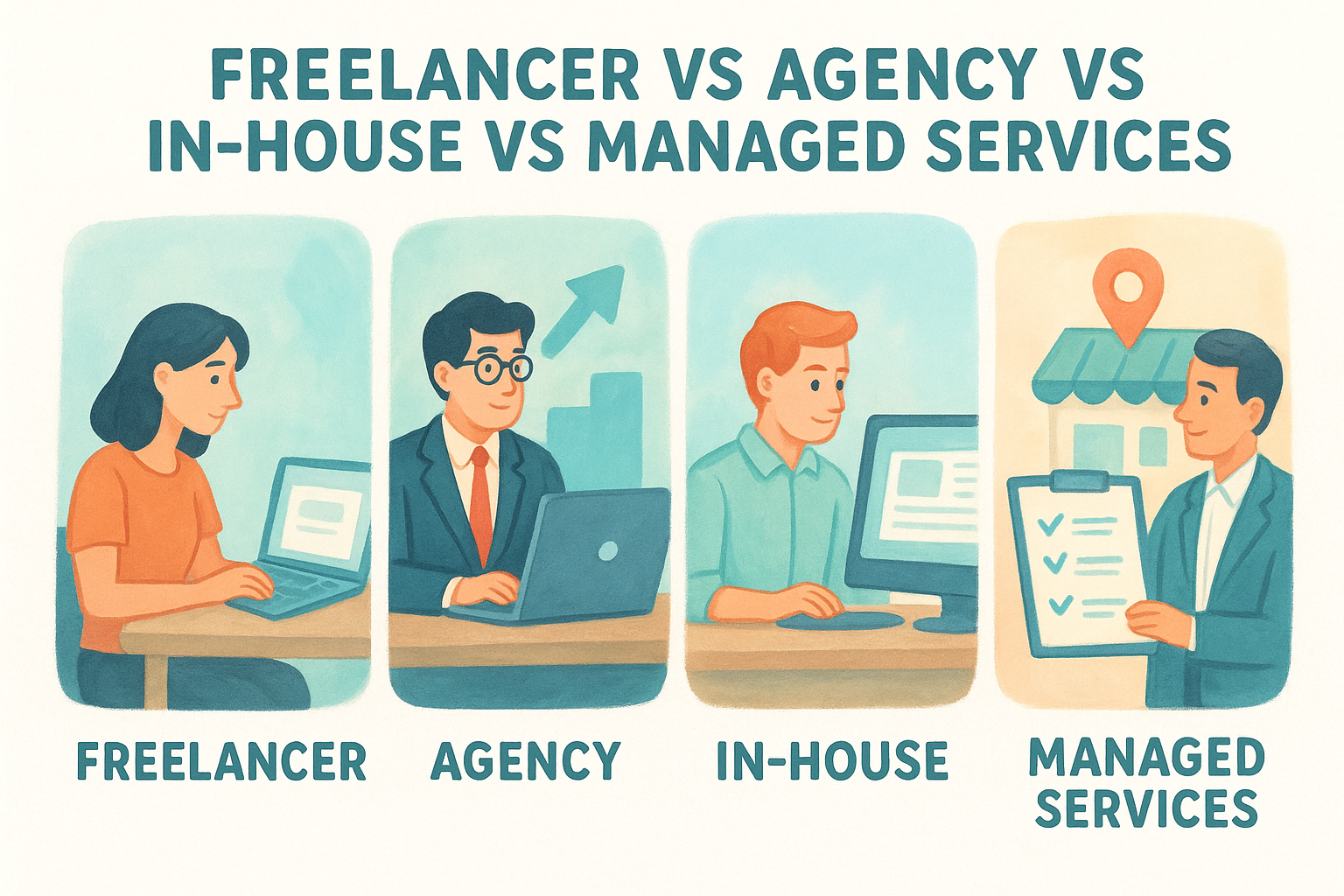
How much does website management cost shifts significantly based on the model you choose. Each option comes with a different cost structure, and how much of the ongoing work lands back on you varies just as much as the monthly price.

Model Typical Monthly Cost Best For
Freelancer $50–$300 Small, static sites
Agency $500–$5,000+ Complex or multi-location sites
In-house $5,000–$7,500+ Large enterprises
Managed services $200–$1,500 Multi-location and franchise businesses

Hourly and project models: freelancers and agencies

Freelancers charge $25 to $75 per hour on average, which looks affordable for occasional fixes but grows expensive fast when your site needs regular content updates or active SEO work. The bigger hidden cost is coordination time on your end , since you manage the schedule, review every deliverable, and follow up on fixes yourself.

Agencies give you a structured team and charge $500 to $5,000+ per month depending on scope. You get dedicated roles handling design, development, and SEO simultaneously, which tends to produce more consistent results than a solo contractor. The tradeoff is that agency pricing at the higher end can be difficult to justify for businesses that primarily need steady ongoing maintenance rather than frequent strategy overhauls.

Flat-rate models: in-house and managed services

Hiring a full-time in-house web manager adds salary, benefits, and software costs that push total annual spend past $65,000 to $85,000 in most markets. You gain direct control, but that overhead makes financial sense mainly for large organizations with enough ongoing technical complexity to justify a dedicated full-time headcount .

Managed website subscriptions bundle maintenance, content updates, and SEO into one flat monthly rate with no hourly billing surprises. For multi-location and franchise businesses , this model handles every location under a single plan, keeping costs predictable and making sure nothing falls through the gaps between separate vendors .

Managed service plans typically deliver the best cost-per-location value for franchise operators who need consistent upkeep across every market they serve.

How to budget, compare plans, and avoid surprises

Once you know the rough cost ranges, the next step is matching them to your actual needs and building a budget that holds up over time. The biggest mistake businesses make is picking a plan based on the lowest monthly number without checking what work that price actually covers.

Build a baseline budget before you shop

Start by listing every task your site needs on a monthly basis : content updates, security patches, SEO work , and any location-specific changes. Count how often those tasks happen and estimate the time involved. That list becomes your baseline, and any plan you evaluate should map directly to it.

  • List all recurring update types (menus, promotions, location hours)
  • Estimate update frequency per month
  • Separate technical maintenance from content and SEO work
  • Flag tasks that require specialized skills like local SEO

Knowing exactly what your site needs before you start comparing prices prevents you from paying for services you don't use or missing ones you can't do without.

Read the fine print on what's included

When you ask how much does website management cost , the answer on a provider's pricing page rarely tells the full story. Check whether content updates are unlimited or billed hourly , whether SEO is active management or just a one-time setup, and whether you own your domain and files if you ever leave. Hidden fees for extra locations, rush updates, or redesign work can push your real annual cost well above the quoted monthly rate.

Ask every provider the same three questions before signing: what triggers an extra charge and who owns the assets, and what happens to your site if you cancel. Those answers will reveal more about the true cost of a plan than any pricing table will.

Next steps for picking the right option

Now that you have a clear picture of how much does website management cost across different site types and service models, the next step is making a decision that fits your actual situation. Start by revisiting the baseline task list your site needs every month. Match it against the cost ranges in this article and cut any options that don't cover the basics without adding fees for every change.

If you run a multi-location business or franchise , find a provider that handles every location under one plan. Juggling separate vendors for design, updates, and SEO wastes time and creates gaps in your coverage. Multi Web Team builds and manages websites specifically for multi-location businesses under a flat monthly subscription , covering unlimited updates, SEO, and ongoing maintenance so you can focus on running your business instead of tracking down your web team every time something needs to change.

By cinchweb April 27, 2026
What is franchise marketing? Learn how to balance national brand power with local growth through targeted SEO and neighborhood-specific promotions.
By cinchweb April 27, 2026
Convert visitors into customers with 12 small business website best practices. Learn to optimize for local SEO, mobile users, and site speed to grow sales.
By cinchweb April 25, 2026
Compare the 15 best web design services for small businesses in 2026. Find the right agency or DIY tool to build your site and grow your online presence.
By cinchweb April 24, 2026
Learn how to get more google reviews with 8 easy tactics. Use automation, QR codes, and smart timing to boost your local ratings and scale your business.
By cinchweb April 23, 2026
Compare pricing for 7 monthly website maintenance plans to find the right fit. Learn how to balance cost, security, and SEO for your business in 2026.
By cinchweb April 22, 2026
Compare the 10 best website maintenance services for 2026. Find the right partner to manage your site's security, updates, and SEO to drive growth.
By cinchweb April 21, 2026
Compare the 9 best website maintenance services for small businesses in 2026. Find the right partner for security, SEO, and updates to keep your site fast.
By cinchweb April 20, 2026
See what a google business profile optimization service includes. Compare pricing, audits, and management strategies for single and multi-location brands.
By cinchweb April 19, 2026
Learn how to market a franchise business using a national and local plan. Master brand standards, local SEO, and location pages to drive more traffic.
By cinchweb April 19, 2026
Compare 10 small business web design packages for 2026. See how DIY builders, freelancers, and managed services stack up on cost, SEO, and ongoing support.
SHOW MORE