10 Small Business Web Design Packages Compared for 2026
Picking the right web design package can make or break your online presence, especially when you're running a small business with real budget constraints. The problem? There are hundreds of providers offering small business web design packages , and the pricing, features, and service quality vary wildly. Some bundle everything you need into one monthly fee, while others nickel-and-dime you for every update and add-on.
At Multi Web Team, we build and manage websites for multi-location businesses and franchises, so we know exactly what separates a solid web design package from a waste of money . We've seen business owners overpay for bloated packages and underpay for sites that do nothing. That experience gives us a sharp eye for what actually matters when comparing options.
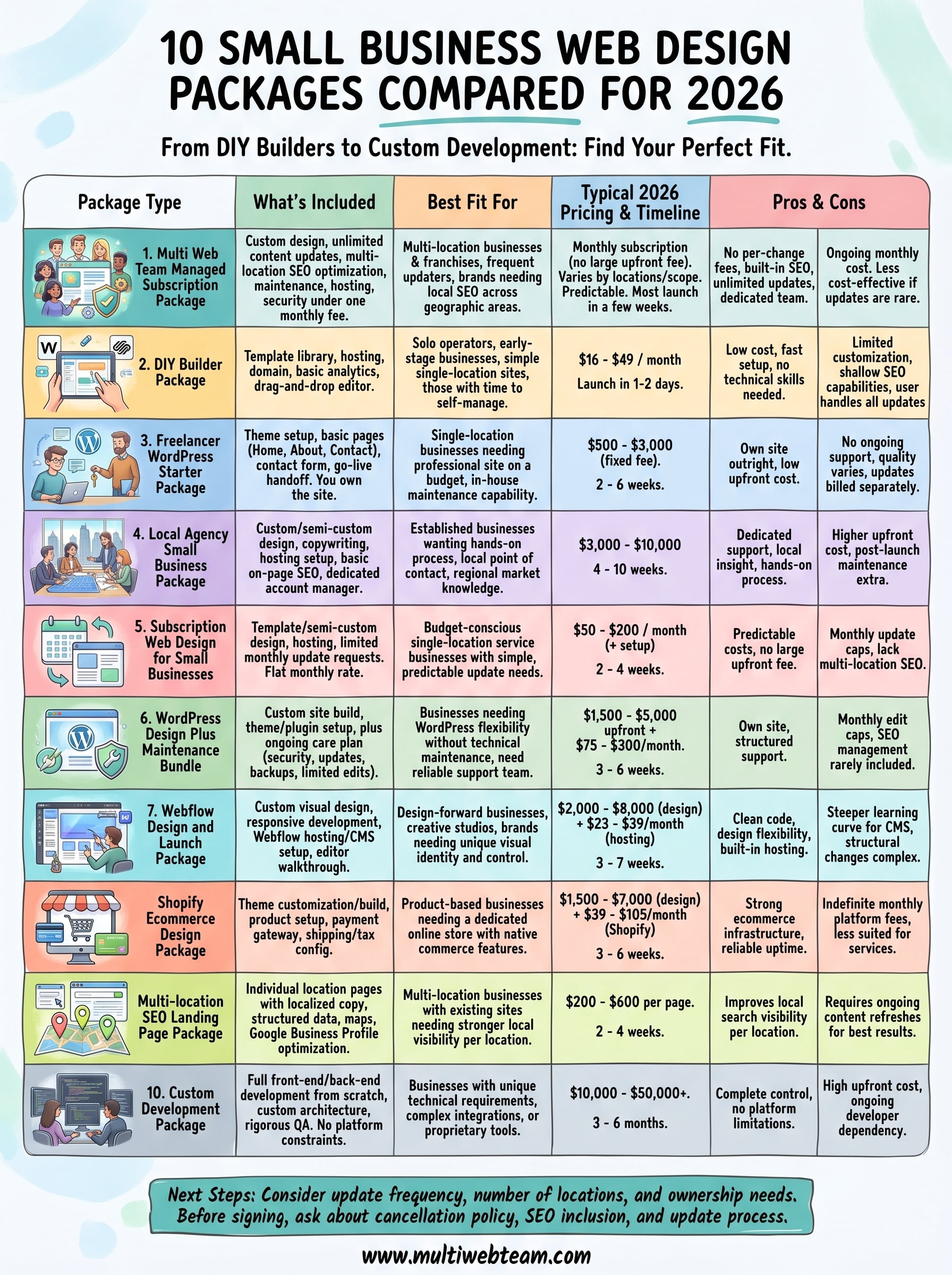
This article breaks down 10 web design packages worth considering in 2026 , covering what's included, what it costs, and who each one works best for. Whether you're launching your first site or replacing one that isn't pulling its weight, this comparison will help you make a confident decision without sorting through dozens of sales pages yourself.
1. Multi Web Team managed subscription package
Multi Web Team takes a different approach from most small business web design packages on this list. Instead of charging you upfront for a build and disappearing, Multi Web Team acts as your dedicated external web team , handling design, updates, SEO, and maintenance under one monthly subscription.

What the package includes
The package covers custom website design built specifically for your business, along with unlimited content updates, photo swaps, promotional changes, and video additions at no extra charge. You also get multi-location SEO optimization built into the service, so each of your locations gets the local search attention it needs without requiring separate contracts or bolt-on add-ons.
Best fit for
This package works best for multi-location businesses and franchise operators who update their sites frequently and need local SEO across several geographic areas. If you run a food service, fitness, or retail brand with more than one location, this setup removes the overhead of managing web updates internally while keeping every location visible in local search.
If your business adds locations regularly, having a team that already knows your brand saves significant ramp-up time compared to re-briefing a new agency each time.
Typical 2026 pricing and timeline
Multi Web Team operates on a monthly subscription model , which means no large upfront build fee. Pricing depends on the number of locations and the scope of SEO work involved, but the structure stays predictable and all-inclusive with no surprise charges per change. Most sites launch within a few weeks after onboarding, and the ongoing work continues month to month.
Pros and cons to weigh
Pros: No per-change fees, built-in SEO management, unlimited updates, and a team experienced with multi-location business needs.
Cons: The subscription model means ongoing monthly costs rather than a one-time purchase. Businesses that rarely update their site may not fully use the unlimited updates feature.
Questions to ask before you buy
Before committing, get clear answers to these:
- How many locations does the base subscription cover?
- What does SEO management include on a month-to-month basis?
- What is the process for requesting updates, and what is the typical turnaround time?
2. DIY builder package
DIY builder packages from platforms like Wix, Squarespace, or GoDaddy put the design work in your hands using drag-and-drop editors and pre-built templates. These are among the most widely used small business web design packages because they lower the barrier to getting online quickly.
What the package includes
Most DIY builder plans include a template library, hosting, a domain name, and basic analytics in a single subscription. Higher tiers add features like online scheduling, ecommerce, and marketing integrations.
Best fit for
This option suits solo operators and early-stage small businesses that have time to manage the site themselves and don't need advanced SEO or frequent complex updates. If your business runs from a single location and your website mainly serves as a digital business card, a DIY builder can work fine.
If your needs grow beyond a few pages or updates pile up, the time cost of self-managing often outweighs the monthly savings.
Typical 2026 pricing and timeline
DIY builder plans typically run $16 to $49 per month , with business-tier plans landing on the higher end. You can launch in a day or two if you're comfortable with the interface, though polished results take longer.
Pros and cons to weigh
Pros: Low cost, fast setup, and no technical skills required to get started.
Cons: Templates limit how distinct your site looks, SEO capabilities are shallow , and every update falls on you.
Questions to ask before you buy
- Does the plan include a custom domain , or is that an added cost?
- What happens to your site if you cancel the subscription ?
3. Freelancer WordPress starter package
Hiring a freelancer to build a WordPress site is one of the most accessible small business web design packages available today. A freelancer handles design and development for a fixed project fee, typically delivering a site built on WordPress using a purchased premium theme.
What the package includes
Most freelancer WordPress starter packages cover theme setup, basic page creation (home, about, services, contact), contact form integration, and a go-live handoff. Some freelancers include one or two revision rounds. You typically own the site outright once the project closes.
Best fit for
This option works well for single-location small businesses that need a professional-looking site without agency-level costs. It suits businesses that have someone in-house to handle future updates after launch, or those whose sites rarely change after going live.
If you need ongoing updates after launch, you'll likely need to rehire the freelancer or find a separate maintenance provider, which adds unpredictable costs over time.
Typical 2026 pricing and timeline
Freelancer WordPress packages typically range from $500 to $3,000 , depending on page count and complexity. Most projects deliver in two to six weeks , though timelines shift based on the freelancer's current workload.
Pros and cons to weigh
Pros: You own the site outright, and upfront costs stay well below typical agency pricing.
Cons: No ongoing support comes included, and quality varies significantly between individual freelancers.
Questions to ask before you buy
- Does the package include hosting and domain setup , or just the design work?
- What is the process if you need changes or revisions several months after launch?
4. Local agency small business package
Local digital marketing and web design agencies offer small business web design packages that sit between a freelancer's rate and a full enterprise contract. These firms typically handle everything from discovery and design to launch , with a dedicated account manager keeping you in the loop throughout.
What the package includes
Local agency packages usually cover custom or semi-custom design, copywriting support, hosting setup, and basic on-page SEO at launch. Many agencies also include a brief CMS training session so your staff can handle minor updates without calling anyone.
Best fit for
This option suits established small businesses that want a professionally managed build with a local point of contact. It works well when face-to-face meetings and regional market knowledge matter to how you operate.
Local agencies often understand your regional market better than a remote provider, which can sharpen initial SEO targeting and messaging.
Typical 2026 pricing and timeline
Local agency projects typically run $3,000 to $10,000 for a standard small business site. Most projects take four to ten weeks from kickoff to launch, depending on how quickly you deliver feedback and content.
Pros and cons to weigh
Pros: Dedicated account management, local market insight, and a more hands-on process than hiring a freelancer.
Cons: Higher upfront costs and post-launch maintenance are often billed separately at hourly rates.
Questions to ask before you buy
- Does the fee include post-launch support , and for how long?
- Who owns the site files if you part ways with the agency?
5. Subscription web design for small businesses
Subscription web design services charge a flat monthly rate covering your site build, hosting, and ongoing support without a large upfront project fee. These small business web design packages appeal to budget-conscious owners who want predictable billing and a managed site without committing to a lengthy agency contract.
What the package includes
Most subscription services provide a template-based or semi-custom design , hosting, and a set number of monthly update requests. Some providers layer in basic on-page SEO and uptime monitoring at the base tier. What you get beyond that depends heavily on the plan level you choose.
Best fit for
This option fits single-location service businesses like cleaning companies, salons, or consultants that need a reliable online presence without complex functionality. It works well when your update needs are predictable and your site doesn't require multi-location SEO or frequent structural changes.
If your requirements stay simple and consistent month over month, a subscription service keeps costs low without sacrificing a maintained site.
Typical 2026 pricing and timeline
Subscription web design services typically charge $50 to $200 per month , with setup fees ranging from free to around $500. Most providers launch within two to four weeks after you deliver your content and brand materials.
Pros and cons to weigh
Pros: Predictable costs and no large upfront payment.
Cons: Monthly update caps can create bottlenecks, and most providers lack multi-location SEO capabilities.
Questions to ask before you buy
- How many monthly update requests does your plan include?
- Who owns the site files if you cancel?
6. WordPress design plus maintenance bundle
A WordPress design plus maintenance bundle combines a custom site build with an ongoing care plan , giving you both a professionally launched site and a team that keeps it running after go-live. Unlike a standard freelancer project, these bundles keep the relationship active so your site stays updated, secure, and backed up without you needing to manage any of it yourself.
What the package includes
These bundles typically cover WordPress installation, theme customization, core page setup , plugin configuration, and an ongoing monthly maintenance plan. The care plan usually includes security monitoring, plugin updates, backups, and a set number of monthly edit requests to handle content changes as your business evolves.
Best fit for
This option suits small businesses that want the flexibility of WordPress but lack the time or technical comfort to maintain it themselves. It works well for businesses that already have a content strategy and need a reliable team to execute updates without friction.
If you're already familiar with WordPress and just need someone to handle the back-end upkeep, this bundle structure tends to be more cost-effective than a full managed service.
Typical 2026 pricing and timeline
Expect to pay $1,500 to $5,000 upfront for the build, plus $75 to $300 per month for the maintenance plan. Most projects launch within three to six weeks depending on site complexity.
Pros and cons to weigh
Pros: You own the site, and ongoing support is structured into the agreement from day one.
Cons: Monthly edit caps can limit flexibility, and SEO management is rarely included in standard bundles.
Questions to ask before you buy
- How many monthly edits does the maintenance plan include?
- Does the bundle cover hosting costs , or is that billed separately?
7. Webflow design and launch package
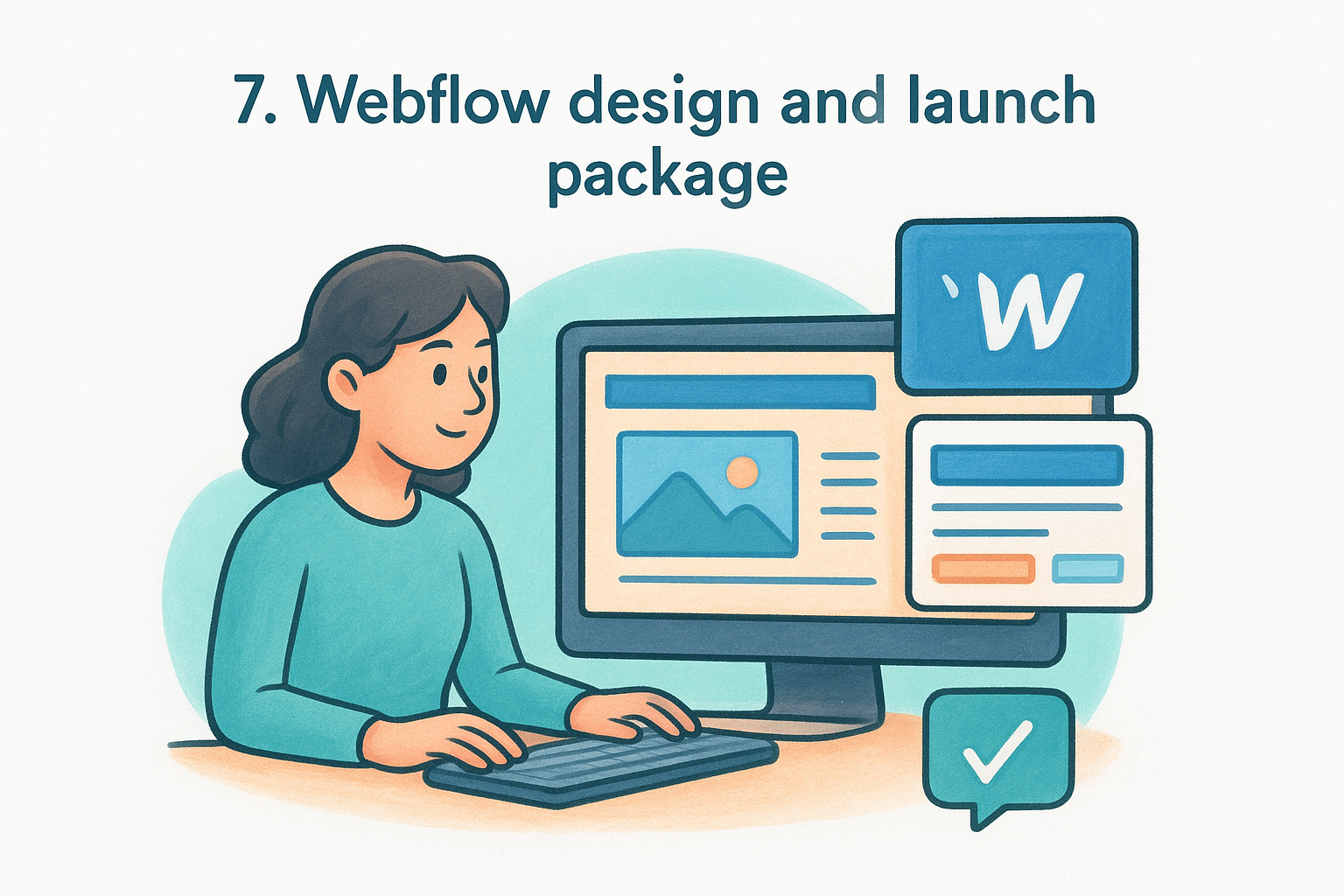
Webflow has grown into a serious platform for designers who want precise visual control without writing custom code. Webflow design and launch packages give you a visually polished, responsive site built on a platform that's more flexible than most theme-based WordPress setups, with cleaner output under the hood.
What the package includes
A typical Webflow package covers custom visual design, responsive layout development , and a final handoff to Webflow's hosting or a connected custom domain. Most providers include a brief editor walkthrough so you can update text and images yourself through Webflow's built-in CMS without touching the underlying design.
Best fit for
This option suits design-forward small businesses like creative studios, boutique retailers, or professional service firms where visual presentation directly drives conversions. It works well when your brand identity is strong and you want a site that looks distinct from template-heavy competitors.
If your business relies on visuals to sell, Webflow gives designers more precise layout control than most other small business web design packages on this list.
Typical 2026 pricing and timeline
Webflow projects typically run $2,000 to $8,000 for design and development, plus $23 to $39 per month for Webflow's CMS hosting plan. Most projects deliver in three to seven weeks depending on page count and complexity.
Pros and cons to weigh
Pros: Clean code output, strong design flexibility, and built-in hosting with reliable uptime.
Cons: The Webflow editor has a steeper learning curve than WordPress or Squarespace for non-technical users making changes post-launch.
Questions to ask before you buy
- Does the package include Webflow CMS training for your team?
- Who handles the site if you need structural layout changes after launch?
8. Shopify ecommerce design package
Shopify design packages give you a purpose-built storefront optimized for selling products online. These packages are a distinct category among small business web design packages because they combine design work with Shopify's native commerce infrastructure, giving you checkout, inventory, and payment processing from day one.
What the package includes
A Shopify design package typically covers theme customization or a fully custom theme build , product page setup, payment gateway configuration, and navigation structure built around your product catalog. Most providers also handle shipping settings, discount codes, and basic email marketing integration as part of the initial launch scope.
Best fit for
This option suits product-based small businesses that need a storefront ready to take orders at launch. It works best for retail brands, makers, and boutique shops that want a dedicated sales channel rather than a general business site with a tacked-on store.
If you already sell on Shopify and just need a design upgrade, many providers offer redesign-only packages that work within your existing Shopify account.
Typical 2026 pricing and timeline
Shopify design packages typically run $1,500 to $7,000 depending on whether you use a customized theme or a fully custom build. Shopify's own hosting runs $39 to $105 per month on standard plans. Most projects deliver in three to six weeks .
Pros and cons to weigh
Pros: Strong ecommerce infrastructure built in from the start, with reliable uptime and native payment processing.
Cons: Monthly Shopify fees continue indefinitely, and the platform suits product businesses more than service-based ones.
Questions to ask before you buy
- Does the package include product upload and setup , or just the design work?
- How are ongoing design changes handled after launch?
9. Multi-location SEO landing page package
A multi-location SEO landing page package solves one specific problem: getting each of your locations to rank in local search results . Unlike broader small business web design packages that build an entire site from scratch, this option delivers dedicated, optimized landing pages for each physical location you operate.
What the package includes
These packages typically cover individual location pages built with location-specific copy, structured data markup, embedded maps, and localized keyword targeting. Most providers also include Google Business Profile optimization to reinforce each location's local search signals from the start.
Best fit for
This option suits multi-location businesses and franchise operators that already have a main website but need stronger local visibility per location. It works well when a generic contact page isn't pulling local search traffic in competitive markets.
If you run five or more locations, individual location pages consistently outperform sending all local traffic to a single page.
Typical 2026 pricing and timeline
Expect to pay $200 to $600 per location page , with full packages often discounted for higher location counts. Most providers deliver pages within two to four weeks depending on total locations.
Pros and cons to weigh
Pros: Directly improves local search visibility per location and integrates cleanly into an existing site.
Cons: Ongoing content refreshes are needed to stay competitive, and results take several months to build.
Questions to ask before you buy
Before committing, get written answers to these key questions to avoid surprises after launch.
- Does the package include structured data markup on each page?
- Who handles content updates if your location details change?
10. Custom development package
A custom development package gives you a site built entirely from scratch by a development team writing custom code. These packages sit at the top end of small business web design packages in both cost and capability, delivering functionality that off-the-shelf solutions cannot match.
What the package includes
Custom development packages typically cover full front-end and back-end development , UX design, database architecture where needed, and a rigorous quality assurance process before launch. Your developers write the code from the ground up rather than configuring a pre-built platform or theme.
Best fit for
This option suits businesses with unique technical requirements that no existing platform handles out of the box, such as custom booking engines, complex third-party integrations, or proprietary tools built directly into the user experience.
If your requirements fit a standard platform like WordPress or Shopify, custom development will almost always cost more than the problem warrants.
Typical 2026 pricing and timeline
Custom development projects typically start at $10,000 and can run well past $50,000 depending on scope. Most projects of this complexity take three to six months from kickoff to launch.
Pros and cons to weigh
Pros: No platform constraints and complete control over every feature, interaction, and integration your business needs.
Cons: High upfront investment and ongoing developer dependency for updates, bug fixes, and future feature additions after launch.
Questions to ask before you buy
- Does the package include full source code ownership upon project completion?
- How are post-launch maintenance and bug fixes scoped and billed?
Next steps for choosing a package
The right choice among small business web design packages comes down to three things: how often your site needs updates, how many locations you operate, and whether you want to own the site outright or pay for ongoing service. If your needs are simple and static, a DIY builder or freelancer starter package may cover them. If you manage multiple locations and need consistent local SEO and unlimited updates , a fully managed subscription model will serve you better over time.
Before you sign anything, confirm what happens to your site if you cancel, whether SEO is included or billed separately, and who handles updates after launch. These three questions alone will eliminate most packages that look appealing on the surface but fall short in practice. If you run a multi-location business and want a team that handles everything, explore what Multi Web Team includes in its managed subscription and see if it fits what you need.