
Local Citation Building: What It Is And Why It Matters For SEO
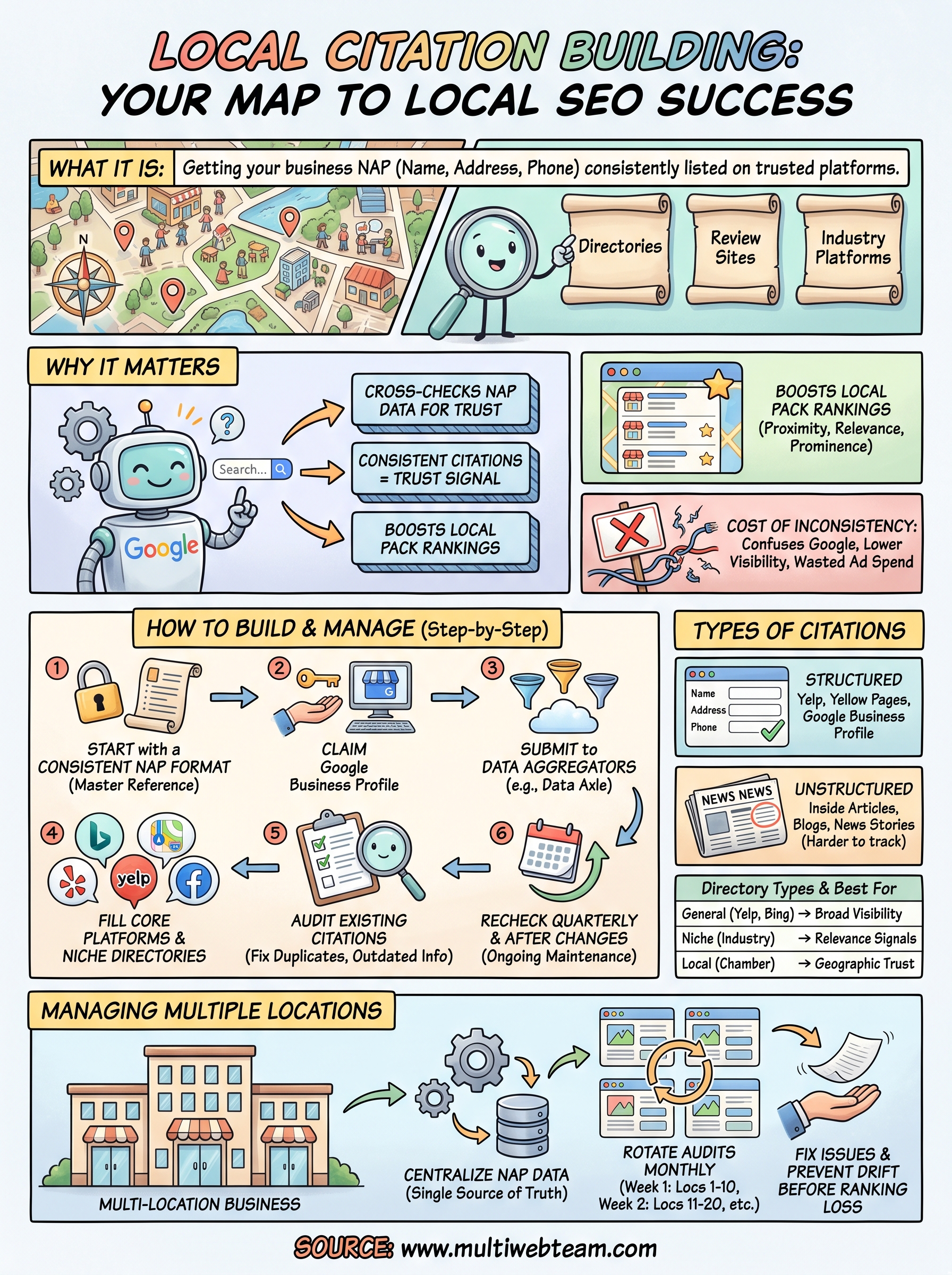
If you run a multi-location business and one of your locations isn't showing up when people search nearby, there's a good chance your citations are the problem. What is local citation building ? It's the process of getting your business name, address, and phone number, known as NAP data, listed consistently across directories, review sites, and industry platforms that Google trusts. Every listing acts like a vote of confidence for your location.
Here's the direct answer: citation building matters because Google cross-checks your NAP data across the web to decide how trustworthy and relevant your business is for local searches. Consistent citations build that trust. Mismatched addresses, old phone numbers, or duplicate listings do the opposite, and they can quietly bury a location's rankings for months.
This article breaks down what actually counts as a citation, how the building process works in practice, and why it becomes more complicated once you're managing five, ten, or fifty locations instead of one. If you're juggling multiple locations , you'll see why citation consistency isn't a one-time task but an ongoing part of any serious local SEO strategy.
Why local citation building matters for your rankings
Google's algorithm doesn't crawl your storefront, so it leans on outside sources to confirm you're real, active, and located where you say you are. That's what local citation building actually accomplishes: it feeds Google's trust model with matching data points from dozens of independent sources. The more places that agree on your name, address, and phone number, the more confident Google gets about ranking you in local results.
Trust signals Google can verify
Search engines weigh citation consistency heavily because it's one of the few trust signals they can independently check. When Yelp, the Better Business Bureau, and your local chamber of commerce all list the same address, that agreement acts as a verification layer no website copy can fake.
Consistent citations are the closest thing Google has to a background check on your business.
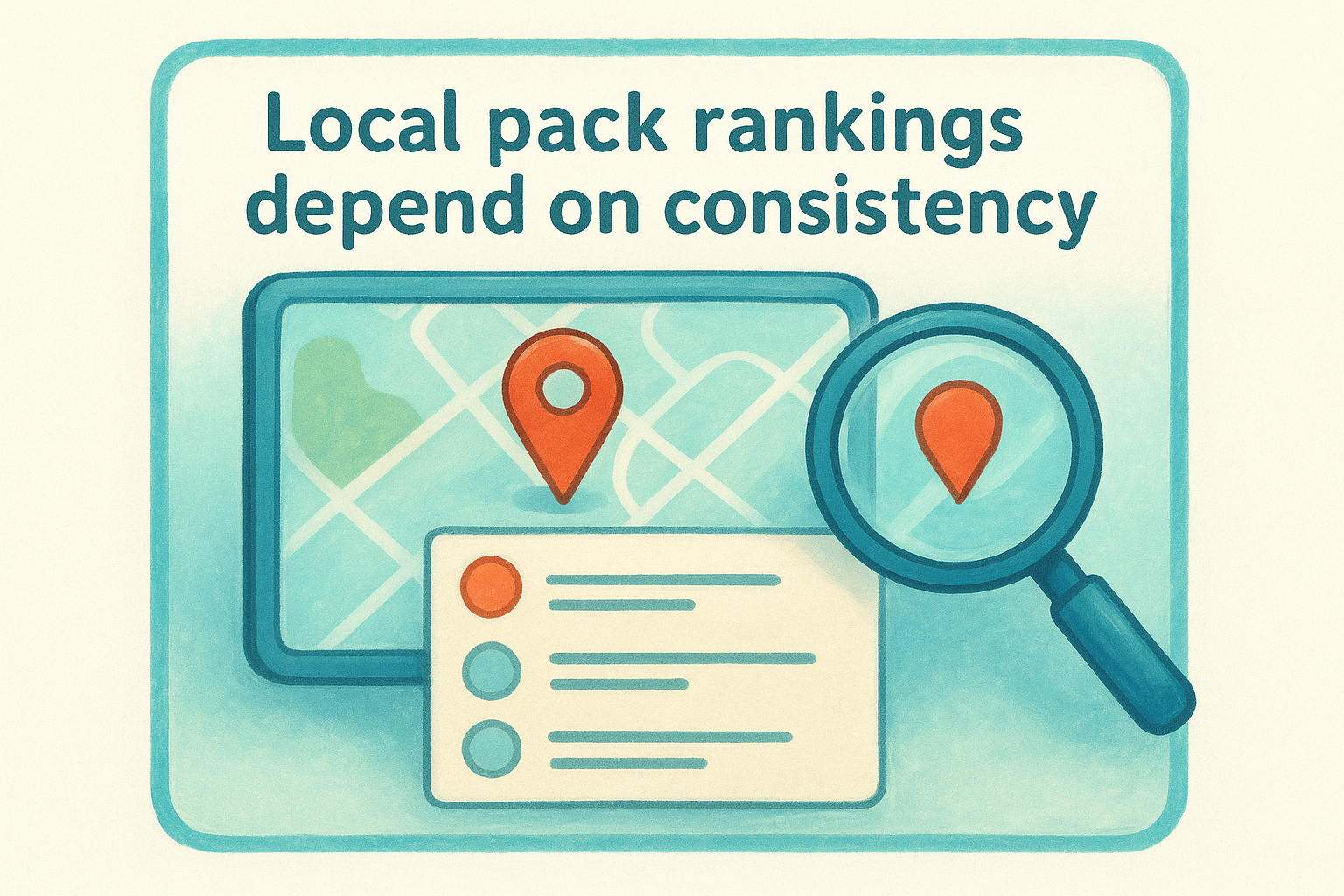
Local pack rankings depend on consistency
Ranking in the local pack, that map box with three business listings above organic results, depends heavily on proximity, relevance, and prominence . Citations feed directly into prominence. A location with 40 accurate, matching citations typically outranks a competitor with five scattered, outdated ones, even if that competitor has a nicer website.
The cost of inconsistent data
Inconsistent NAP data doesn't just confuse customers, it confuses Google's algorithm too. When the system finds conflicting addresses or phone numbers across the web, it can't confidently associate all those listings with one business, which weakens or splits your ranking signals . Common consequences include:
- Lower visibility in the local pack for affected locations
- Wasted ad spend when customers call disconnected numbers
- Duplicate listings competing against your own real one
- Slower recovery after a rebrand, move, or phone number change
Getting this right matters even more once you're running several locations at once, since one bad citation source can multiply errors across dozens of listings in a matter of weeks.
How to build local citations step by step
Building citations isn't complicated, but it does need a system. Skipping steps or rushing the process creates the same inconsistency problems you're trying to avoid. Here's the sequence that actually works for local citation building , whether you're launching a single location or rolling out a franchise network.
Start with a consistent NAP format
Before you list your business anywhere, lock down one exact format for your name, address, and phone number. Decide whether you write "Street" or "St.", include a suite number, or format your phone number with dashes or dots. Save this as your master reference so every listing matches it exactly.
Follow the build process
- Claim and verify your Google Business Profile for each location.
- Submit consistent NAP data to major data aggregators like Data Axle and Neustar Localeze, which feed hundreds of smaller directories.
- Fill out listings on core platforms: Bing Places, Apple Maps, Yelp, and Facebook.
- Add your business to industry-specific and local directories relevant to your niche.
- Audit existing citations for outdated addresses or duplicate entries.
- Correct or remove duplicates before they compete with your real listing.
- Recheck every listing quarterly, especially after any move, rebrand, or number change.
A citation you never audit is a citation you can't fully trust.
Once this foundation is in place, the real work becomes maintenance, not creation, which is exactly where most multi-location businesses start to struggle.
Types of citations you'll come across online
Not every citation looks the same, and knowing the difference helps you prioritize where to spend your time. Local citation building covers everything from full directory profiles to a passing mention of your address in a blog post, and each type carries different weight with Google.
Structured citations
Structured citations live on directory sites with dedicated fields for your name, address, and phone number, think Yelp, Yellow Pages, or your Google Business Profile. These are the easiest to audit because the NAP data sits in its own labeled box, making mismatches obvious at a glance.
Unstructured citations
Unstructured citations show up inside articles, press releases, or social posts where your business info appears in regular text. A local news story mentioning your address counts here. These carry real trust value but are harder to track since there's no standard format to scan.
If you can't find a citation with a simple search, Google probably can't verify it either.
Niche and general directories
| Citation Type | Example Platforms | Best For |
|---|---|---|
| General | Yelp, Bing Places, Facebook | Broad visibility |
| Niche | Industry associations, trade directories | Relevance signals |
| Local | Chamber of commerce, city guides | Geographic trust |
General directories reach the widest audience, while niche and local listings signal relevance to your specific industry and community. Balancing both types builds a citation profile that looks natural, not manufactured, which is exactly what search engines reward.
Common citation mistakes that hurt local rankings
Most citation problems come from neglect, not bad intentions. A business gets busy, forgets to update a listing after a move, and suddenly Google is showing three different addresses for the same local citation building effort. These small oversights compound fast once dozens of directories are involved.
Duplicate listings split your authority
Duplicates happen when a location gets claimed twice, once by an owner and once by an aggregator or automated directory scraper. Search engines can't tell which listing is authoritative, so they often split ranking signals between both instead of boosting either one.
Outdated NAP data after changes
Owners frequently update their Google Business Profile after a move or number change but forget the dozens of smaller directories that fed off the old data months earlier. Those stale listings keep pointing customers to a wrong address long after the real one has changed.
An outdated citation doesn't just confuse customers, it tells Google you stopped paying attention.
Inconsistent formatting across platforms
Small formatting differences, like listing "Suite 200" on one site and "#200" on another, seem harmless but create inconsistent citations that weaken trust signals. Watch for these common culprits:
- Abbreviated street names on some listings, spelled out on others
- Missing suite or unit numbers
- Old area codes left on legacy directories
- Business name variations, like including "LLC" inconsistently
Fixing these details one by one protects the rankings you've already earned.
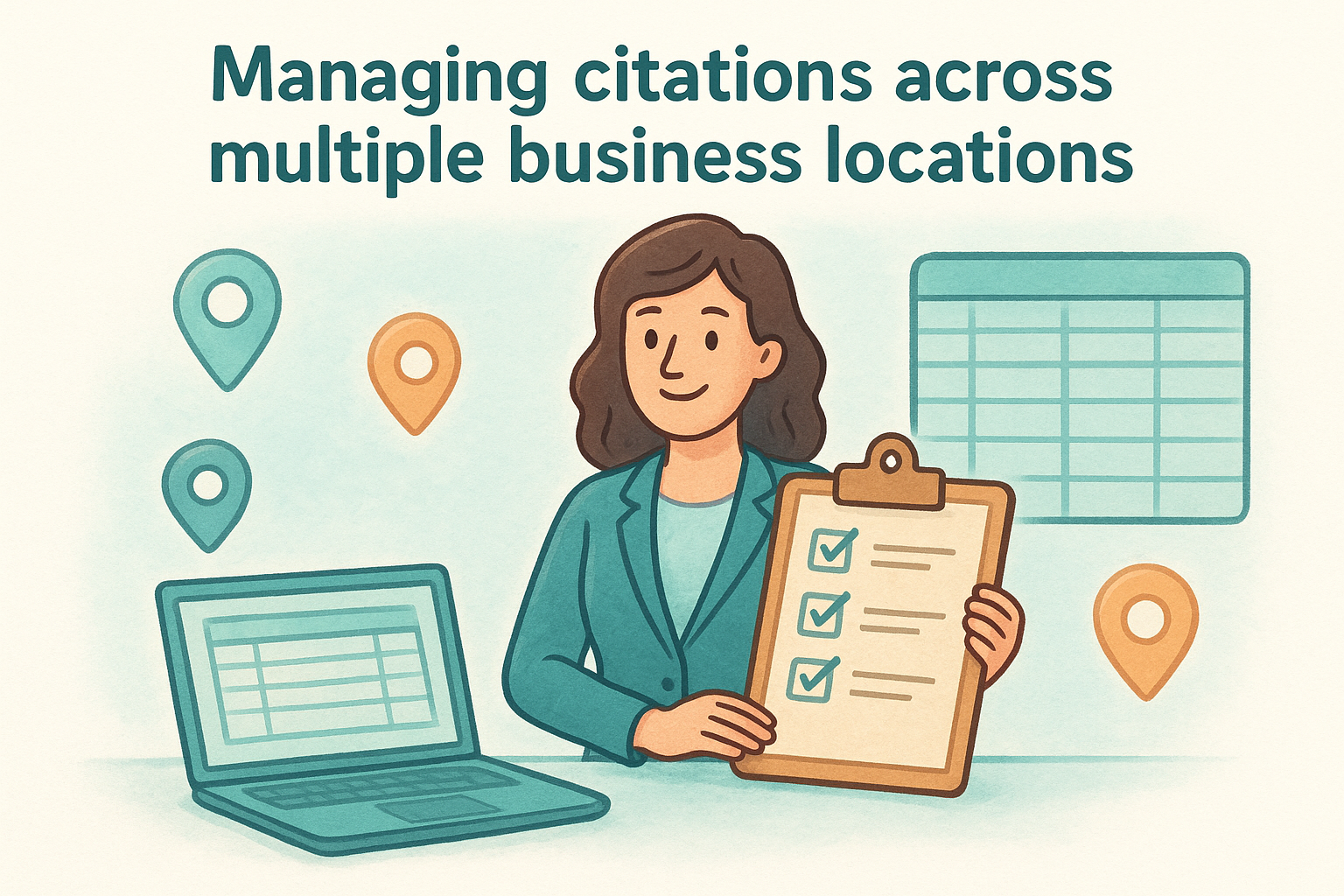
Managing citations across multiple business locations
Running citations for one location is manageable with a spreadsheet and a few hours a month. Running them for twenty locations is a different job entirely. Each address, phone number, and manager name multiplies the chances for a typo, and multi-location businesses often find that one franchisee's mistake creates ranking problems for locations they've never even visited.
Centralize your data before you scale
The fix starts with a single source of truth. Store every location's approved NAP data in one master spreadsheet or platform, then require that every listing, new or updated, pull from that document instead of memory. This stops the drift that happens when five different people manage five different locations without talking to each other.
A franchise with one accurate master list beats a franchise with fifty separate guesses.
Audit on a rotating schedule
Instead of auditing everything at once, which becomes overwhelming past a handful of locations, rotate through your locations monthly. A simple cycle looks like this:
- Week 1: Audit locations 1 through 10
- Week 2: Audit locations 11 through 20
- Week 3: Audit locations 21 through 30
- Week 4: Fix flagged issues and recheck aggregators
This keeps citation management from piling up into a quarterly emergency and catches errors while they're still small enough to fix in minutes, not hours.
Keeping your citations working for you
At its core, local citation building is about giving Google and your customers one consistent story about who you are and where to find you. Get that story straight across enough trusted directories, and your locations start showing up where they belong in local search. Skip the maintenance, and even a well-built citation profile decays within a year as businesses move, rebrand, or change numbers.
Building citations once is easy. Keeping them accurate across ten, twenty, or fifty locations while you're also running a business is the part that trips most owners up. That's exactly the ongoing work a dedicated web team handles well, matching your NAP data everywhere it needs to live and catching drift before it costs you rankings.
If managing this across your locations sounds like more than you want on your plate, see how Multi Web Team keeps every location's SEO and website consistent.