Local Search Marketing: What It Is And How It Works
Search for anything near you, coffee, gym, plumber, and Google already knows what to show you before you finish typing. That's local search marketing at work, and if your business has more than one location, understanding it isn't optional anymore. It's the difference between your Chicago store showing up for "best pizza near me" and losing that customer to the chain three blocks away.
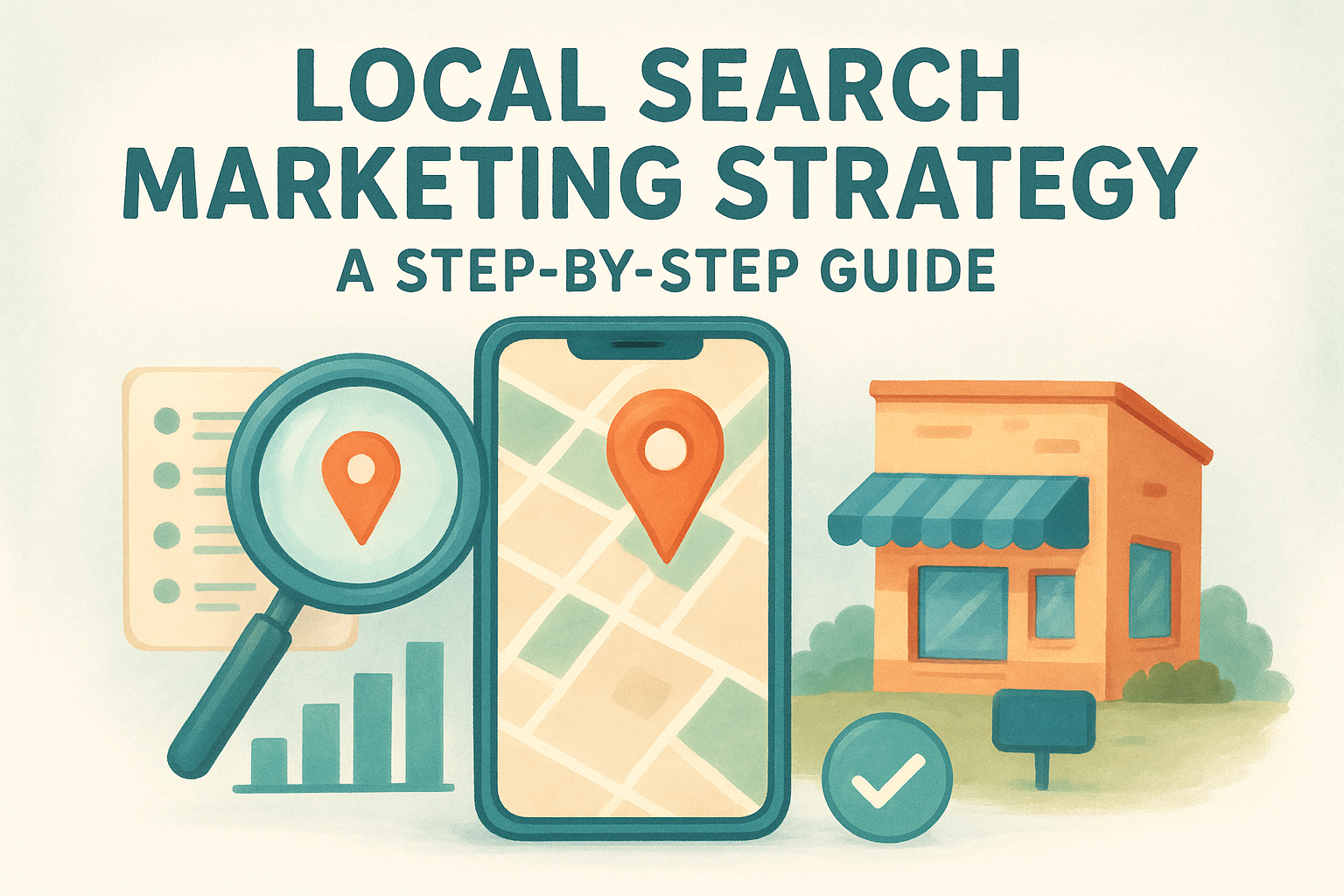
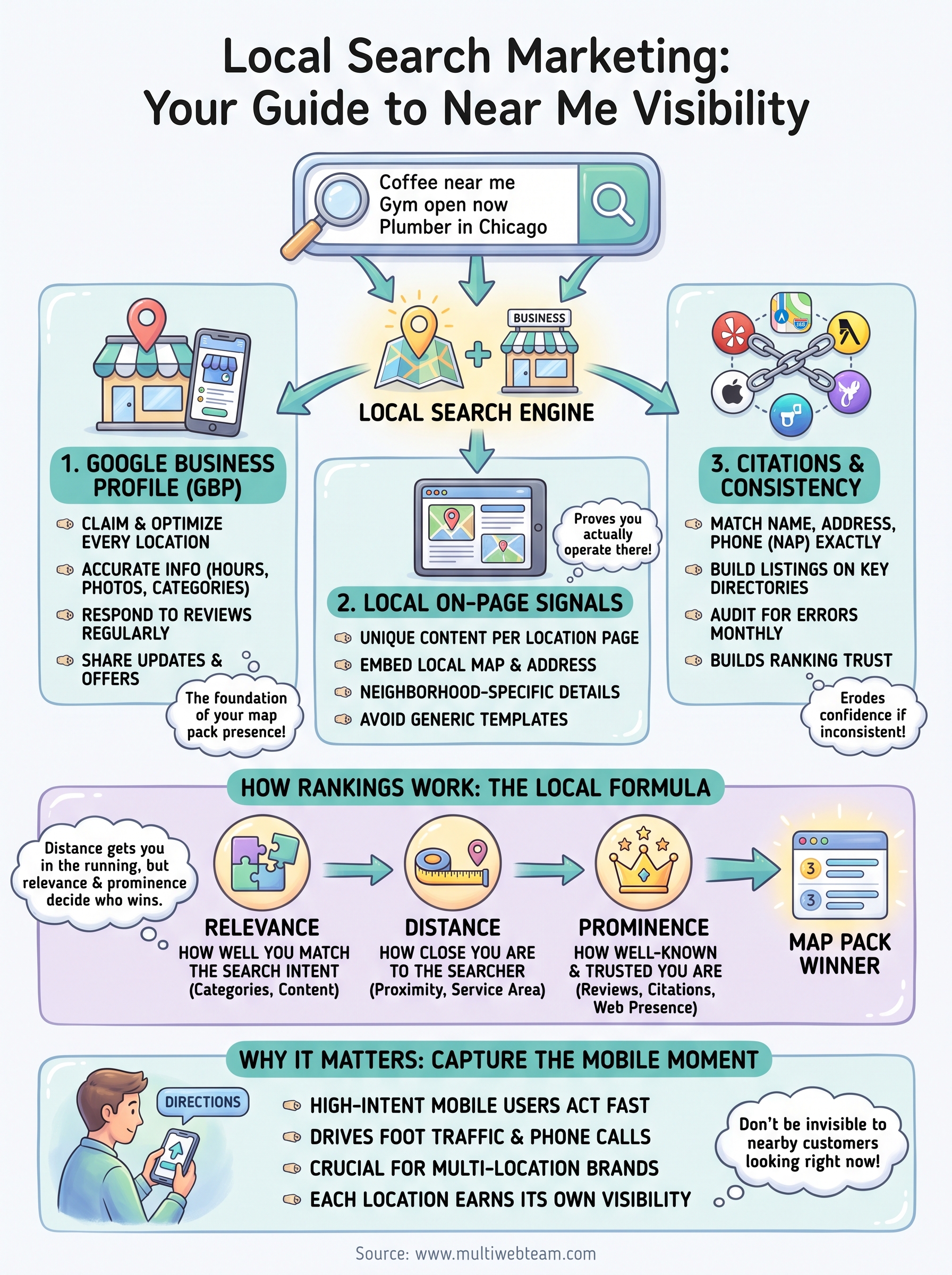
So what is it, exactly? Local search marketing is the practice of optimizing your online presence so each of your physical locations ranks in searches from nearby customers, using tools like Google Business Profiles , location pages, citations, and reviews. Unlike general SEO, it's built around geography: proximity, relevance, and prominence in a specific area decide who shows up first.
In this article, we'll break down the core components of local search marketing, from on-page location signals to review management and citation building, and show how multi-location businesses put these pieces together without duplicating work across every site. If you're running five locations or fifty, you'll see exactly how each one earns its own visibility.
Why local search marketing matters for your business
Google reports that "near me" searches have grown exponentially over the past several years, and mobile users act on those searches fast. Someone searching for a locksmith or a burger joint isn't researching for next month. They're deciding right now, and whichever business shows up in that first screen of results usually wins the visit. If your locations aren't optimized for local search marketing, you're not just missing clicks, you're missing customers who were already looking for exactly what you sell.
The mobile moment of decision
According to Google's own research on consumer behavior, a huge share of local searches on mobile devices lead to a store visit within a day. That's not a slow-building brand awareness play, it's a direct path from search bar to storefront. Businesses that show up with accurate hours, current photos, and a strong review count capture that intent. Businesses that don't, whether because their Google Business Profile is outdated or their location page barely exists, hand that customer straight to a competitor.
A customer searching "near me" isn't comparison shopping for later, they're choosing who gets their business in the next hour.
Multi-location businesses face a harder version of the problem
Franchises and multi-location brands run into a specific trap: corporate branding overshadows local relevance . A national pizza chain might have massive domain authority, but if the Tulsa location's page reads like a generic template with no local phone number, no local reviews, and no neighborhood-specific content, Google has little reason to rank it above a well-optimized independent shop three blocks away. Every location competes in its own local market, against its own set of local competitors, and needs its own signals to prove relevance there.
This is where the operational challenge shows up. A single-location business can hand-manage one Google Business Profile and one website. A business with twenty or a hundred locations can't do that manually without either hiring a full internal team or letting most locations fall behind. Consider what's actually at stake per location:
- Search visibility : whether the location shows up in the map pack for relevant local searches
- Review reputation : star ratings and review volume, which directly influence click-through and trust
- Content accuracy : hours, promotions, menus, or service areas that change location by location
- Citation consistency : matching name, address, and phone number across directories, which affects ranking confidence
The revenue impact is measurable
Businesses that invest in local search marketing typically see the payoff in foot traffic and phone calls, not just impressions. A location that climbs into the top three map pack results for its core service terms tends to see a direct jump in calls and walk-ins, because those top three spots capture the overwhelming majority of clicks on local results. Locations stuck on page two of local results, or missing from Google Business Profile entirely, are essentially invisible to nearby customers, no matter how good the product or service actually is.
For multi-location brands, the compounding effect matters too. Strong local visibility at one location builds brand trust that carries over when a customer searches for a different location in a different city. Weak or inconsistent visibility does the opposite: it makes the whole brand look unreliable, one outdated profile at a time. That's why local search marketing isn't a nice-to-have add-on to your website, it's the mechanism that determines whether each of your locations gets found, chosen, and visited.
How to build a local search marketing strategy that works
Building a real strategy means treating each location as its own small business with its own search presence, not a branch office of a template. Start with a location audit before touching anything: check every Google Business Profile, every location page, and every directory listing for accuracy and consistency. You can't fix what you haven't measured, and most multi-location brands are surprised how many profiles are unclaimed, outdated, or duplicated.
Claim and optimize every profile
Google Business Profile is the foundation, and skipping it costs you the map pack entirely. Claim every location, fill in complete categories, add real photos taken at that specific site, and keep hours current down to holiday schedules. Local citations across directories like Yelp, Apple Maps, and industry-specific listings need to match that profile exactly, since inconsistent name, address, and phone data erodes the ranking confidence Google places in a listing.
If your business information doesn't match across the web, Google trusts it less, and so do customers.
Build location pages that actually differentiate
Each location needs its own page on your main website, not a generic template swapped with a city name. That page should include the local address, embedded map, staff or franchise owner names where relevant, service-area details, and content that speaks to that neighborhood. Location-specific content gives Google real signals to match against local searches, and it gives customers proof that the business actually operates there.
Manage reviews and citations on a schedule
Reviews aren't a set-it-and-forget-it asset. They need active requests, timely responses, and monitoring across every platform where customers leave feedback. A workable cadence looks like this:
- Weekly : respond to new reviews on Google and Facebook, flag anything needing follow-up
- Monthly : audit citations for accuracy across top directories
- Quarterly : refresh photos and update location page content for seasonal promotions
- Ongoing : request reviews after every completed service or purchase
Consistency here beats intensity. A location that gathers five new reviews every month outperforms one that gets fifty in a single push and then goes silent for a year, because Google and customers both read recency as a sign of an active, trustworthy business.
Running this across ten locations by hand eats a full-time job fast. Running it across fifty without a system or a dedicated team isn't realistic, which is exactly why most growing multi-location brands eventually centralize the work instead of trying to replicate it location by location.
How local search rankings actually work
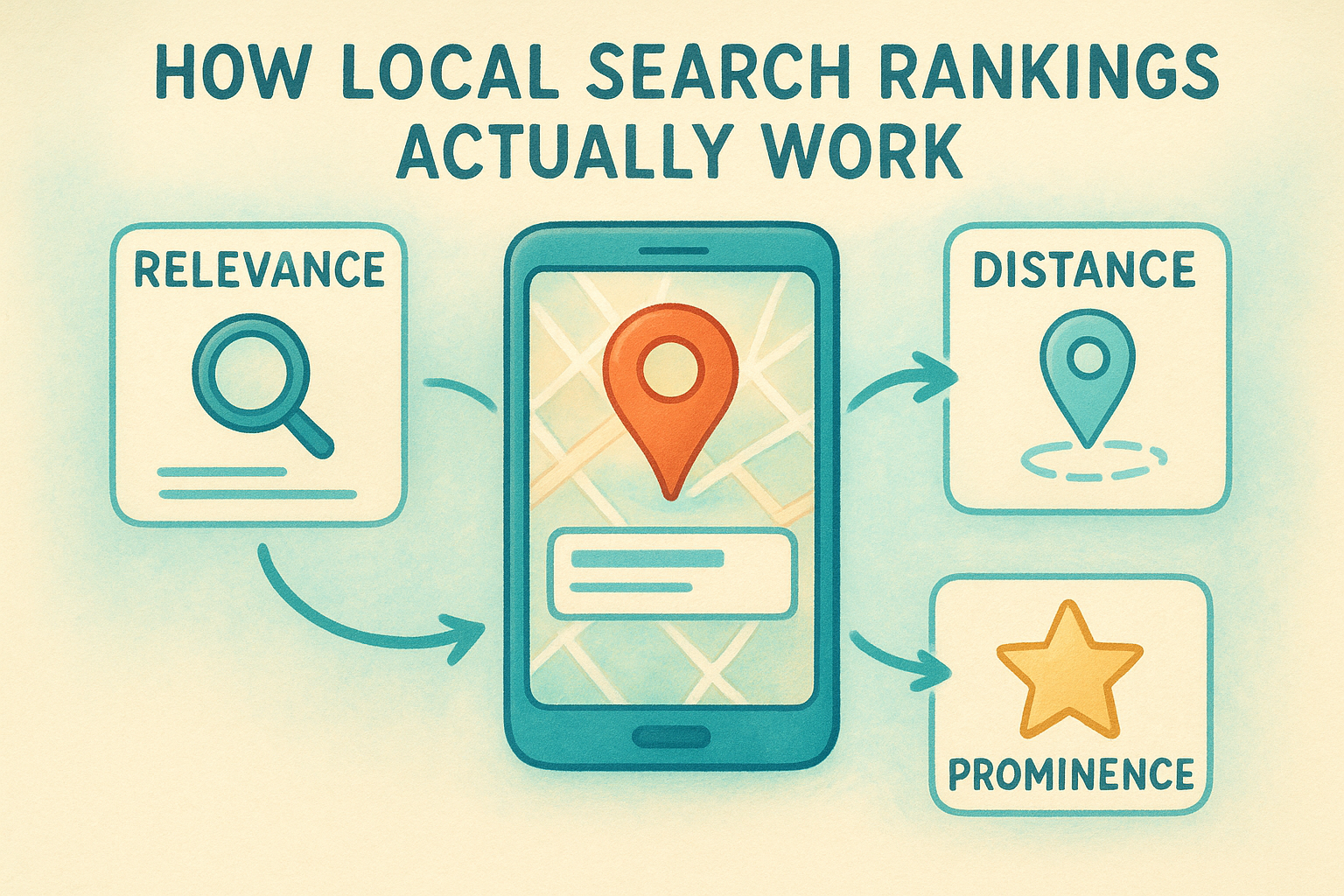
Underneath every local search result sits a formula Google has explained openly: relevance, distance, and prominence . These three factors decide which businesses show up in the map pack and which get buried on page two, and understanding them changes how you prioritize your time and budget across locations.
The three ranking factors Google actually uses
According to Google's own guidance on local search ranking, relevance measures how well a listing matches what someone searched for, distance measures how close the searcher is to each potential match, and prominence measures how well-known and trusted a business is based on information Google has gathered from across the web. No single factor wins alone. A closer location with thin reviews and a half-empty profile can lose to a slightly farther one with strong signals across all three.
| Factor | What it measures | What influences it |
|---|---|---|
| Relevance | How well your listing matches the search | Categories, business description, location page content |
| Distance | How close you are to the searcher | Physical address, service area settings |
| Prominence | How trusted and known your business is | Reviews, citations, backlinks, overall web presence |
Why proximity isn't everything
Distance matters, but it's not destiny. Google adjusts results based on how well a listing satisfies the search intent, so a location three miles away with complete categories and dozens of recent reviews can outrank one half a mile away that's barely maintained. Understanding this is critical for multi-location brands , because it means every location controls its own fate through the parts of the formula it can actually influence.
Distance gets you in the running, but relevance and prominence decide who wins.
Signals that build prominence
Prominence accumulates from sources you might not expect: press mentions, directory citations, backlinks to your domain, and the sheer volume and quality of reviews all feed into it. Search engines also weigh on-page relevance signals , like whether your location page actually names the neighborhood, the services offered there, and the specific problems local customers search to solve. Together, these signals explain why two locations from the same brand, running the same promotions, can rank completely differently just a few miles apart. This is the piece of local search marketing that rewards ongoing attention over a one-time setup, because prominence is never static.
Local search marketing examples across industries
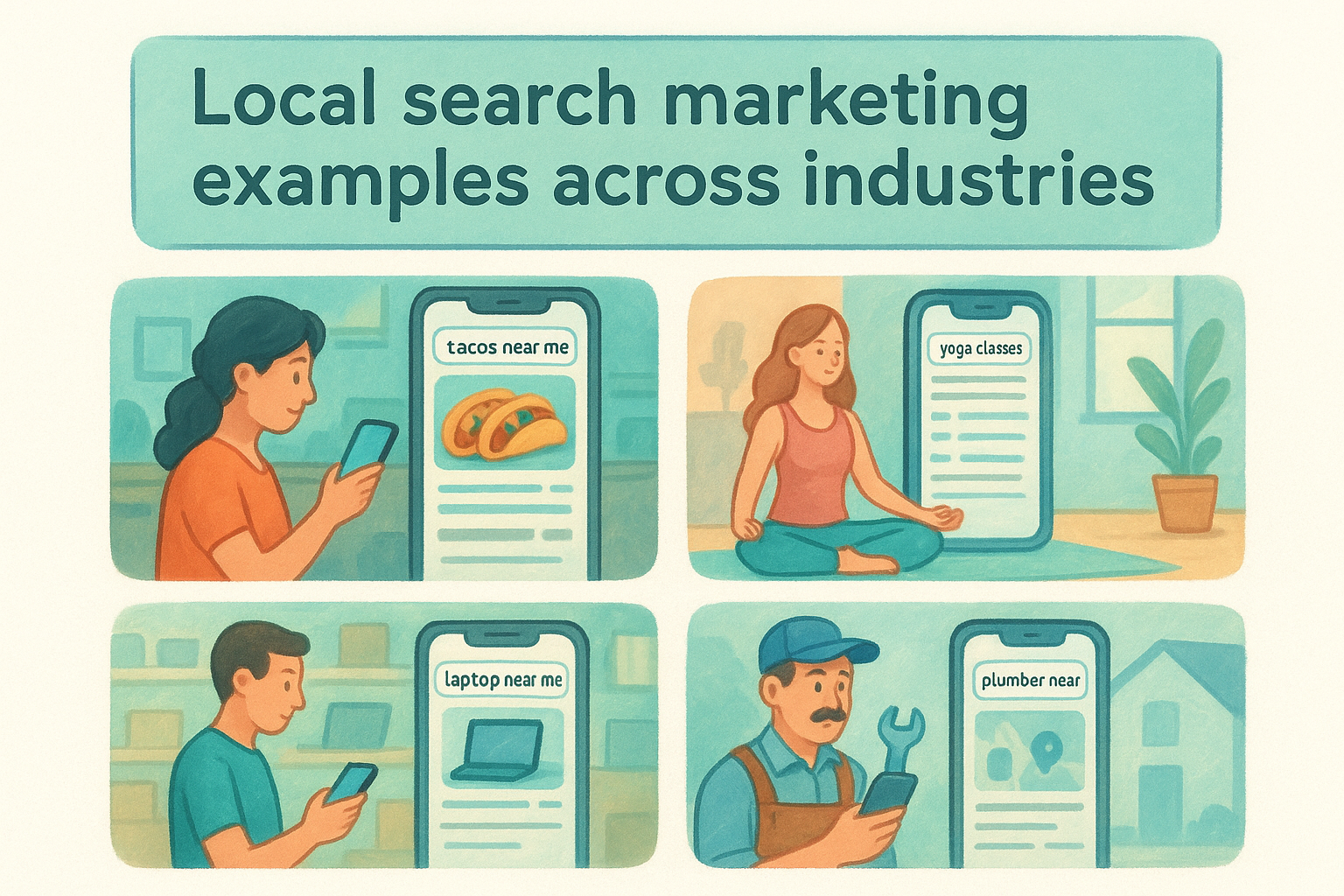
Every industry uses the same underlying formula, but the tactics that move the needle differ by what customers actually search for. Seeing how local search marketing plays out across sectors makes the concept concrete instead of theoretical, and it shows why a one-size-fits-all template rarely works for multi-location brands.
Food service and restaurants
Restaurants live or die by menu accuracy and photos . A diner searching "tacos near me" at 7pm wants to see today's hours, a current menu with prices, and recent photos of the actual food, not stock images from a corporate kit. Chains that let each location post its own specials, update seasonal items, and respond to reviews about specific dishes consistently outrank locations running a static, corporate-only profile.
Fitness and wellness studios
Gyms and studios compete on class schedules and instructor names , details that change weekly and that generic pages can't keep up with. A location page that lists actual trainers, current class times, and location-specific amenities like parking or showers gives Google far more to match against a search like "yoga classes near me" than a page that just repeats the brand's national copy.
Two locations from the same brand can rank miles apart if only one keeps its details current.
Retail and franchise chains
Retail locations depend heavily on inventory and service-area signals , since shoppers often search to confirm a product is in stock before driving over. Franchise owners who add location-specific service details, like installation options or same-day pickup, give their profile a relevance edge that a shared national description can't provide.
| Industry | Top local search priority | Common mistake |
|---|---|---|
| Restaurants | Current menu and photos | Stale hours during holidays |
| Fitness studios | Class schedules and staff | Generic, brand-only copy |
| Retail chains | Inventory and service details | Duplicate pages across cities |
| Home services | Service-area accuracy | Missing service-area settings |
Home and field services
Plumbers, electricians, and other field-service businesses rely on service-area settings more than a physical storefront, since customers care about who can reach them, not who they can visit. Getting the service radius right in Google Business Profile, paired with reviews mentioning specific neighborhoods, often matters more than the address itself for these businesses.
Local search marketing vs traditional SEO
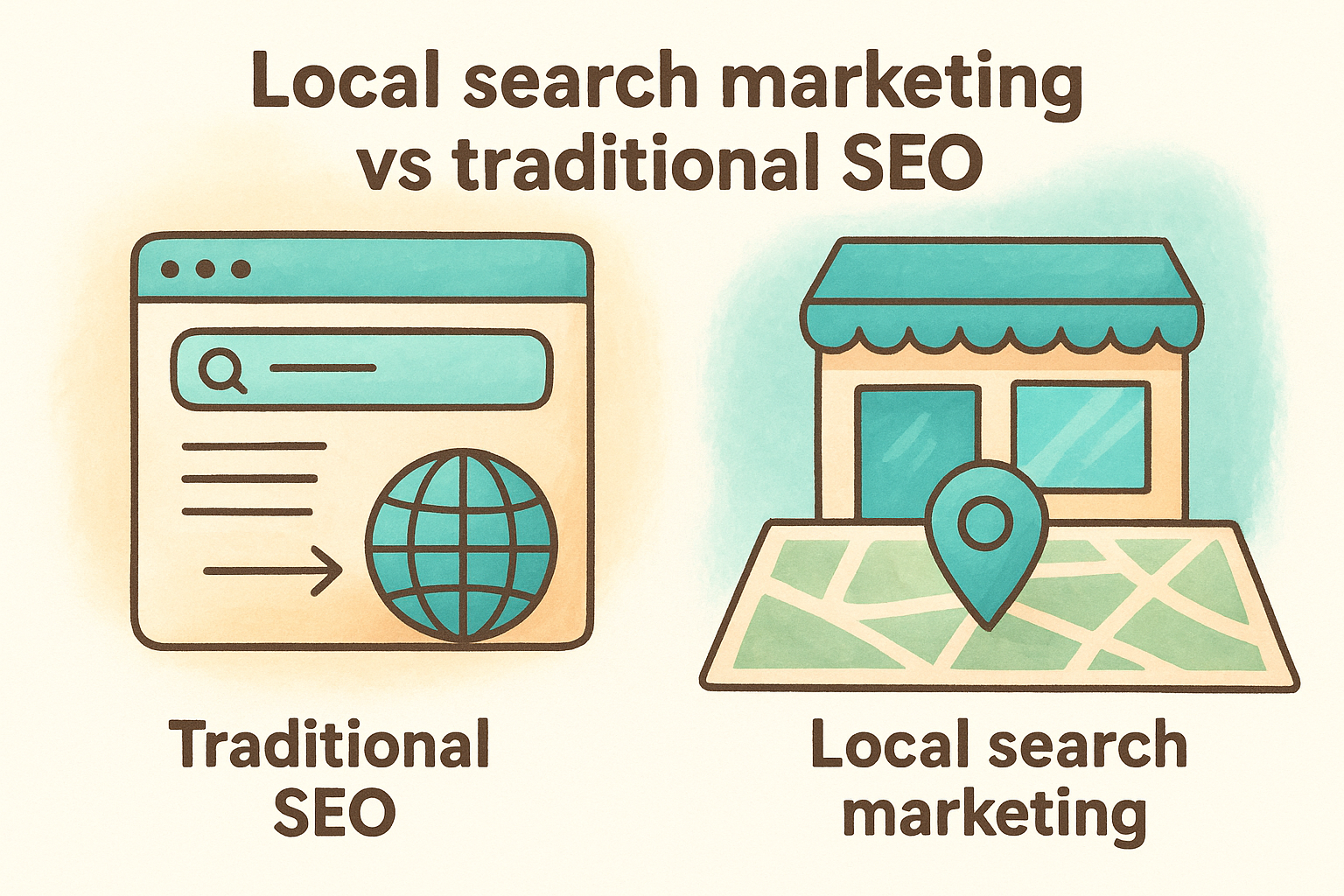
Traditional SEO aims for broad visibility, ranking a single domain for competitive keywords no matter where the searcher sits. Local search marketing flips that goal: it optimizes each physical location so it ranks for searches happening nearby, which means the same brand might need dozens of distinct strategies instead of one. Confusing the two leads multi-location businesses to pour budget into national keyword rankings while their individual locations stay invisible in the map pack that actually drives foot traffic.
Different signals decide the winner
General SEO leans heavily on backlinks, content depth, and domain authority built over years. Local rankings weigh those same trust signals, but add proximity and profile completeness as decisive factors that a national strategy never touches. A location page with a strong Google Business Profile and consistent citations can outrank a page with more backlinks but a thin or unclaimed profile, because the local algorithm is answering a different question: who's close and credible enough to satisfy this specific search right now.
| Factor | Traditional SEO | Local search marketing |
|---|---|---|
| Primary goal | Rank a domain nationally | Rank each location locally |
| Key signals | Backlinks, content depth, authority | Proximity, citations, reviews |
| Unit of optimization | The whole website | Each individual location |
| Success metric | Organic traffic, keyword rank | Map pack rank, calls, visits |
Ranking your website nationally doesn't mean a single location shows up when someone nearby searches for you.
Why mixing the two wastes effort
Brands that apply only traditional SEO tactics to a multi-location site often duplicate content across cities, assuming Google will sort out relevance automatically. It won't. Google's local algorithm actively penalizes thin, templated pages that offer no distinct signal for a given address, which is exactly the outcome a copy-paste approach produces. Optimization for multi-location businesses has to run on both tracks at once: enough domain-level SEO to build overall trust, plus location-by-location work that gives each address its own case for ranking in its own neighborhood. Skipping the local half means the domain-level effort never reaches the customer standing three blocks away with their phone out.
Common local search marketing mistakes to avoid
Most multi-location brands don't fail at local search marketing because they lack budget, they fail because a handful of avoidable mistakes quietly undo everything else. Recognizing these patterns early saves months of wasted effort and lost foot traffic.
Letting duplicate content spread across locations
Nothing tanks local rankings faster than templated location pages that swap out a city name and call it done. Google reads these as thin content with no real signal for that specific address, which means the page has almost nothing to compete with against a locally-focused independent business. Every location page needs its own address details, its own photos, and language that actually reflects the neighborhood it serves.
Ignoring citation consistency
Inconsistent name, address, and phone data across directories is one of the most common and most damaging mistakes multi-location businesses make. One directory lists a suite number, another drops it, a third has an old phone line still active. Each mismatch chips away at the trust Google places in that listing.
A single wrong phone number repeated across directories can quietly cost you rankings at every location that shares it.
Neglecting reviews until they pile up
Reviews left unanswered for months signal an inactive, uninterested business, exactly the opposite of what drives clicks and conversions. A short checklist keeps this from slipping:
- Respond to every review within 48 hours, positive or negative
- Never copy-paste the same reply across multiple reviews
- Flag negative reviews internally for a real follow-up, not just a canned apology
- Track review volume monthly per location, not just brand-wide
Treating Google Business Profile as a one-time setup
Too many businesses claim their profile, fill it out once, and never touch it again. Stale hours, outdated photos , and missing seasonal updates all erode prominence over time, even if nothing else about the business changed. Profiles need the same ongoing attention as the website itself.
Centralizing everything without local nuance
The opposite mistake also happens: brands centralize so aggressively that every location loses its distinct voice. Efficiency matters, but a system that strips out local relevance to save time ends up costing more in lost visibility than it saves in labor. The goal is centralized management that still produces location-specific results, not a single template stretched across every city.
Putting local visibility to work for your locations
Local search marketing comes down to one idea: each of your locations has to earn its own visibility, not borrow it from the brand name above the door. That means claimed and current Google Business Profiles , location pages with real local detail, consistent citations, and reviews that get answered instead of ignored. Skip any of these and you're handing customers to the competitor down the block who didn't.
Doing this well across five locations is manageable. Doing it across fifty, with fresh content and steady review responses at every single one, is a full-time operation most businesses don't have the bandwidth to run internally, and shouldn't have to build from scratch.
That's the gap Multi Web Team fills. If you'd rather hand off the ongoing work than manage it location by location, see how Multi Web Team can manage it for you.