Website Redesign Cost Breakdown: What You'll Actually Pay
Ask three agencies for a quote on a redesign and you'll get three wildly different numbers, sometimes off by tens of thousands of dollars. That gap isn't random. A real website redesign cost breakdown depends on how many pages you're rebuilding, whether you need custom design or a template, and how many locations your business operates. If you're budgeting blind, it's easy to either overpay for features you don't need or underfund a project that stalls halfway through.
This article gives you actual dollar ranges, not vague "it depends" answers. You'll see what a single-location small business site typically runs versus what a multi-location or franchise redesign costs once you factor in location pages, local SEO, and ongoing updates across every site. We break down pricing by project scope so you can match a number to your specific situation.
We'll walk through the line items that make up a quote: design, development, content migration, SEO setup, and maintenance, plus the hidden costs that catch owners off guard, like per-change fees and slow revision turnarounds. By the end, you'll know what questions to ask any agency and where a subscription-based model can save you money over a traditional one-time redesign.
Why the cost breakdown matters more than the total price
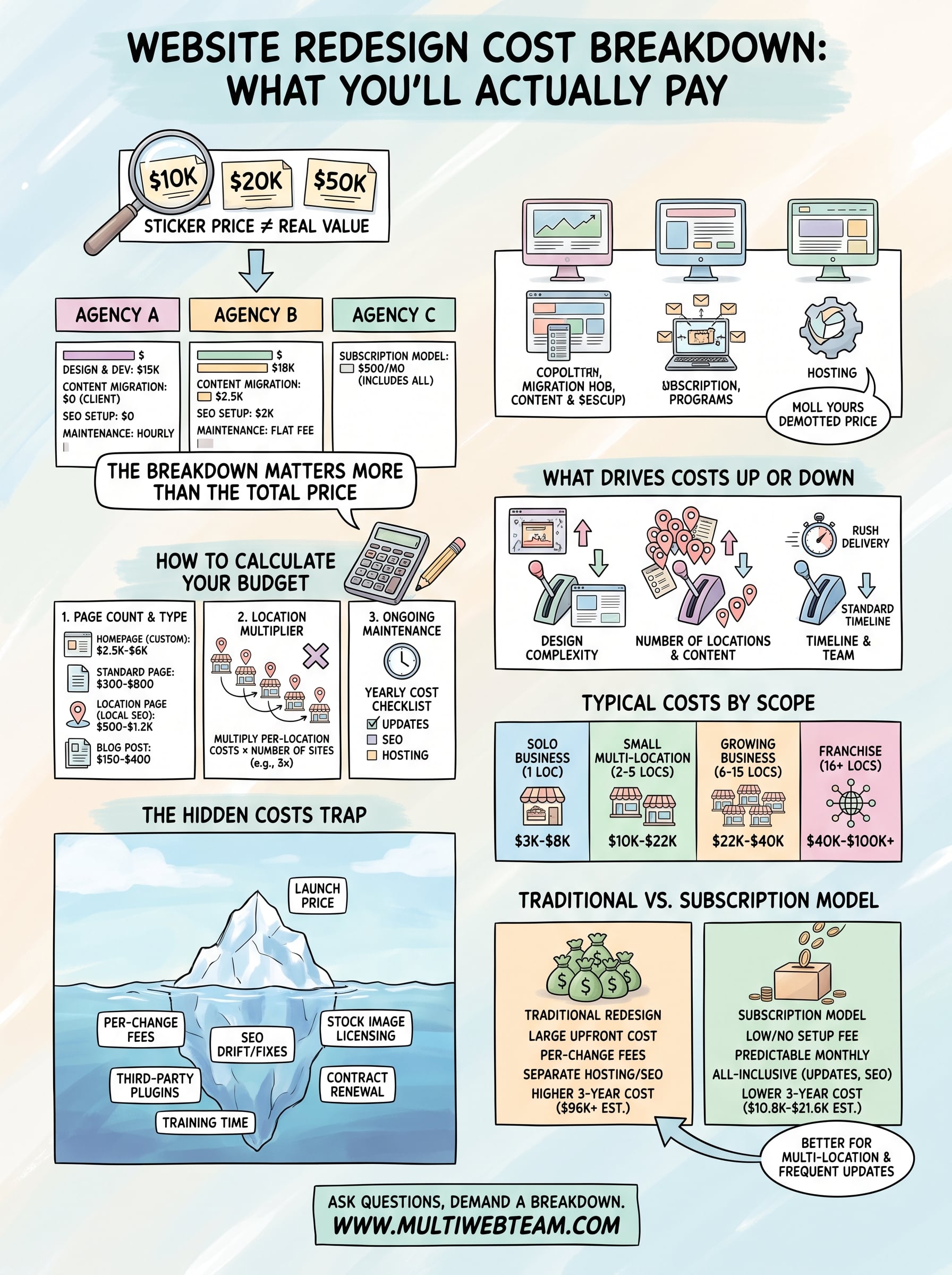
Most business owners shop for a redesign the way they'd shop for a used car: they ask for the sticker price and compare numbers. That approach fails you here. Two agencies can quote you $15,000 for the exact same project and mean completely different things by it. One number covers design and development only , with content migration, SEO, and hosting billed separately once the project starts. The other bundles everything into a single flat fee with no surprises down the line. Without a line-item breakdown, you can't tell which quote is actually cheaper.
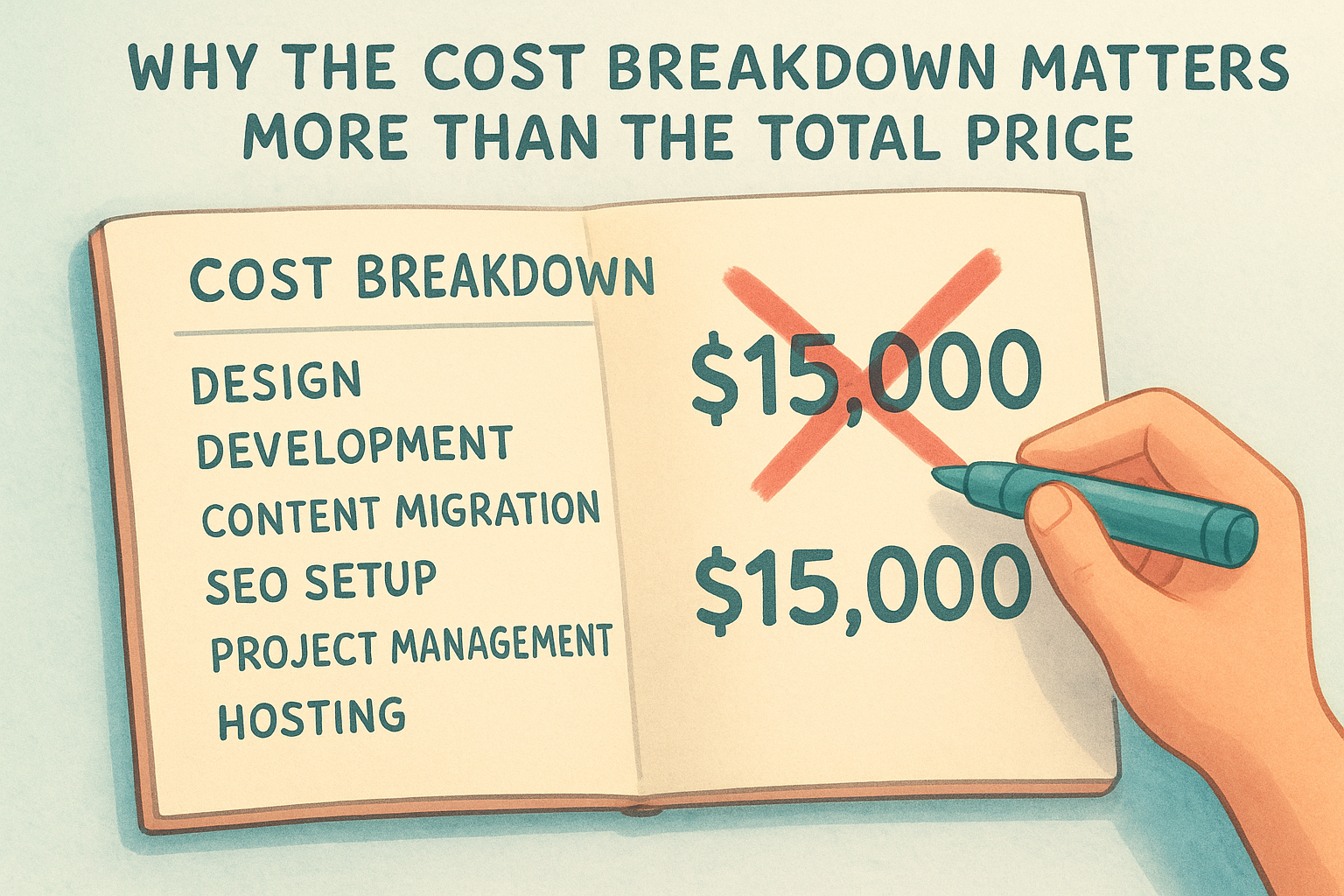
Consider two real-world quotes for a five-location restaurant chain redesign, both landing at roughly $18,000:
| Line item | Agency A | Agency B |
|---|---|---|
| Design (homepage + templates) | $6,000 | $9,000 |
| Development (5 location pages) | $5,000 | $4,000 |
| Content migration | $0 (client does it) | $2,500 |
| Local SEO setup | $0 (not included) | $2,000 |
| Project management | $2,000 | $0 |
| First-year hosting | $5,000 | $500 |
Same total, wildly different value. Agency A leaves you doing your own content migration and SEO setup, work that easily costs another $4,000 to $5,000 if you hire it out later. Agency B builds that into the price and charges a fraction as much for hosting. If you only compared the bottom line, you'd have picked the worse deal.
The total price tells you what you'll pay. The breakdown tells you what you'll actually get.
Line items expose what's missing, not just what's included
Breaking a quote into its components does more than help you compare vendors. It shows you gaps before they become problems. If a proposal lists design and development but says nothing about SEO migration , that's a red flag, not an oversight you can ignore. Redirect a URL wrong during a redesign and you can lose rankings you've spent years building. Google's own guidance on site moves and structural changes stresses that redirects and canonical signals need careful handling during any redesign, which is exactly the kind of task that gets skipped when a quote only covers
How to calculate your website redesign budget
Budgeting for a redesign starts with math, not guesswork. Count your pages, classify them by complexity, and multiply by a realistic per-page rate before you ever talk to a vendor. This gives you a baseline number to compare against any quote you receive, so you walk into negotiations knowing whether $12,000 is a fair price or a markup.
Start with your page count and content type
Not every page costs the same to redesign. A homepage with custom animations and a hero video takes far longer than a standard service page pulled from a template. Break your site into categories before you estimate anything.
| Page type | Typical cost per page |
|---|---|
| Homepage (custom design) | $2,500 to $6,000 |
| Standard interior page | $300 to $800 |
| Location page (with local SEO) | $500 to $1,200 |
| Blog or resource page | $150 to $400 |
Sum these up based on your actual site map and you'll land close to a realistic design and development figure, before content, SEO, or maintenance enter the picture.
Add the location multiplier
Franchise and multi-location owners need one extra step: multiply your per-location costs by the number of sites you're running. A five-location business doesn't just need one location page redesigned, it needs five, each with unique local SEO signals like localized schema markup, city-specific keywords, and separate Google Business Profile alignment. Skip this multiplier and your budget will fall apart the moment you scope past location one.
Multiply everything by your location count before you accept any single quote.
Build in a maintenance line, not just a launch cost
Redesigns don't end at launch. Factor in ongoing updates , whether that's a monthly retainer, an hourly maintenance rate, or a subscription fee, because a site that never gets touched again starts losing rankings within months. Use this quick checklist to sanity-check your total number before you sign anything:
- Did you count every page type separately, not just "the whole site"?
- Did you multiply location-specific pages by your actual location count?
- Did you add a line for content migration, not assume it's free?
- Did you budget for at least 12 months of updates and SEO maintenance, not just the launch?
- Did you compare the total against your current site's traffic and revenue, not just the sticker price?
Run your numbers through this checklist and you'll catch the gaps that turn a $10,000 quote into an $18,000 project six months in.
What drives website redesign costs up or down
Several variables swing a redesign quote by thousands of dollars before you even see a proposal. Design complexity , the number of locations you operate, and how fast you need the project finished all push the number in different directions. Understanding these levers lets you negotiate scope instead of just accepting whatever number lands in your inbox.
Custom design versus template builds
A fully custom design, built from scratch with original graphics and unique layouts, costs two to four times more than a redesign using a proven template framework. Templates aren't a downgrade for most multi-location businesses. A well-built template with location-specific customization often outperforms a custom build that never gets updated because the client can't afford ongoing tweaks. Save custom design dollars for your homepage and spend the rest on consistent, easy-to-update location pages.
Number of locations and content complexity
Every additional location adds a page, a set of local SEO signals, and content that needs someone to keep it current. A ten-location franchise redesign costs substantially more than a two-location shop, not because the design changes, but because the content volume multiplies. Menus, service lists, staff bios, and location-specific promotions all need to be built and then maintained after launch.
Team experience and turnaround speed
Rushing a redesign costs more per hour than giving a team a normal timeline, because rush fees and overtime get baked into the quote. Experienced agencies that specialize in multi-location sites also tend to charge more per hour than generalist freelancers, but they finish faster and make fewer costly mistakes with redirects and SEO migration.
| Cost driver | Pushes price up | Pushes price down |
|---|---|---|
| Design approach | Fully custom design | Template-based framework |
| Location count | More locations, more unique pages | Fewer locations, shared templates |
| Timeline | Rush delivery, tight deadlines | Standard 8 to 12 week timeline |
| Content readiness | Client needs copywriting and photography | Client provides finished content |
| SEO scope | Full local SEO buildout per location | Basic on-page SEO only |
| Team type | Specialized multi-location agency | Generalist freelancer or DIY builder |
The number of locations and the level of design customization matter more to your final price than almost anything else in the quote.
Running your project through this list before you request quotes gives you leverage. If a vendor's price seems high, ask which of these drivers is pushing it there and whether you can adjust scope to bring it back in line with your budget.
Typical costs by business size and project scope
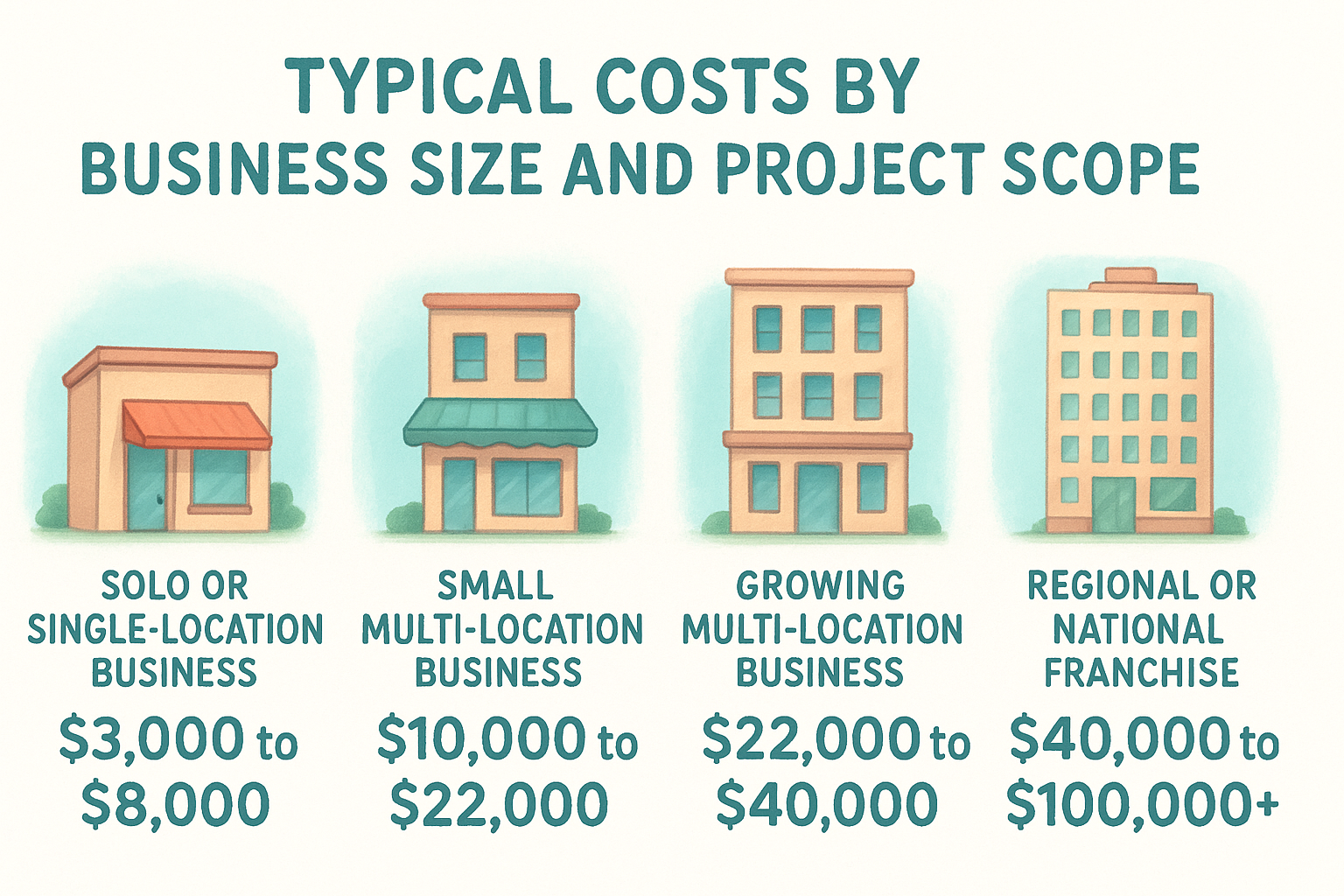
Numbers matter more than categories here, so let's put real dollar ranges next to real business types. A single-location small business redesign, think a local bakery or a solo law practice, typically runs $3,000 to $8,000 for a template-based site with basic on-page SEO. A multi-location business with two to ten locations lands between $10,000 and $35,000, depending on how many location pages need custom local SEO work. Franchise operations with dozens of locations can push past $50,000 once you add centralized brand control, franchisee-level content permissions, and location-specific schema markup across every site.
Matching scope to spend
Scope drives these ranges more than brand size does. A single-location shop that wants a fully custom homepage with video and animation can spend as much as a five-location franchise using a template. Use this table as a starting reference point, then adjust based on the design complexity decisions covered earlier.
| Business type | Location count | Typical redesign cost range |
|---|---|---|
| Solo or single-location business | 1 | $3,000 to $8,000 |
| Small multi-location business | 2 to 5 | $10,000 to $22,000 |
| Growing multi-location business | 6 to 15 | $22,000 to $40,000 |
| Regional or national franchise | 16+ | $40,000 to $100,000+ |
Location count moves your redesign budget more predictably than almost any other single factor.
Why franchise pricing jumps so fast
Once a franchise crosses into double-digit locations, pricing stops scaling in a straight line. Every added location needs its own Google Business Profile alignment , its own set of local keywords, and its own content updates when hours, menus, or promotions change. Agencies quoting flat per-location rates for large franchises often underprice the ongoing maintenance burden, then come back six months later asking for a bigger monthly retainer. Ask any agency quoting a franchise-level project to show you how their price per location changes at 10, 25, and 50 locations, not just the number for your current count.
Smaller multi-location businesses face a different trap: agencies price the design and development fairly, then quietly underscope the SEO buildout per location because it's harder to see the cost of that work upfront. A five-location business paying $18,000 for design and development but nothing for local SEO will spend that savings back within a year in lost search visibility. When you compare quotes across business sizes, always check whether local SEO is priced per location or bundled as an afterthought, because that single line item explains more of the range in the table above than design complexity ever will.
Hidden costs that quietly inflate redesign budgets
Every redesign quote has costs that never make it onto the first page of the proposal. These aren't scams, they're line items that vendors assume you already know about, or that only surface once the project is underway. Per-change fees top the list: many traditional agencies charge $75 to $200 every time you ask them to swap a photo, update a phone number, or add a seasonal promotion. If you update content monthly across five locations, that adds up to thousands of dollars a year that never appeared in the original quote.
A quote without a maintenance clause almost always costs more than one that includes it.
The maintenance gap
Few redesign proposals spell out what happens after launch. Ask directly whether the price includes post-launch support , and for how long. A common pattern: the agency includes 30 days of free fixes, then switches you to an hourly rate of $100 to $175 for anything after that. Multi-location businesses that need frequent updates, new menu items, changing hours, rotating promotions, get hit hardest here, because those updates never stop.
SEO drift and redirect mistakes
A redesign that ignores technical SEO can quietly cost you more than the redesign itself. Broken redirects, missing canonical tags, and orphaned location pages tank your rankings within weeks, and recovering that traffic often means paying for an SEO audit and cleanup project on top of the redesign you already paid for. Google's guidance on site moves makes clear that redirect mapping and structured data need deliberate handling during any redesign, not an afterthought bolted on after launch.
Other line items that catch owners off guard
Before you sign anything, ask your vendor to confirm, in writing, how each of these is handled:
- Stock photography and licensing : many quotes exclude image licensing, adding $200 to $1,000 depending on how many custom images you need.
- Third-party plugin or tool fees : booking systems, review widgets, and chat tools often carry their own monthly costs separate from the redesign fee.
- Content migration : moving existing blog posts, reviews, and location content to a new platform is sometimes billed as a separate project.
- Training time : if you need to learn a new content management system, some agencies bill that onboarding time hourly.
- Contract renewal fees : some vendors charge a re-signing or renewal fee every 12 months, separate from any ongoing maintenance retainer.
Run through this list with any vendor before you sign. A proposal that answers every item clearly, with no vague language or "we'll discuss that later," is a proposal you can trust. One that dodges these questions is telling you the real cost will show up after you've already committed.
How subscription pricing compares to traditional redesign quotes
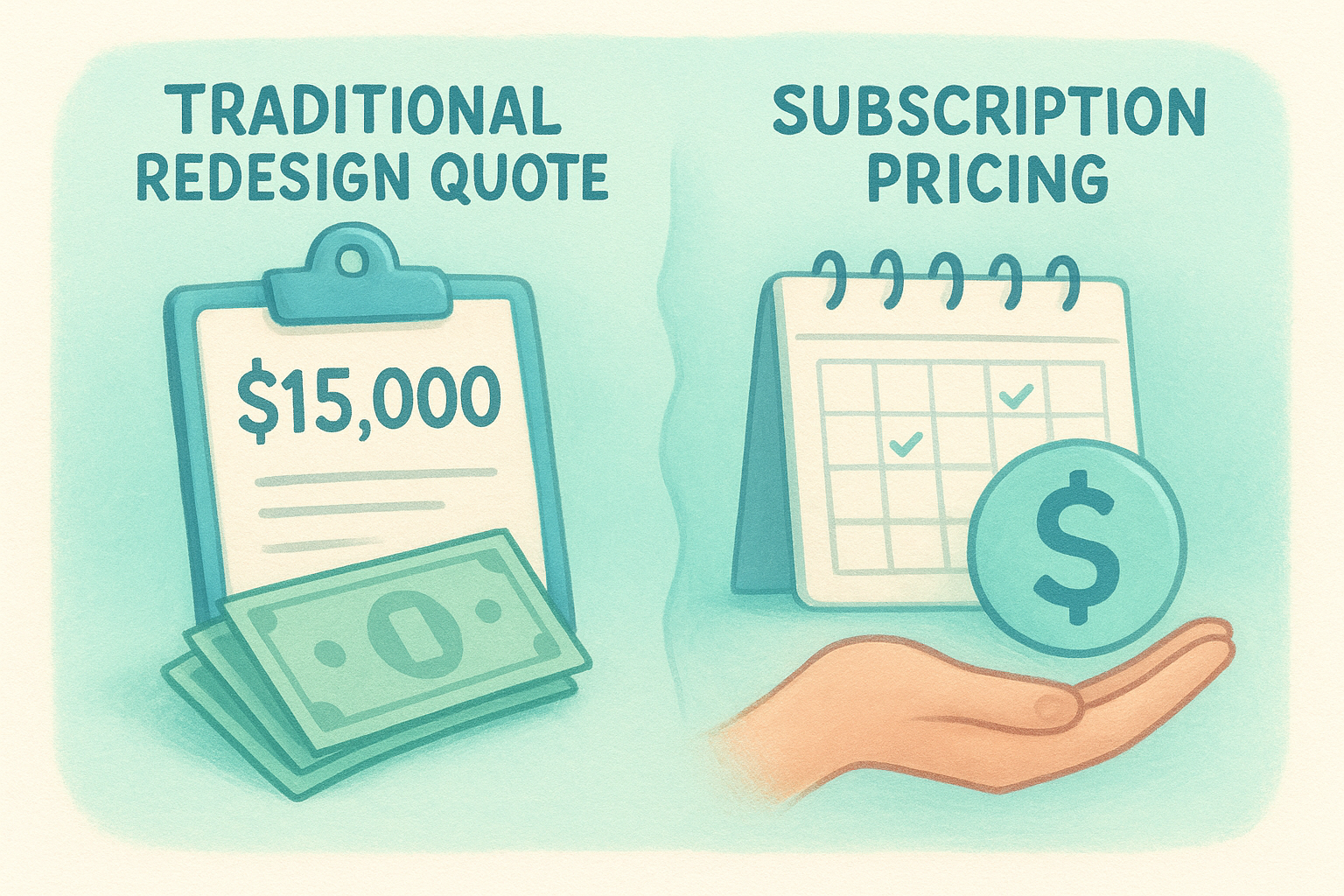
Traditional redesign quotes front-load the cost. You pay $15,000 to $40,000 upfront, then get billed again for every change after launch. A subscription-based model flips that structure: you pay a monthly fee that covers design, updates, and SEO management for as long as you're a customer, with no separate invoice every time you swap a photo or add a location. For multi-location businesses that update content constantly, that structural difference changes the real cost far more than the sticker price on either option suggests.
Running the numbers over three years
Money talks louder than marketing copy here, so compare the totals directly. A traditional agency quote for a five-location redesign might run $18,000 upfront, plus $150 per change and $500 a month for hosting and basic maintenance. A subscription model built for multi-location businesses often runs $300 to $600 a month, all-inclusive, with unlimited updates built into the fee.
| Cost category | Traditional quote (3 years) | Subscription model (3 years) |
|---|---|---|
| Upfront design and development | $18,000 | $0 to $2,000 setup |
| Monthly hosting and maintenance | $18,000 ($500 x 36) | Included |
| Content updates (avg. 10/month across locations) | $54,000 ($150 x 10 x 36) | Included |
| Local SEO management | $6,000 (one-time setup only) | Included, ongoing |
| Estimated 3-year total | $96,000 | $10,800 to $21,600 |
Those numbers assume a business that actually updates its site regularly, which most multi-location owners do. Menus change, promotions rotate, new locations open. If you barely touch your site after launch, a traditional one-time quote can work out cheaper. But that's rarely the reality for a growing business.
Subscription pricing rewards businesses that update often; traditional pricing punishes them for it.
Where subscriptions save the most money
The savings compound fastest in two areas: per-change fees and SEO maintenance . Traditional agencies bill each update separately because that's how they've always priced web work, but a business with five locations posting weekly specials generates dozens of billable requests a month. Subscription pricing removes that meter entirely, so you can update as often as your business actually needs without watching a bill climb.
Where traditional quotes still make sense
Subscriptions aren't automatically the right fit for every business. A single-location site that gets built once and rarely touched again might genuinely cost less as a one-time project, since you're not paying an ongoing fee for updates you never request. The math favors subscriptions specifically when update frequency and location count both climb, which describes most multi-location and franchise businesses but not every solo operator.
Questions to ask before you sign a redesign contract
Every contract you've read so far in this article shows the same pattern: the surprises live in what's left unsaid. Before you sign anything, get answers to specific questions in writing, not verbal reassurances from a sales call. Vague answers today become expensive change orders tomorrow , and the only way to avoid that is to force clarity before you commit a dollar.
Questions about scope and deliverables
Start by pinning down exactly what's included in the number on the page. Ask the vendor to confirm, item by item, whether the quote covers design, development, content migration, and SEO setup, or just some of them.
- How many rounds of revisions are included before extra fees kick in?
- Who writes and uploads the content, you or the agency?
- Does the quote include location pages for every site, or just a template you'll duplicate yourself?
- What happens if the project takes longer than the estimated timeline?
If a vendor can't answer a scope question in one sentence, that's the part of the project that will cost you extra.
Questions about ongoing costs
Next, shift the conversation to what happens after launch, since that's where traditional quotes hide their real cost. Ask directly how much a typical content update costs after the free revision period ends, and get a number, not a range. Find out whether hosting, SSL, and security updates are included in the quote or billed separately every year. Push for a written answer on how the vendor handles a sudden need, like a menu change across five locations before a holiday weekend, and what that costs if it falls outside your plan.
Questions about SEO and technical handling
Technical questions matter just as much as pricing ones, because a mishandled redesign can cost you rankings that took years to build. Query the vendor's plan for redirects, canonical tags, and structured data during the migration, and ask them to walk you through a past project where they handled this correctly. Reference Google's own guidance on site moves if they seem unfamiliar with the terminology, since any agency doing this work regularly should already know it cold.
A short checklist before you sign
Use this list as your final gate before signing anything:
- Is every deliverable listed by name, not summarized as "full website redesign"?
- Are per-change fees, if any, listed with an exact dollar amount?
- Is there a written SEO and redirect plan for the migration?
- Does the contract specify how many locations are covered, by name or count?
- Is there a clear exit clause if the relationship doesn't work out?
A vendor willing to put clear answers to all five in writing is a vendor worth trusting with your budget.
Putting your budget into perspective
A website redesign cost breakdown only matters if it changes what you actually sign. You now know how to count pages, multiply by location, and spot the line items that turn a $10,000 quote into an $18,000 project. You also know why a subscription model beats a traditional quote for most multi-location businesses that update content often, since per-change fees and stalled SEO maintenance quietly cost more than the redesign itself over three years.
Don't let a sales call talk you out of the math you just ran. Compare every quote against the checklists in this article, and walk away from any vendor who won't put deliverables and fees in writing.
If you'd rather skip the guesswork entirely, see how Multi Web Team's subscription-based redesign and management plans cover design, updates, and local SEO for every location under one predictable monthly fee.