Google Maps Ranking Factors: 9 That Matter Most in 2026
If your locations aren't showing up in the Google Maps pack, you're losing customers to competitors who show up first. Understanding google maps ranking factors isn't optional anymore, it's the difference between a location that fills tables or empty chairs. Most business owners guess at what moves the needle, tweaking a business description here or adding a photo there, without knowing which changes actually affect rank.
This article breaks down exactly what Google weighs when deciding which businesses appear at the top of local search results. You'll get the real ranking signals Google uses in 2026, from proximity and relevance to the review velocity and citation consistency that separate top-ranked locations from the ones buried on page two. No fluff, just the factors that actually move rankings.
We cover all 9 factors in detail, with specific actions you can take for each one, whether you run a single storefront or manage a dozen locations across three states. If you operate a multi-location business or franchise, you'll also see why these factors get harder to manage at scale, and what that means for keeping every location visible in its own market.
1. Google Business Profile completeness and categories
Your Google Business Profile (formerly Google My Business) is the foundation everything else builds on. It's the free listing that shows up when someone searches your business name or a relevant local term, and it's the single biggest data source Google pulls from when deciding where to rank you in the Maps pack.
What it is
A Google Business Profile is the free listing you claim and manage directly through Google, containing your business name, address, phone number, hours, photos, services, attributes, and the categories that tell Google what kind of business you are. Primary and secondary categories matter more than most owners realize. A pizza shop that only selects "Restaurant" as its category is leaving visibility on the table compared to a competitor who also adds "Pizza Restaurant" and "Italian Restaurant" as secondary categories. Completeness covers every field Google offers: business description, service areas, product listings, Q&A, booking links, and the attributes that flag things like outdoor seating or wheelchair accessibility.
Why it matters for local rankings
Google can't rank what it doesn't understand. Every field you fill out gives Google's algorithm more relevance signals to match your profile against a searcher's query. A profile with a vague or missing description, no listed services, and only one category is harder for Google to confidently place in front of the right searchers. Incomplete profiles also tend to rank behind competitors who've filled in every available field, because Google treats completeness as a proxy for legitimacy and effort.
A half-finished Google Business Profile tells Google you're not serious about being found, and it will treat your ranking the same way.
For multi-location businesses, this problem multiplies. Each location needs its own fully built-out profile, not a copy-pasted version of the flagship store's listing. A franchise location with mismatched hours, a generic description, or missing categories will underperform even if the parent brand is well known nationally.
How to improve it
Start by auditing every field Google offers, not just the obvious ones. Here's what to prioritize:
- Select one primary category that most precisely describes your core business, and add 3-5 relevant secondary categories
- Write a unique business description for each location, mentioning neighborhood names and specific services
- Upload fresh photos monthly, including interior, exterior, staff, and product shots
- Fill out every attribute that applies, from payment methods to accessibility features
- List specific services or products rather than leaving that section blank
- Keep hours updated , including holiday hours, since inaccurate hours hurt both rankings and customer trust
If you manage several locations, build a checklist and audit each profile quarterly. Categories and attributes change as Google adds options, and a profile that was complete a year ago might be missing new fields today. This is exactly the kind of ongoing maintenance that gets neglected once the initial setup is done, which is why businesses running multiple locations often hand this work to a team dedicated to keeping every profile current.
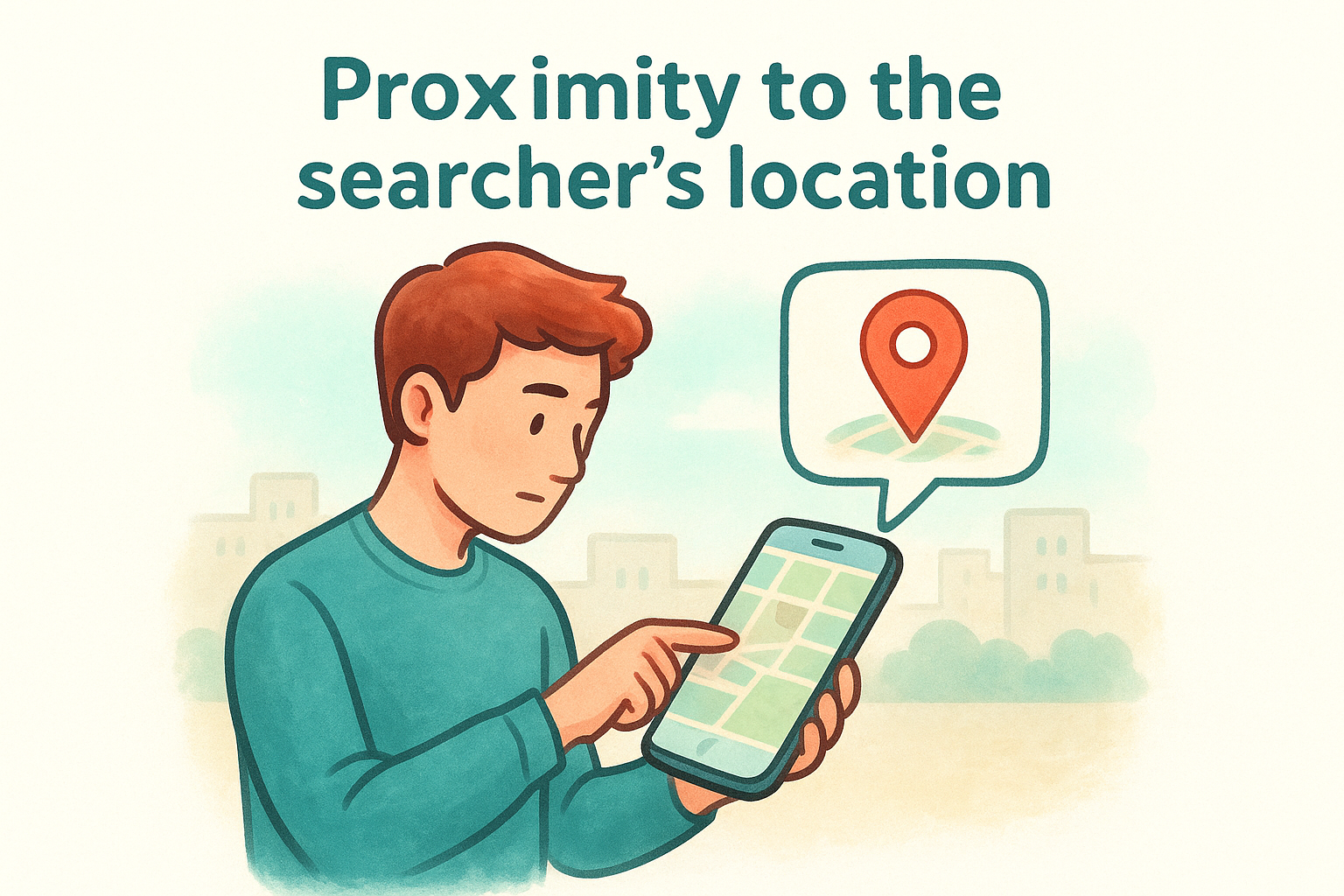
2. Proximity to the searcher's location
Distance plays a bigger role in Google Maps rankings than almost any other factor, and it's the one you can't fully control. When someone searches "coffee shop near me," Google leans heavily on physical distance between the searcher and your listed address to decide who shows up first in the local pack.
What it is
Proximity refers to how close your business address is to the location of the person searching, or to the location implied in their search query. Google estimates this using the searcher's device location, or the city, ZIP code, or neighborhood typed into the search. This is different from the other factors on this list because it shifts constantly based on who's searching and from where, rather than something fixed about your profile.
Why it matters for local rankings
Searchers want results near them, and Google optimizes for that intent above almost everything else in local pack results. A business with a mediocre profile two blocks from the searcher will often outrank a perfectly optimized profile ten miles away. This is why location density matters so much for multi-location brands: each additional storefront gives you another shot at showing up as the closest relevant result in a different neighborhood.
You can't move your storefront to chase rankings, but you can make sure Google knows exactly where it sits.
Franchises that treat proximity as fixed and unchangeable miss the real lesson here: since you can't influence distance directly, every other ranking factor becomes your lever for competing against closer competitors.
How to improve it
You won't change your building's coordinates, but you can make sure Google reads your location correctly:
- Confirm your pinned map location matches your actual entrance, not just the building's center point
- Use a precise street address , avoiding PO boxes or shared suite numbers that confuse geocoding
- Set an accurate service area if you're a mobile or service-based business without a public storefront
- Double-check address formatting matches across your website and Google Business Profile
Getting these details right removes proximity-related ranking mistakes that have nothing to do with actual distance.
3. Online reviews and star ratings
Reviews are the most visible ranking factor on your entire profile, and searchers judge you by them before Google even finishes loading the map pin. Among all the Google Maps ranking factors , review volume and rating quality are the ones customers actually see and react to, which makes them impossible to ignore.
What it is
Online reviews are the star ratings and written feedback customers leave directly on your Google Business Profile. Google factors in your average star rating , the total number of reviews, how recently they were posted, and whether you respond to them. A location with 200 reviews at 4.7 stars sends a very different signal than one with 12 reviews at 3.9 stars, even if both businesses deliver the same experience.
Why it matters for local rankings
Google treats reviews as a trust signal from real customers, something no amount of self-written content can fake. Review velocity , meaning how steadily new reviews come in, tells Google a business is active and still serving customers well. A profile that hasn't earned a new review in eight months looks stagnant compared to a competitor collecting five a week.
Reviews don't just influence rankings, they influence whether someone who finds you actually calls.
Keyword mentions inside reviews also help. When customers naturally mention services, neighborhoods, or products in their feedback, it reinforces relevance signals Google already pulls from your profile.
How to improve it
Build review generation into your regular operations instead of leaving it to chance:
- Ask at the point of service , right after a positive interaction, either verbally or through a follow-up text
- Send a direct review link by email or SMS to reduce friction
- Respond to every review , positive or negative, within a few days
- Address negative reviews professionally , showing future customers you take feedback seriously
- Avoid review gating or incentivizing reviews , since Google penalizes both practices
For multi-location brands, consistency across locations matters. One store with hundreds of reviews and another with a handful creates uneven visibility across your entire footprint.
4. Local citations and NAP consistency
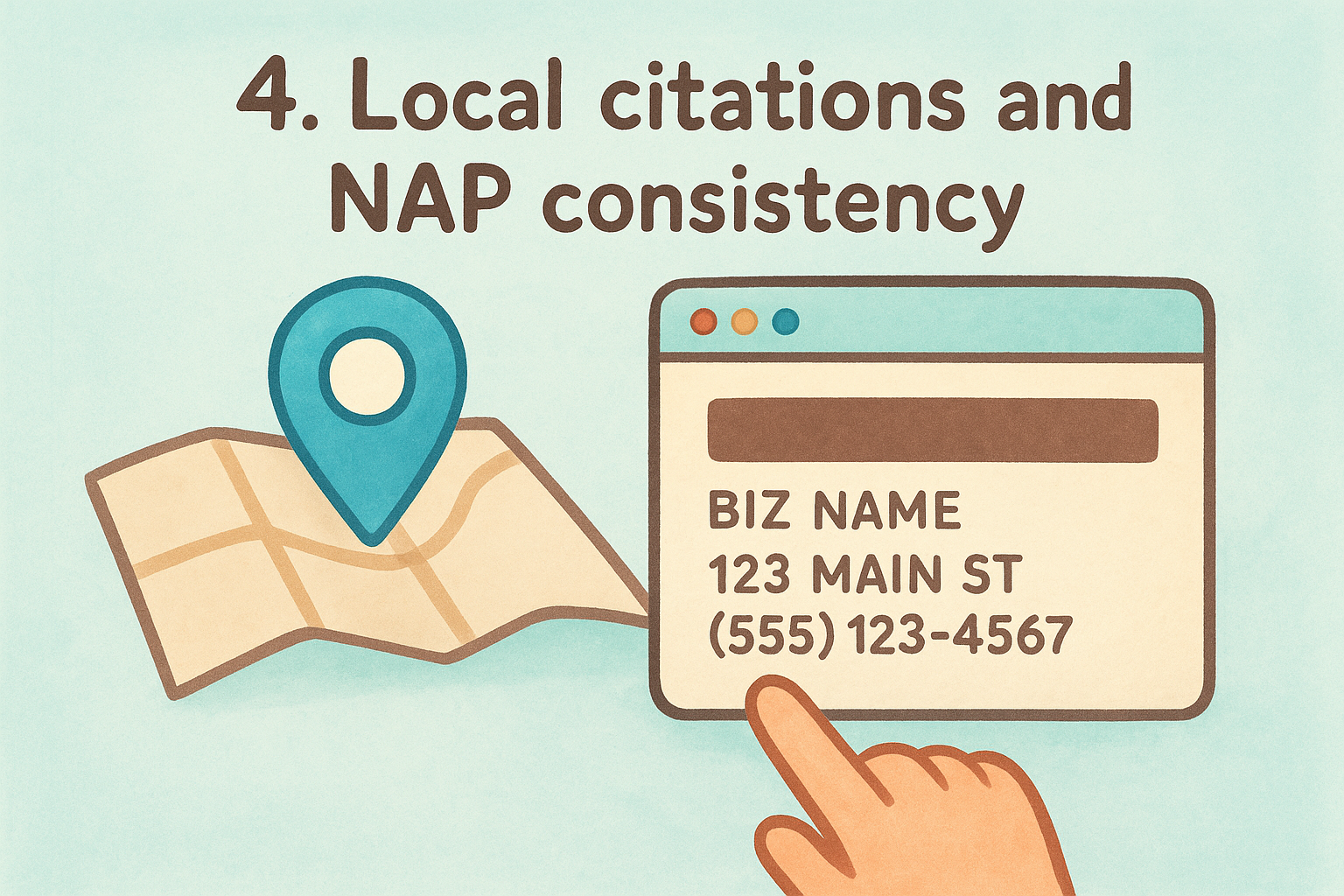
Citations work quietly in the background of your local rankings, and most business owners never think about them until something breaks. A citation is any online mention of your business name, address, and phone number, whether that's on Yelp, an industry directory, a chamber of commerce site, or a local news article. Google cross-checks these mentions to confirm your business is real and located where you say it is.
What it is
NAP consistency means your business Name, Address, and Phone number appear identically across every platform that lists you, from Google Business Profile to Yelp, Facebook, Bing Places, and niche directories in your industry. Even small mismatches count, like listing "123 Main St Suite 4" on one site and "123 Main Street, #4" on another. Google's algorithms compare these mentions across the web to build confidence in your business's identity and location.
Why it matters for local rankings
Inconsistent citations confuse Google's matching systems, and confusion translates directly into weaker rankings. When your business data doesn't match across platforms, Google has to guess which version is accurate, and it often responds by trusting your profile less overall. This gets worse fast for multi-location businesses, since a single wrong suite number or old phone number can get copied across dozens of directories before anyone notices.
Every inconsistent listing is a small vote of doubt that adds up against your rankings.
Citations also serve as a volume signal. A business mentioned accurately across 40 relevant directories looks more established to Google than one that only exists on its own website and Google profile.
How to improve it
Cleaning up citations is tedious but straightforward work:
- Audit your existing citations using a tool like Moz Local or BrightLocal to find inconsistencies
- Standardize your NAP format and use that exact format everywhere, including abbreviations
- Claim and update major directories first: Yelp, Bing Places, Apple Maps, Facebook
- Fix duplicate listings , which happen often when locations change ownership or rebrand
- Update every citation immediately after any address, phone, or name change
For businesses with several locations, this becomes a recurring maintenance task rather than a one-time fix, since directories get repopulated and duplicated over time without warning.
5. Backlink quality and relevance
Backlinks feel like an old-school SEO concept, but they still carry real weight in how Google evaluates local rankings. A backlink is simply a link from another website pointing to yours, and Google reads each one as a small vote of confidence from the site that placed it.
What it is
Backlink quality refers to how authoritative and relevant the linking site is, not just how many links you've collected. A link from your local newspaper or a respected industry association carries far more weight than ten links from random directories nobody visits. Relevance matters too: a plumbing company earning links from home improvement blogs sends a clearer signal than the same links landing on a site with nothing to do with plumbing.
Why it matters for local rankings
Google uses backlinks to gauge domain authority , which factors into how much trust it places in your entire website, including the pages tied to your Google Business Profile. A single link from a trusted local source, like a city government page or a well-known regional publication, can do more for your rankings than dozens of low-quality links combined.
One link from a source Google already trusts outweighs a pile of links from sites nobody respects.
For multi-location businesses, this factor often gets overlooked because building links takes more effort than filling out a profile field. But locations backed by genuine local press coverage or community partnerships consistently outrank competitors who never bothered to build any off-site authority.
How to improve it
Focus on earning links naturally rather than buying them or chasing volume:
- Sponsor local events or teams , which often earns a link from the event's website
- Partner with local news outlets for stories about your business, openings, or community involvement
- Get listed on local chamber of commerce and business association websites
- Contribute expertise to industry publications or local blogs relevant to your field
- Avoid link farms or paid link schemes , since Google's algorithms flag and penalize these tactics
A steady, patient approach to earning a handful of strong links beats any shortcut, and it protects your site from the penalties that come with manipulative link building.
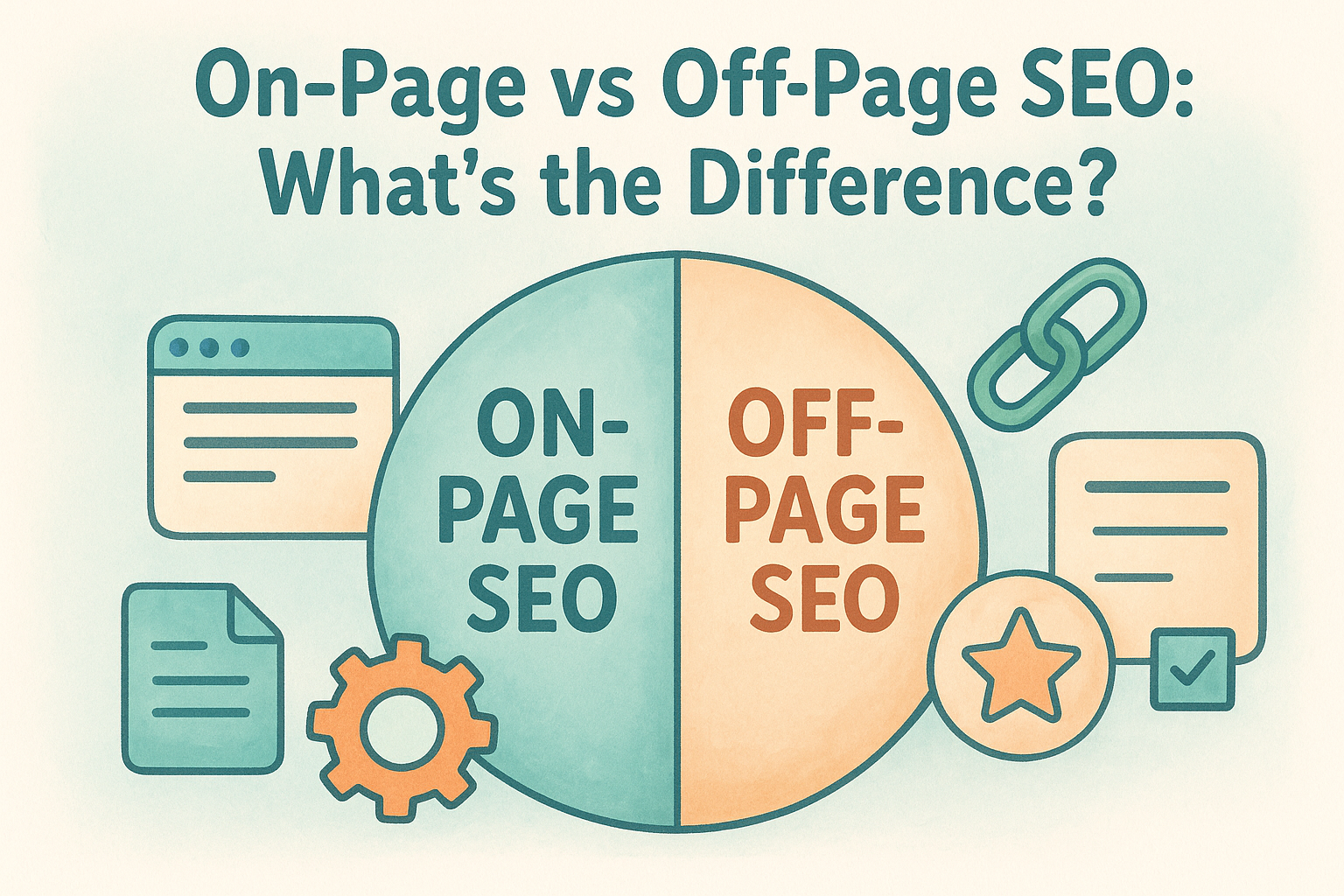
6. On-page website optimization and keywords
Your Google Business Profile doesn't work in isolation. Google crawls the website linked to that profile and uses what it finds there to confirm relevance, which makes on-page optimization one of the more overlooked google maps ranking factors on this list. A strong profile paired with a thin, poorly optimized website sends mixed signals that hold back your local pack rankings.
What it is
On-page optimization covers the elements on your website that tell Google what your business does and where it operates, things like title tags , header tags, body copy, image alt text, and schema markup. For local businesses, this also includes mentioning your city, neighborhood, or service area naturally throughout the site rather than burying that information on a single contact page. Schema markup, specifically LocalBusiness schema, gives Google structured data it can read directly instead of guessing from paragraph text.
Why it matters for local rankings
Google cross-references your website content against your Google Business Profile to verify consistency and relevance. When your keyword targeting matches what people actually search for, like "emergency plumber in [city]" instead of vague phrases like "quality service," Google has an easier time matching your site to those queries. A website with no location-specific content leaves Google guessing which searches you deserve to rank for.
If your website never mentions where you actually work, don't expect Google to guess it for you.
How to improve it
Treat your website as a supporting document for your Google Business Profile, not a separate project:
- Include your city or neighborhood name in title tags, headers, and page copy, not just your footer
- Add LocalBusiness schema markup to your homepage and location pages
- Write unique page titles and meta descriptions for each service and location
- Use descriptive alt text on images, mentioning location where relevant
- Keep page load speed fast , since slow sites hurt both rankings and conversions
For multi-location brands, generic website copy is the most common mistake. Duplicating the same paragraph across ten location pages tells Google nothing new about each market, which weakens the relevance boost this factor is supposed to provide.
7. Dedicated location pages for multi-location businesses
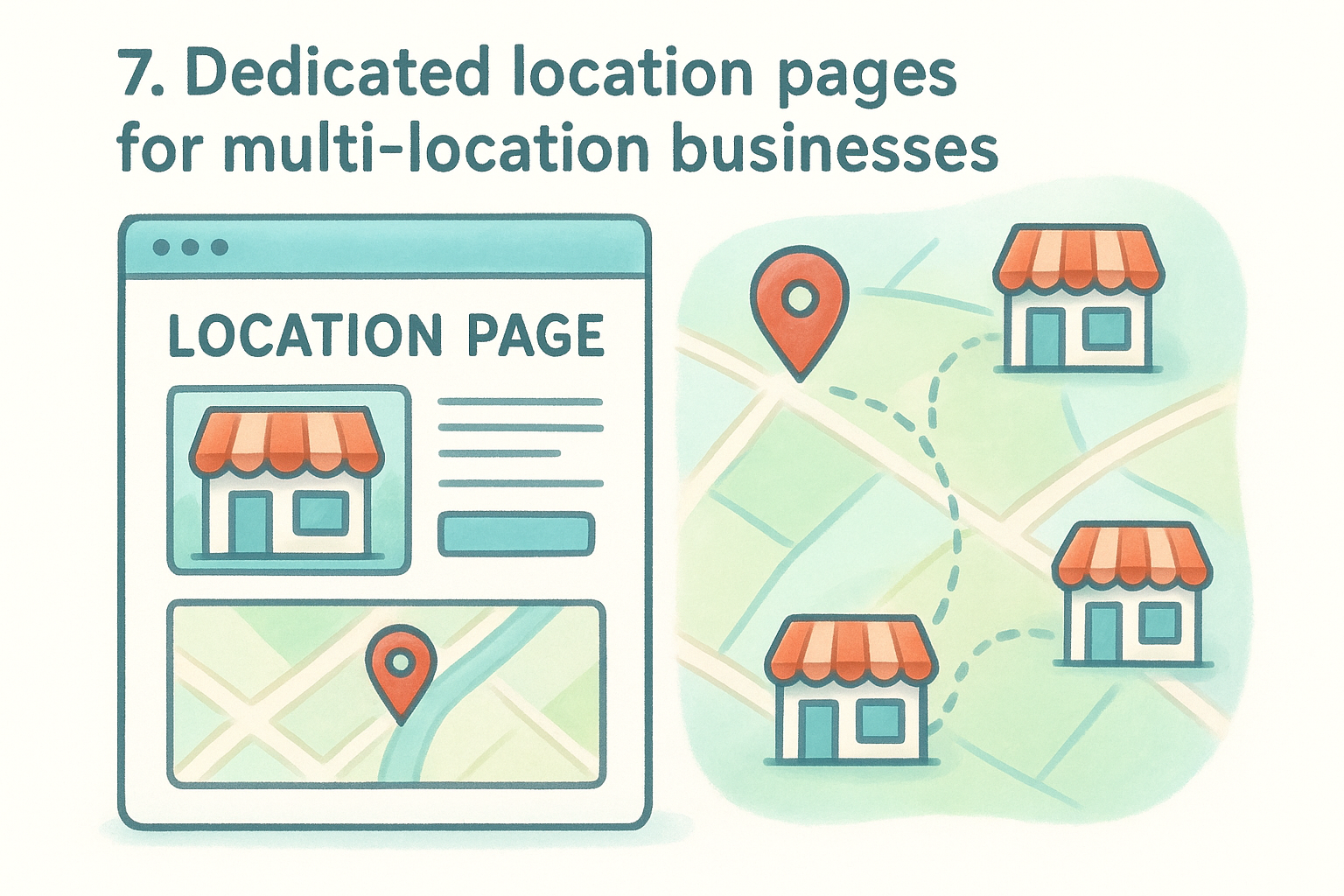
A single homepage can't represent ten different storefronts, each with its own address, hours, and neighborhood. Dedicated location pages solve that problem by giving every branch its own URL, its own content, and its own chance to rank in that specific market's local pack.
What it is
A dedicated location page is a standalone page on your website built for one specific address, distinct from a generic "locations" list or a shared contact page. Each page includes that location's address, phone number, hours, staff, photos, and a written description unique to that market, along with a map embed and links to reviews specific to that branch. Franchises with fifteen locations need fifteen pages, not one page with a dropdown menu.
Why it matters for local rankings
Google matches your website content against your Google Business Profile for each address, and a thin or shared location page gives it little to work with. Location-specific content helps Google confirm that a particular branch genuinely serves a particular area, which strengthens that branch's chances in local search for its own neighborhood. Without this, one strong flagship location can end up cannibalizing visibility that should belong to your other branches.
Every location deserves its own page, because Google ranks addresses, not brands.
Businesses that skip this step often see their newer or smaller locations struggle to rank at all, even when the parent brand carries strong name recognition nationally.
How to improve it
Building out proper location pages takes structure, not just more pages:
- Write a unique description for each location, mentioning the neighborhood and nearby landmarks
- Embed a Google Map pointing to that specific address, not a generic company map
- Display location-specific reviews rather than pooling all reviews under one page
- List local staff, promotions, or services that differ from other branches
- Add LocalBusiness schema unique to each page's address and phone number
Managing this across a growing footprint is exactly where multi-location businesses tend to fall behind, since new locations get added faster than pages get properly built.
8. Behavioral signals like clicks and calls
Google watches what happens after your listing appears in search results, not just what's written on your profile. Behavioral signals like clicks, calls, direction requests, and website visits tell Google whether real searchers actually want what you're offering, and that feedback loop shapes your ranking over time just as much as any field you fill out.
What it is
Behavioral signals cover the actions people take on your Google Business Profile: clicking through to your website, tapping the call button, requesting directions, checking your menu, or booking an appointment directly through the listing. Google tracks engagement metrics like click-through rate and dwell time on your profile compared to competitors appearing for the same search. These actions happen in aggregate across thousands of searches, giving Google a real-world signal it can't get from a static profile alone.
Why it matters for local rankings
A listing that gets clicked, called, and navigated to repeatedly tells Google that searchers find it relevant and trustworthy, which reinforces its position in future searches for similar queries. Click-through rate acts almost like a vote from real users, separate from anything you control directly on the profile itself. Two nearly identical businesses can rank differently over time simply because one earns more engagement from the same volume of impressions.
Google ranks what people actually use, not just what looks good on paper.
This creates a compounding effect. Higher rankings generate more visibility, more visibility generates more clicks and calls, and that engagement helps sustain the higher ranking.
How to improve it
You can influence behavioral signals by making your listing more compelling at the moment someone sees it:
- Use a clear, high-quality cover photo that stands out in search results
- Add a direct booking or ordering link to reduce friction between searching and acting
- Keep your phone number visible and correct , since a broken number kills call volume instantly
- Highlight promotions or offers in your profile posts to encourage clicks
- Respond quickly to messages through the profile's messaging feature
For multi-location businesses, tracking this data per location through Google Business Profile insights helps identify which branches need stronger visuals or clearer calls to action.
9. Social signals and engagement
Social media doesn't feed directly into Google's local algorithm the way reviews or citations do, but it shapes the signals that surround your business online. Social signals like shares, mentions, and engagement on platforms such as Facebook and Instagram add another layer of activity that reinforces everything else you're building toward stronger google maps ranking factors performance.
What it is
Social signals refer to the activity your business generates on social platforms: likes, shares, comments, check-ins, and mentions from customers or local pages. This also includes how often your business gets tagged in posts, whether local influencers mention you, and how actively you post updates yourself. None of this lives inside Google Business Profile, but it creates a web of activity around your brand that Google's crawlers and algorithms can pick up on indirectly.
Why it matters for local rankings
Google has never confirmed social signals as a direct ranking factor, but the correlation shows up consistently in local search studies. Active social profiles generate traffic, mentions, and sometimes links back to your website, all of which feed the broader trust signals Google already weighs. A business with regular posts, tagged photos, and community engagement looks more alive online than one with a dormant page nobody has touched in a year.
Social activity won't rank you on its own, but a business that looks abandoned online rarely looks trustworthy to Google either.
Engagement also drives branded searches, and Google tracks how often people search your business name directly, which strengthens your overall local presence.
How to improve it
Treat social platforms as supporting evidence for your local SEO, not a separate marketing channel:
- Post consistently , at least a few times a week, with photos and updates relevant to each location
- Encourage check-ins and tags from customers visiting in person
- Respond to comments and messages promptly to show an active, managed presence
- Share Google reviews on social channels to extend their reach
- Geotag posts with the correct location for multi-location brands
For franchises, keeping every location's social presence active becomes another task that competes with daily operations, which is often where consistency breaks down first.
Focusing your local SEO efforts
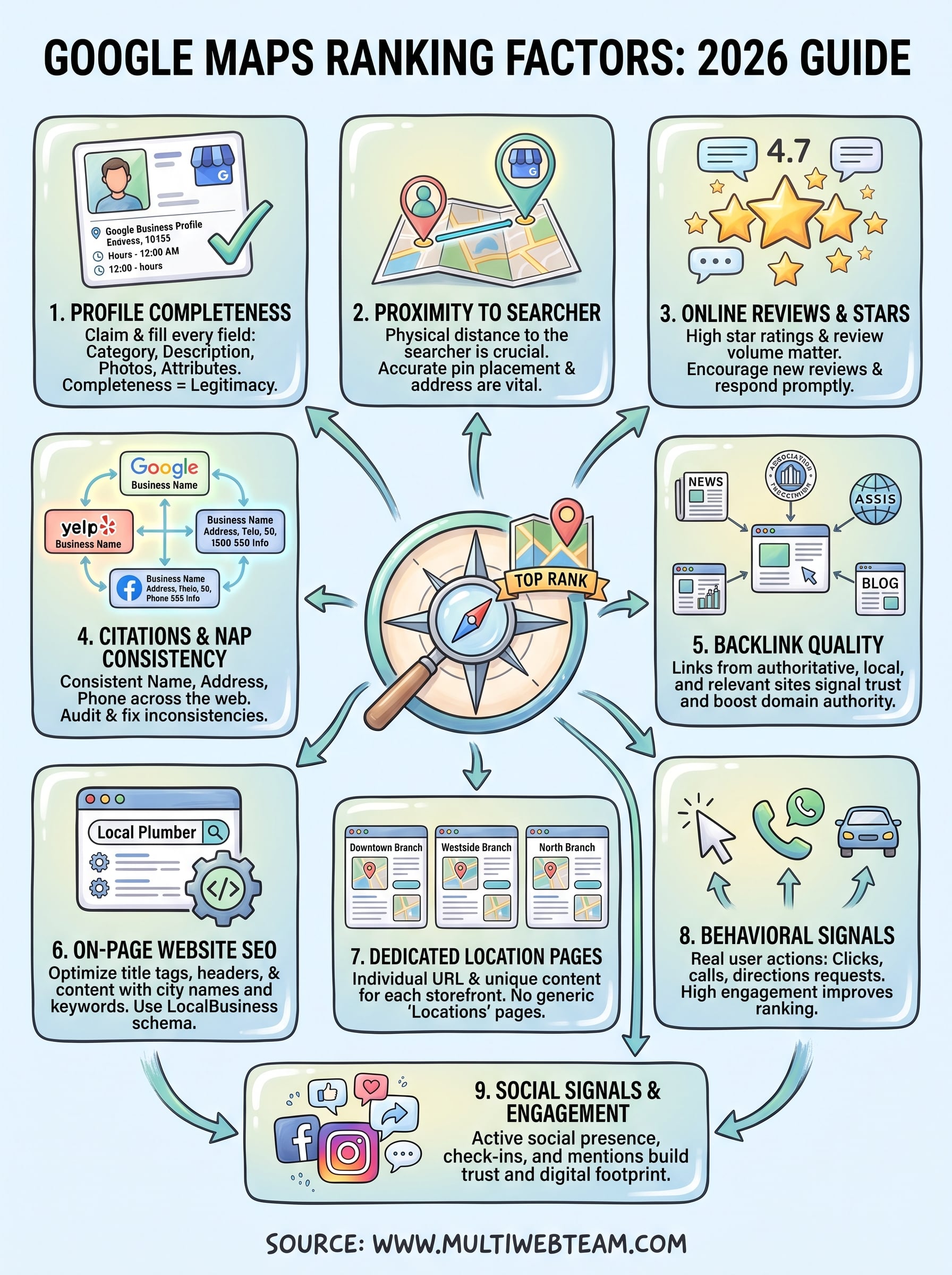
Nine factors is a lot to track, and trying to fix all of them at once usually means none of them get done well. Start with Google Business Profile completeness and NAP consistency , since those two form the foundation everything else builds on. Reviews and location pages come next, then backlinks and social engagement as ongoing habits rather than one-time projects.
The hard truth for multi-location businesses is that these ranking factors don't get easier as you grow, they multiply. Ten locations mean ten profiles, ten sets of citations, ten review streams, and ten location pages, all needing regular attention at the same time.
If keeping up with that across every location sounds like more than your team has time for, that's exactly the gap Multi Web Team was built to fill, handling the ongoing design, SEO, and updates so every location stays visible in its own market.