
On-Page vs Off-Page SEO: What's the Difference?
If you manage a website for a multi-location business, you've probably heard both terms thrown around and wondered which one actually moves the needle. On page vs off page seo isn't an either-or question. It's two different halves of the same ranking equation, and confusing them leads to wasted budget and stalled rankings for individual store pages.
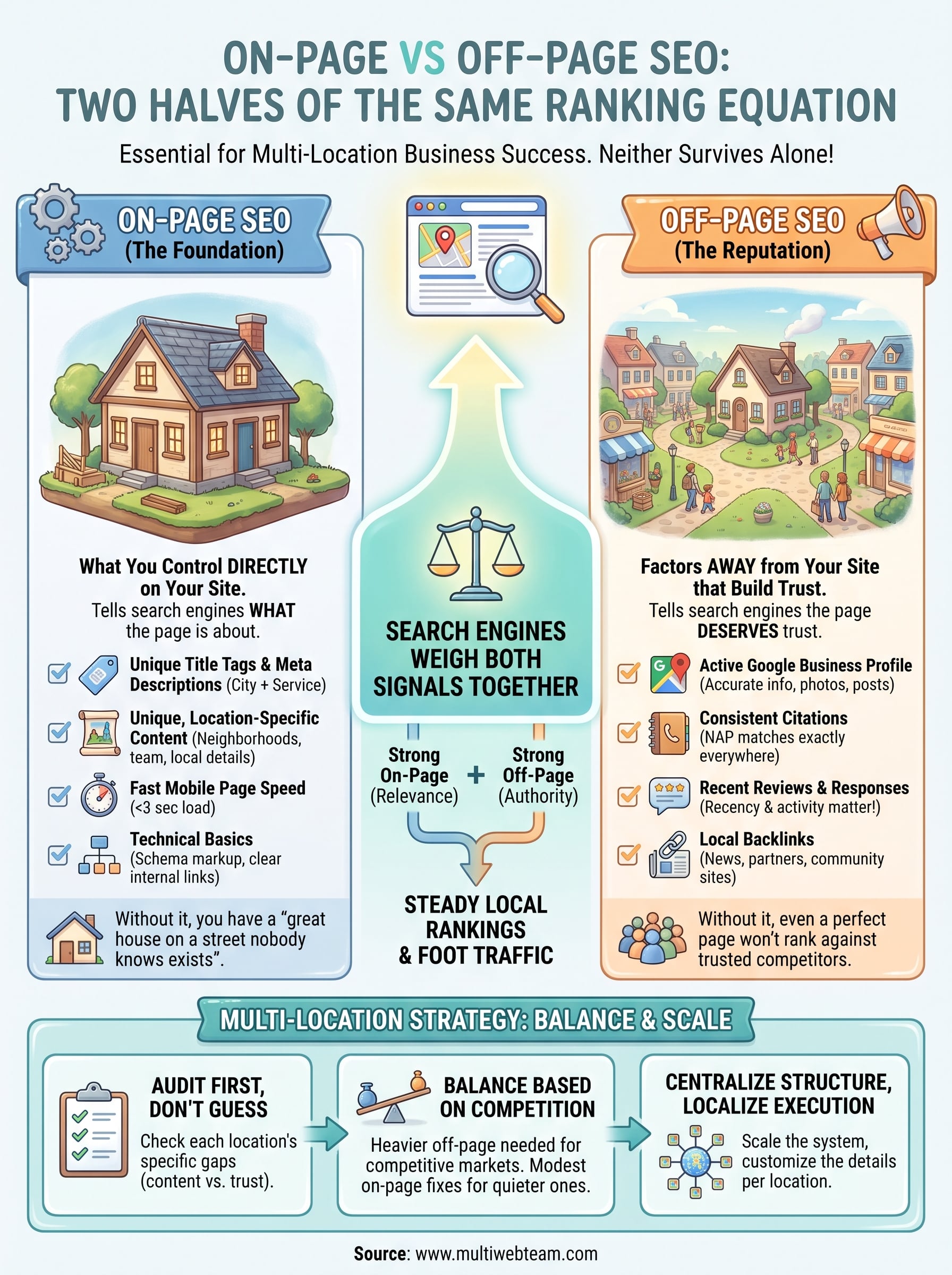
On-page SEO covers everything you control directly on your site: title tags, content, internal links, page speed, and location-specific details like city names and store hours. Off-page SEO happens away from your site: backlinks, citations, Google Business Profile signals, and reviews that build trust with search engines. Search engines weigh both before deciding who ranks first, so skipping either one caps how high any location page can climb.
In this article, we'll break down exactly what falls into each category, why franchises and multi-location brands need to treat them differently at the location level, and how combining the two gives every store page a real shot at ranking locally. You'll walk away knowing where to focus your time first.
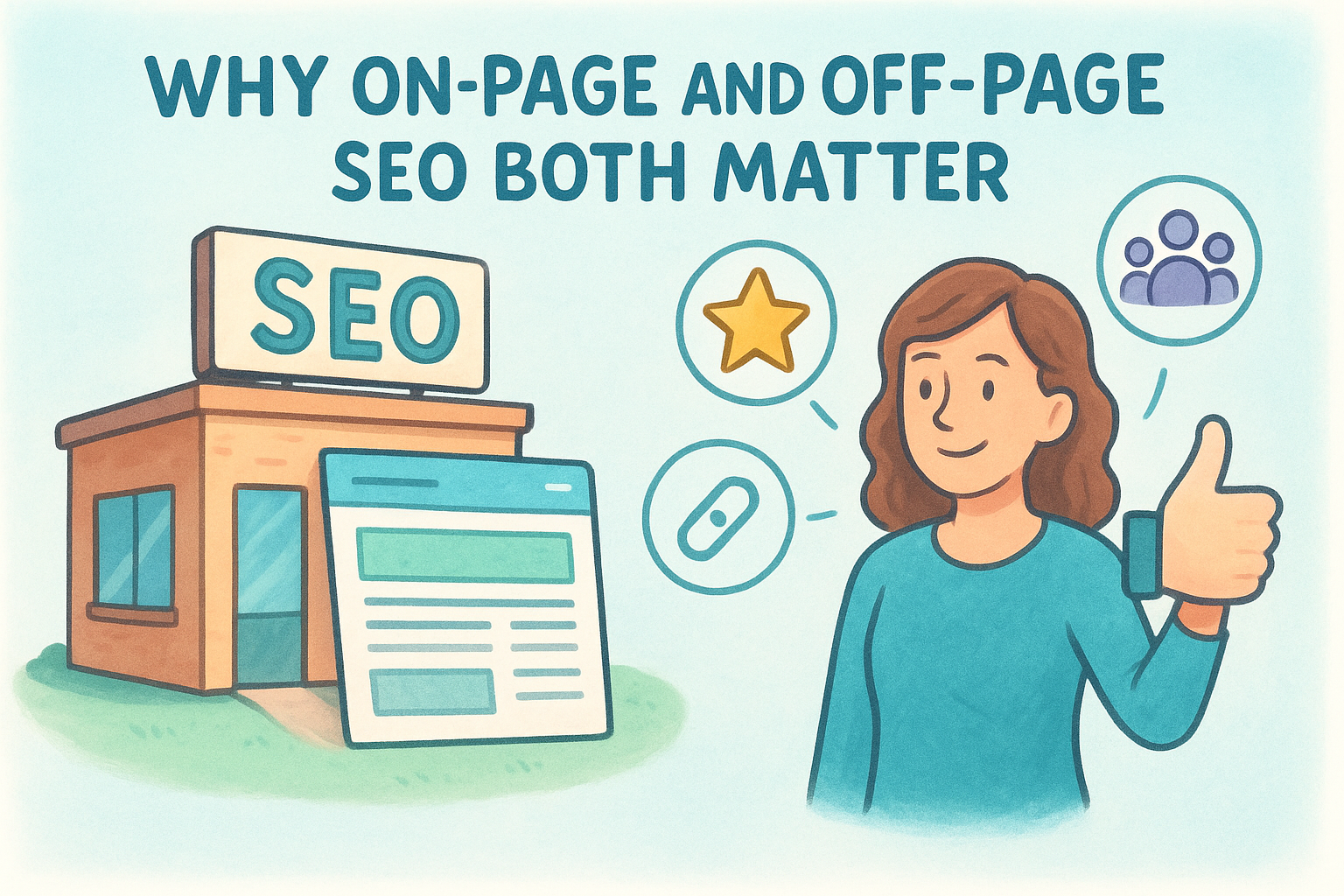
Why on-page and off-page SEO both matter
Think of on-page SEO as the foundation of a store and off-page SEO as the reputation that gets people to walk through the door. A well-built page with fast load times, clear service descriptions, and the right city name in the title tag tells Google what the page is about. But if nobody links to it, nobody reviews the business, and no local directories mention it, Google has no way to confirm the page deserves trust. Rankings depend on both signals working together, not one propping up the other.
A perfectly optimized page with zero authority behind it will lose to a mediocre page backed by strong local trust signals.
Here's where this shows up most for multi-location businesses: two locations can run the identical page template, same content structure, same meta tags, and still rank completely differently in their local markets. Why? Because one location has 40 Google reviews and a handful of local backlinks, while the other has five reviews and no outside mentions. Off-page signals are what separate two technically identical pages in the eyes of a search engine.
What happens when you only invest in one
Businesses that pour all their budget into on-page work often end up with beautiful, fast, well-written pages that never crack the first page of results. They've built a great house on a street nobody knows exists. On the flip side, businesses that chase backlinks and reviews without cleaning up their on-page content end up with pages that rank briefly, then slide back down because the content doesn't actually answer what the searcher typed. Google's own documentation on how search works makes clear that ranking systems evaluate both relevance and reputation as separate but connected inputs, which is why neither strategy survives alone.
The compounding effect across locations
Multi-location brands feel this gap more acutely than single-location businesses. Every location page competes in its own local search market, against its own set of local competitors. A location in a competitive city like Austin or Denver needs both strong on-page content and a steady stream of local citations and reviews to outrank other businesses fighting for the same searches. A location in a smaller town might rank with less off-page effort simply because competition is thinner. Location-level results vary widely , which is exactly why a one-size-fits-all SEO plan across all your locations rarely works.
Here's a quick way to see how the two interact:
| Scenario | On-Page Strength | Off-Page Strength | Typical Result |
|---|---|---|---|
| Strong content, no backlinks or reviews | High | Low | Page indexes but rarely ranks above page 2 |
| Weak content, strong reviews and citations | Low | High | Short-term ranking bump, then drops |
| Balanced investment in both | High | High | Steady rankings, more foot traffic, more calls |
The takeaway for any franchise or multi-location owner is straightforward: treat on-page and off-page SEO as two line items in the same budget, not two competing strategies. Neglect either one and you're leaving rankings, and revenue, on the table for every single location you operate.
How to balance on-page and off-page SEO
Getting the balance right starts with knowing where each location page currently stands, not with picking an arbitrary percentage to spend on each. Franchise owners often ask us for a fixed ratio, like 60% on-page and 40% off-page, but that ignores the fact that a brand-new location page needs different treatment than a five-year-old page sitting on page two of results. Balance isn't a formula you set once. It's a decision you revisit every quarter as each location's competitive picture shifts.
Start with an audit, not a guess
Before assigning budget, run a quick check on every location page:
- Does the title tag include the city and service, and does the page load in under three seconds?
- Does the location have at least 15 to 20 recent Google reviews compared to nearby competitors?
- Are there local citations on directories relevant to the industry, with consistent name, address, and phone details?
- Has the page earned any backlinks from local news sites, chambers of commerce, or partner businesses?
Any "no" answer tells you exactly where to put next month's effort, instead of splitting resources evenly across every location regardless of need.
Set a realistic split based on competition
Once you know where a location stands, weight your effort toward its weaker side. A page with strong content but thin reviews needs an off-page push. A page drowning in citations but written with generic, copy-pasted service descriptions needs on-page attention first. Competitive markets demand heavier off-page investment because every competitor already has solid content; quieter markets often respond well to modest on-page fixes alone.
Balance means matching effort to the specific gap on each location page, not splitting your budget evenly and hoping it works out.
For multi-location brands managing dozens or hundreds of pages, this location-by-location approach is the only one that scales without wasting money on markets that don't need it.
Key on-page SEO factors to get right
Every location page lives or dies on a handful of on-page details, and most multi-location businesses get at least one of them wrong. Title tags and meta descriptions need the city, the service, and a reason to click, not just a template swapped with a new zip code. Page speed matters just as much; a location page that takes five seconds to load on mobile loses visitors before Google even finishes crawling it. Get these basics right first, because no backlink can fix a page that search engines can't understand or that visitors abandon before it loads.
Content that actually mentions the location
Generic service pages with a city name swapped in the header rarely rank. Google's guidance on helpful content confirms that pages need genuine, specific value for the person searching, not thin variations copied across locations. Write about the neighborhood, the specific team at that store, local landmarks customers use for directions, and services that location actually offers. Unique content at each location is what separates a page that ranks from one that gets ignored in favor of a competitor's more detailed listing.
A location page that reads like every other location page gives Google no reason to rank it above the competition.
Technical basics that quietly kill rankings
Broken internal links, missing schema markup, and duplicate title tags across locations all quietly cap how well a page performs, even with great content sitting on top of them. Run through this list on every location page at least once a quarter:
- Unique title tag and H1 for each location, including city and primary service
- Schema markup identifying the business type, address, and hours
- Mobile page speed under three seconds
- No duplicate content shared word-for-word across multiple locations
- Internal links pointing to nearby locations and relevant service pages
Technical cleanup like this rarely takes more than a few hours per page, but it removes the silent barriers that stop otherwise solid content from ranking.
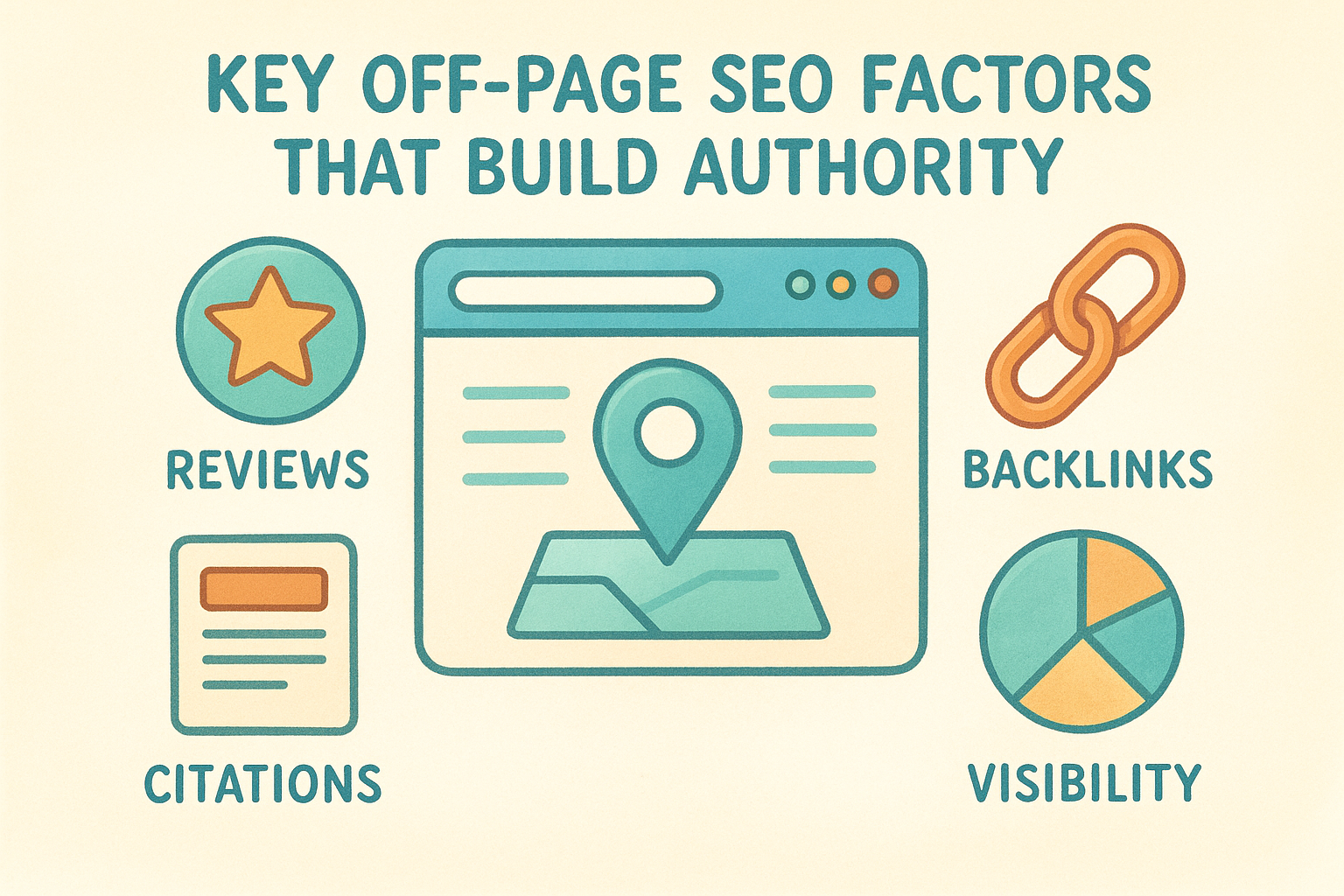
Key off-page SEO factors that build authority
Off-page SEO builds the trust signals that no amount of on-page polish can fake. Google Business Profile sits at the center of this for any multi-location brand, and it needs consistent attention at every single location, not just the flagship store. A profile with accurate hours, recent photos, and a steady stream of responses to reviews tells Google the business is active and legitimate. Neglect one location's profile and that store quietly falls behind competitors who keep theirs current.
Reviews and citations do the heavy lifting
Reviews carry more weight than most owners realize, and volume alone isn't the whole story. Google looks at recency, response rate, and the language customers use, so a location with 60 reviews from three years ago loses ground to a competitor with 20 reviews from the last six months. Citations matter just as much: your business name, address, and phone number need to match exactly across every directory listing a location appears on.
A single mismatched phone number across ten directories can quietly undercut months of on-page work.
Run this check for every location on a recurring basis:
- New Google reviews requested and responded to within 48 hours
- Name, address, and phone number identical across every directory listing
- Local citations built on directories relevant to the specific industry
- Backlinks earned from local news outlets, chambers of commerce, or community partners
Backlinks still separate the leaders from the rest
Backlinks remain one of the strongest ranking signals Google uses, and Google's own documentation on search fundamentals confirms that links from reputable, relevant sites still carry real weight. A single mention from a local newspaper or a sponsorship listing on a community organization's site often outperforms dozens of low-quality directory links. Sponsoring a local event, partnering with a nearby business, or getting featured in local press all generate the kind of natural backlink that off-page SEO depends on. Local link building takes more effort per location than a blanket national campaign, but it's what actually moves a location page past competitors sitting one spot ahead of it in the map results.
Applying both SEO types across multiple locations
Scaling on-page and off-page SEO across ten, fifty, or five hundred locations breaks most in-house teams, because the same content template and the same backlink outreach approach don't work everywhere at once. Multi-location SEO requires a central strategy that still leaves room for each location to look and rank like its own local business. Franchises that try to run identical campaigns everywhere waste money on markets that don't need help and underserve the ones that do.
Centralize the system, localize the execution
The brands that scale well use one structure for every location page, then customize the details underneath it. Title tag formulas, schema templates, and citation building processes stay the same across the board, while the actual content, review responses, and local outreach shift based on each market's competition.
Consistency in structure and customization in execution is what lets multi-location SEO scale without turning into fifty separate SEO campaigns.
Track performance location by location
A single dashboard averaging results across all locations hides exactly where problems live. Instead, track these metrics per location on a recurring basis:
- Local ranking position for the top three service keywords
- Review count and average rating compared to the three nearest competitors
- Number of active local backlinks and citations
- Page load speed on mobile for that specific location page
This level of detail is what lets you assign budget where it actually moves rankings, instead of spreading effort evenly and hoping the weaker locations catch up on their own.
Watch for pages competing against each other
Multi-location brands also run into a problem single-location businesses never face: two nearby location pages competing against each other in the same search results. When that happens, internal linking and clear geographic boundaries in the content help Google understand which page belongs to which service area, so one location's off-page gains don't accidentally boost the wrong page. Getting this right at scale is exactly where a dedicated location-level strategy earns its cost back many times over.
Bringing on-page and off-page SEO together
On page vs off page seo was never a real competition. Both halves have to work at once, on every single location page you manage, or rankings stall no matter how much budget you throw at either side alone. The businesses that win in local search treat title tags and reviews, page speed and backlinks, content and citations as one connected system rather than separate projects handled by separate people.
Running that system across dozens or hundreds of locations takes more than good intentions and a shared spreadsheet. It takes someone tracking each location's gaps every month and acting on them fast. Multi Web Team builds and manages exactly that kind of system for multi-location businesses and franchises, handling the design, the updates, and the local SEO together under one subscription. If you're ready to stop guessing and start ranking, see how Multi Web Team can manage it for you.