Local SEO Audit Services: How To Choose And What To Expect
Your Google Business Profile is optimized, your NAP citations look consistent, and your website seems fine, but your locations still aren't showing up where they should in local search. Before throwing more money at ads or directory listings, you need a clear picture of what's actually holding you back. That's exactly what local SEO audit services provide: a structured evaluation of your local search presence, from your website's technical health to your citation accuracy and Google Business Profile performance .
But not all audits are created equal. Some agencies hand you a generic automated report and call it a day. Others dig into location-specific data, review your competitors, and give you a prioritized action plan you can actually use. Knowing the difference matters, especially when you're managing multiple locations or a franchise where each storefront needs to rank in its own market .
At Multi Web Team, we handle local SEO management for multi-location businesses every day. We've seen what a thorough audit uncovers, and what a lazy one misses. This guide walks you through how to evaluate local SEO audit services , what a solid audit should include, and the red flags that signal you're about to waste your budget. Whether you're vetting agencies or just trying to understand what you're paying for, you'll leave with a clear framework for making the right choice .
What local SEO audit services include
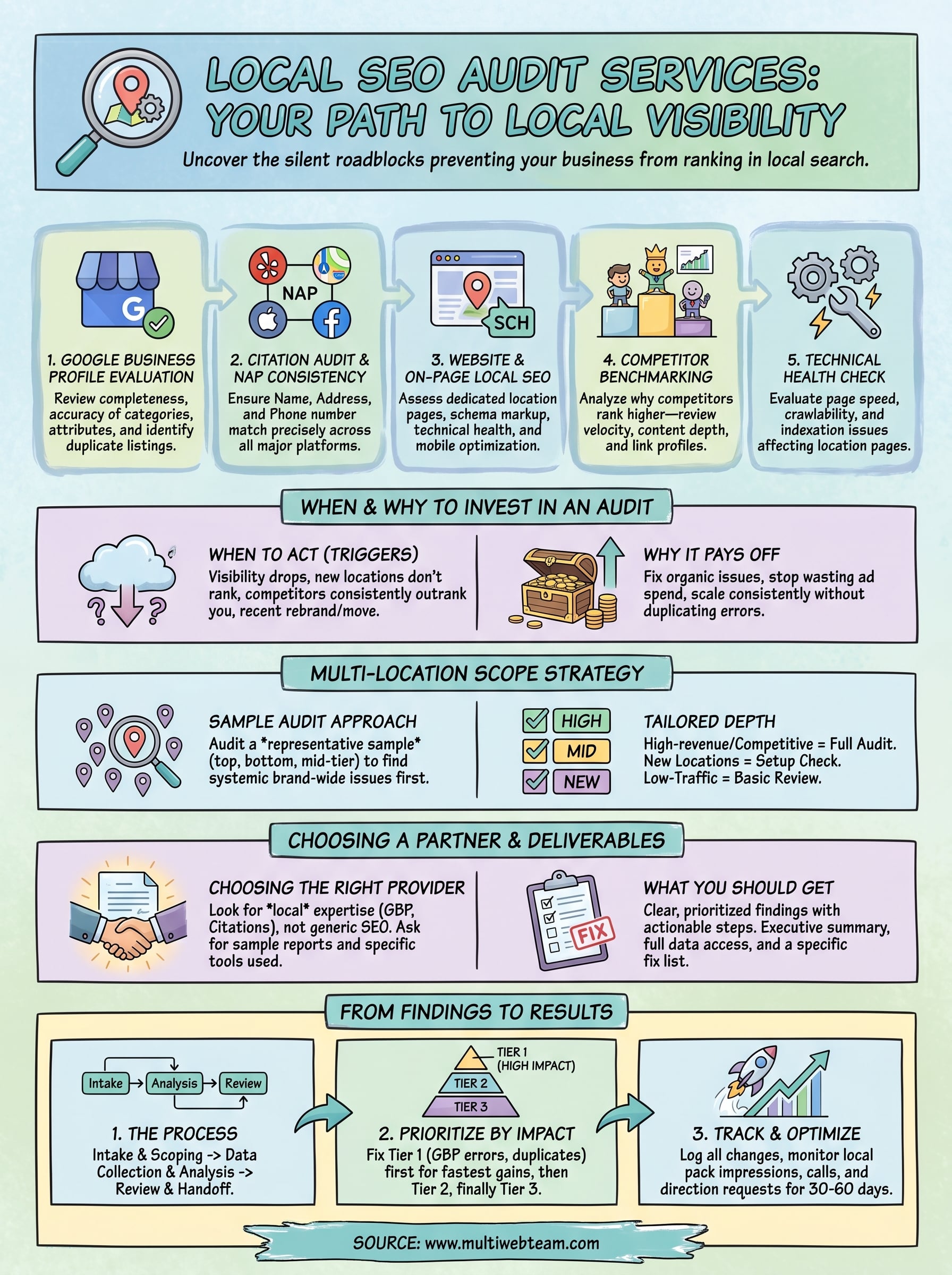
A strong audit isn't a single report from one tool. Local SEO audit services typically cover five distinct areas that each affect how Google decides which businesses to show in local search results. Understanding what each area involves helps you spot whether a provider is giving you real analysis or just pulling recycled data from an automated scanner.
Google Business Profile evaluation
Your Google Business Profile(GBP) is the single biggest driver of local pack rankings, and auditors spend significant time reviewing it. They check whether your business categories, attributes, and service areas are configured correctly, look for duplicate listings, review your Q&A and review response patterns, and flag any policy violations that could suppress your profile.

A thorough GBP evaluation also compares your profile completeness against top-ranking competitors in your specific market. For example, if three competing businesses in your city have 200+ photos and you have 12, that's a measurable gap an auditor should identify, quantify, and prioritize for you.
Citation audit and NAP consistency
NAP stands for Name, Address, and Phone number , and inconsistencies across directories confuse Google and erode your local ranking authority. Auditors pull your listings from major data aggregators and directories, then flag discrepancies in spelling, phone formatting, or suite numbers.
Even minor differences, like "St." vs. "Street" in your address, can fragment your citation authority across dozens of platforms and lower your confidence signals with Google.
A citation audit should produce a clear, actionable list of directories where your NAP is wrong, missing, or duplicated. Here's a simple template for what a proper citation report should include:
| Directory | Current Listing | Correct NAP | Status |
|---|---|---|---|
| Google Business Profile | Wrong phone number | (555) 123-4567 | Fix needed |
| Yelp | Missing address | 123 Main St, City, ST | Fix needed |
| Apple Maps | Correct | N/A | No action |
| Duplicate listing | N/A | Remove duplicate |
Website and on-page local SEO review
Your website needs to send clear geographic signals to Google through properly structured location pages, schema markup, title tags, and meta descriptions. Auditors evaluate whether your site has a dedicated page for each location , whether those pages are indexed, and whether the on-page copy includes localized keywords or is just a copy-paste of your main service page with a different city name swapped in.
Technical factors also come into play here. Page speed, mobile usability, crawlability, and structured data markup all affect how well individual location pages perform in search. An auditor who skips the technical layer is leaving real ranking opportunities off the table.
Competitor benchmarking
Knowing where your site falls short only tells half the story. Competitor benchmarking shows you why your competitors are ranking above you and which specific gaps are worth closing. A solid audit identifies your top three to five competitors per location and analyzes their review velocity, link profiles, GBP completeness, and content depth .
This comparison gives you a prioritized action list based on what's actually working in your specific market, not generic best practices copied from a blog post. For a franchise with 20 locations, that could mean different competitive gaps in each city, and a good provider surfaces those differences rather than handing you one blanket recommendation that applies everywhere equally.
When you should pay for an audit
Free tools like Google Search Console can surface crawl errors and indexing problems, but they won't tell you why your competitor ranks above you for "plumber near me" or which of your 15 location pages are cannibalizing each other in search. You should invest in professional local SEO audit services when guesswork stops being acceptable and you need a clear diagnosis backed by real data.
Signs your current approach isn't working
You don't need an audit on a fixed schedule. You need one when specific, measurable problems appear and you can't identify the root cause. Watch for these signals:
- Your local pack visibility drops without any obvious changes on your end
- You're adding new locations but they're not generating organic traffic within three to six months of launch
- Review volume and ratings are strong , but you're still not ranking in the top three for your primary service keywords
- A competitor that launched after you is consistently outranking you across multiple locations
- You recently changed your business name, phone number, or address and didn't update every directory systematically
If two or more of these apply to your business, you're leaving rankings on the table and an audit will likely surface the specific cause quickly.
Situations where a paid audit makes financial sense
A professional audit costs money, but so does running ads to compensate for poor organic visibility. The math usually favors fixing your organic presence rather than paying indefinitely for traffic you should be earning for free.
If you're spending more than $500 a month on local ads to cover gaps in organic rankings, a one-time audit at a similar price typically delivers faster returns.
Three situations where paying for an audit makes clear financial sense:
- Before a major expansion. If you're adding five new franchise locations, an audit of your existing setup tells you what to replicate and what to fix before you scale the same problems.
- After a Google core update. When local rankings shift significantly following an algorithm change, an audit identifies whether the drop is a penalty signal, a competitor improvement, or a structural issue on your own site.
- When you're switching agencies or platforms. Before onboarding a new web management partner, an audit gives you a baseline and prevents you from paying someone to optimize a site that has fundamental problems underneath.
Each of these situations involves real money moving in the wrong direction without a diagnosis.
Set the right scope for multi-location brands
Running a single-location audit is straightforward. When you manage 10, 20, or 50 locations , the scope conversation becomes the most important decision you make before hiring anyone or running a single report. Without a defined scope, you'll either pay for analysis you don't need or miss the location-specific issues that are actually hurting your rankings.
Decide whether to audit all locations or a representative sample
Auditing every location simultaneously is rarely necessary, especially when you're just starting. A smarter approach is to identify a representative sample that includes your top-performing location, your worst-performing location, and one or two mid-tier locations. This sample gives you a full picture of the systemic problems affecting the whole brand and the location-specific gaps that vary by market.
If your sample audit reveals the same citation errors across three different cities, you almost certainly have a brand-wide data issue that affects every location, not just those three.
Once you identify systemic problems from your sample, you can apply fixes across the entire portfolio without paying for a full individual audit at each address.
Define what each location audit must cover
Not every location needs the same depth of analysis. High-revenue locations in competitive markets warrant a full competitive benchmarking review. Newer locations that launched within the past six months may only need a technical and citation check to confirm they were set up correctly before investing in deeper analysis.
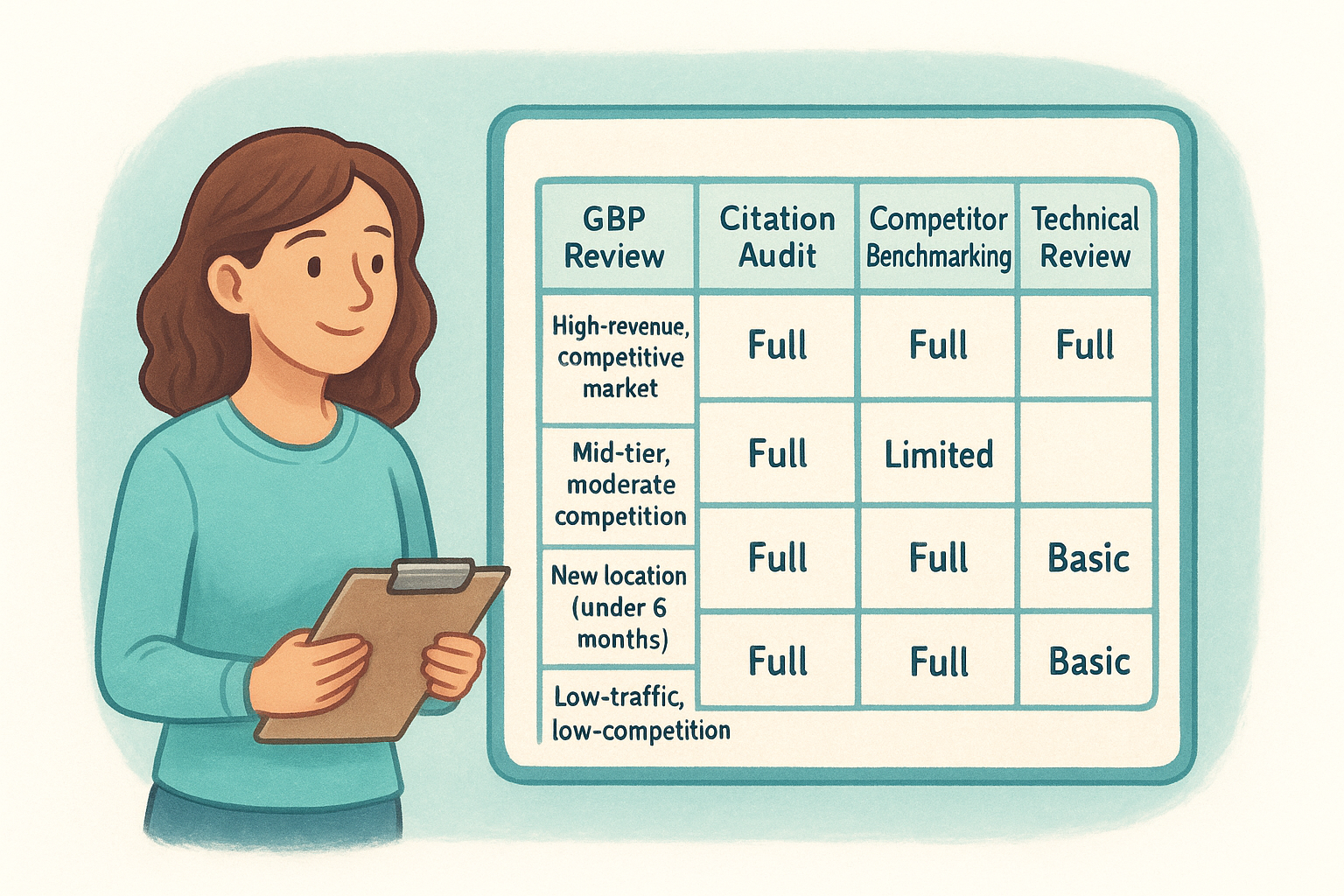
Use this framework to assign audit depth by location type:
| Location Type | GBP Review | Citation Audit | Competitor Benchmarking | Technical Review |
|---|---|---|---|---|
| High-revenue, competitive market | Full | Full | Full (5 competitors) | Full |
| Mid-tier, moderate competition | Full | Full | Limited (3 competitors) | Full |
| New location (under 6 months) | Full | Full | None | Full |
| Low-traffic, low-competition | Basic | Full | None | Basic |
Align your audit scope with your expansion timeline
When you bring in local SEO audit services for a multi-location brand, the audit scope should connect directly to your growth plans. If you're opening three new locations in the next quarter, your audit needs to evaluate whether your current website architecture and citation management process can support rapid expansion without creating duplicate listing problems or diluting your domain's location signals.
Providers who treat every multi-location client the same way will miss this entirely. Ask any candidate directly how they adjust scope based on your growth stage, and expect a specific answer.
How to choose a provider or tool
Picking the right source for local SEO audit services comes down to matching the provider's actual capabilities to your specific situation. A general SEO agency that occasionally handles local clients is not the same as one focused on local search ranking factors, citation management, and Google Business Profile optimization every day. That distinction shapes the depth and accuracy of every finding in your report.
Look for local-specific expertise
Ask any candidate directly whether they have experience auditing multi-location businesses , and ask for a sample deliverable from a past client in a comparable industry. Providers who can't produce a sample are either too new to have a track record or rely on generic automated outputs they'd rather not show upfront.
A provider who specializes in local SEO will immediately talk about GBP signals, citation authority, and local pack visibility. One who doesn't will default to backlinks and domain authority.
Look for these specific markers of genuine local SEO knowledge:
- They reference Google Business Profile policies and recent platform updates by name
- They explain how proximity, relevance, and prominence each affect local rankings
- They discuss citation data aggregators and directory ecosystems rather than just mentioning "citations" generically
- They've worked with businesses in your industry or a closely related one
Ask the right questions before you commit
Before you sign anything, run through a short vetting process. The answers reveal quickly whether a provider understands your situation or is trying to fit you into a standard package built for single-location businesses.
Use these questions directly:
| Question | What a strong answer looks like |
|---|---|
| How do you handle audits for brands with 10+ locations? | Describes a tiered or sample-based methodology |
| What tools do you use and why? | Names specific tools and explains the rationale clearly |
| How do you prioritize findings? | References an impact vs. effort framework |
| What does the final deliverable include? | Lists specific outputs beyond a basic PDF |
| Have you worked with businesses in my industry? | Provides a concrete, verifiable example |
Evaluate fit before you evaluate price
Choosing on price alone is the fastest way to end up with a report that never gets acted on. Instead, evaluate whether the provider's communication style, deliverable format, and follow-up support match how your team actually operates. A thorough audit only generates value when your team can understand and execute the findings without needing a separate consultant to translate the report into plain language.
What deliverables you should expect
Before you sign a contract with any local SEO audit services provider, get specific about what you'll actually receive at the end of the engagement. A vague promise of "a comprehensive report" tells you nothing about whether the findings will be actionable or whether the format will work for your team. Push every provider to describe their deliverables in concrete terms before work begins.
The core report components
A properly structured audit should arrive in a format your team can navigate without a guide. Each major area of your local presence should have its own section, and each section should include a severity rating, a plain-language explanation of the problem, and a specific fix. Anything that doesn't tell you what to do next isn't analysis, it's data.
You should be able to open the report, read through the findings in priority order, and hand a team member the first three tasks without any additional back-and-forth with the provider.
Your deliverable package should include all of the following:
- Executive summary with the three to five most critical issues ranked by their likely impact on your rankings
- A full Google Business Profile audit covering completeness, category accuracy, duplicate listings, and recent policy changes
- A citation report with a directory-by-directory breakdown of every inconsistency found
- On-page and technical findings for each location page, including specific URLs, the problem found, and the recommended fix
- A competitor benchmarking summary showing where your top three competitors outperform you and by how much
What a good findings summary looks like
The findings section is where most generic reports fall short. Strong deliverables include specific examples tied to your actual listings, not templated filler. Here's a template showing what a well-written individual finding should look like:
| Field | Example |
|---|---|
| Issue | Google Business Profile primary category set to "Restaurant" instead of "Pizza Restaurant" |
| Severity | High |
| Why it matters | Incorrect category reduces your appearance in category-specific local pack queries |
| Recommended fix | Log into GBP, navigate to Edit Profile, and update the primary category to match your top service |
| Estimated time to fix | 5 minutes |
Every finding in your report should follow this structure. If your provider delivers a PDF full of charts with no action steps tied to specific URLs or listings, send it back and ask for the version that tells you what to actually do.
How the audit process works end to end
Understanding the audit process before you start prevents confusion, sets clear expectations, and helps you evaluate whether a provider is following a real methodology or improvising. Most professional local SEO audit services run through three distinct phases: intake and scoping, data collection and analysis, and the review and handoff. Each phase has specific inputs and outputs you should know about before you commit any budget.
The intake and scoping phase
This phase is where you and your provider align on exactly what gets evaluated, which locations are included, and what success looks like when the audit is complete. A reputable provider will send you a structured intake questionnaire that covers your current tools, access credentials, business goals, and any known problem areas before they touch a single report.
You should expect to provide access to the following during intake:
- Google Business Profile manager access for each location being audited
- Google Search Console and Google Analytics accounts
- Your current citation management tool or a list of directories you've manually claimed
- Any previous audit reports so the provider can identify recurring issues
Data collection and analysis
Once intake is complete, the provider runs their analysis across all five audit areas simultaneously rather than sequentially. Automated tools pull citation data, GBP signals, and technical issues , while the analyst layer interprets what the data actually means for your specific competitive landscape.

This is the phase where weaker providers cut corners. Automated tools flag problems, but a skilled analyst decides which problems are actually limiting your rankings versus which ones are technical noise that won't move the needle.
The data collection phase typically takes five to ten business days for a single location and two to four weeks for a multi-location brand, depending on how many properties are in scope. Ask your provider for a specific timeline in writing before work begins so you have a reference point if the engagement drags.
Review and handoff
The final phase is a live walkthrough of the report with your primary contact at the agency. Expect a structured presentation covering the executive summary, the top priority findings, and a specific sequence of recommended fixes. This session should leave you with a numbered task list and a clear owner for each item.
Ask whether the provider offers a follow-up call 30 days after delivery to confirm your team understood the findings correctly and is executing against the right priorities first.
How to turn findings into rankings and leads
Getting the audit is only half the job. The other half is converting a document full of findings into actual ranking improvements and new customer contacts. Most audit reports sit unused because the business owner doesn't know where to start or assigns the wrong tasks to the wrong people. A clear execution framework prevents that from happening.
Prioritize by impact, not by ease
When your local SEO audit services provider hands you a list of 30 or more findings, the instinct is to start with the quick fixes. That's usually the wrong move. Quick fixes feel productive but often address low-impact issues like minor formatting inconsistencies that Google barely weighs. Sort your findings into three tiers based on likely ranking impact instead:
| Tier | Finding Type | Example | Fix First? |
|---|---|---|---|
| 1 (High impact) | GBP category errors, duplicate listings | Wrong primary category | Yes |
| 2 (Medium impact) | Missing location pages, citation gaps | No dedicated page for a location | After Tier 1 |
| 3 (Low impact) | Minor NAP formatting differences | "St." vs. "Street" | Last |
Fixing Tier 1 issues first means your site starts earning stronger signals while you work down the list, which compounds your results faster than completing easy tasks in random order.
Complete all Tier 1 items within the first two weeks of receiving your report. Assign each task a specific owner, a due date, and a completion status so nothing stalls in a shared document no one checks.
Track changes and connect them to results
Implementing fixes without tracking them is the same as running an experiment with no control group. You need a simple change log that records what you changed, when you changed it, and the specific metric you expect to move .
Use this template to track your execution:
| Task | Location | Change Made | Date Completed | Metric to Watch |
|---|---|---|---|---|
| Update GBP primary category | Chicago - Main St | Changed to "Pizza Restaurant" | 2026-05-15 | Local pack position |
| Fix duplicate listing | Austin - Cedar Ave | Removed duplicate on Yelp | 2026-05-18 | Citation authority score |
| Add location page | Denver - Colfax | Published new page with local schema | 2026-05-20 | Organic impressions |
Review your Google Business Profile insights and Google Search Console data at the 30-day and 60-day marks after each round of fixes. Look specifically at changes in local pack impressions, direction requests, and phone calls , since those are the signals that connect your SEO work directly to leads walking through your door.
A simple way to move forward
You now have a complete framework for evaluating local SEO audit services , understanding what a solid audit covers, and converting findings into ranking improvements that generate real leads. The immediate next step: pick one location, run a structured audit against the five areas in this guide, and resolve your Tier 1 issues before touching anything else.
For multi-location businesses and franchises, ongoing local SEO management matters just as much as the initial diagnosis. Fixing citation errors today won't protect you from new duplicate listings, GBP policy violations, or location pages that drift out of date next quarter. You need a partner who handles that continuous work so your team stays focused on core operations rather than chasing directory updates across dozens of platforms.
Multi Web Team manages web design and local SEO for multi-location businesses under a subscription model that covers unlimited updates, ongoing SEO work, and location-specific optimization across your entire portfolio.