
May 3, 2026

5 Franchise Digital Marketing Strategy Tactics for Growth

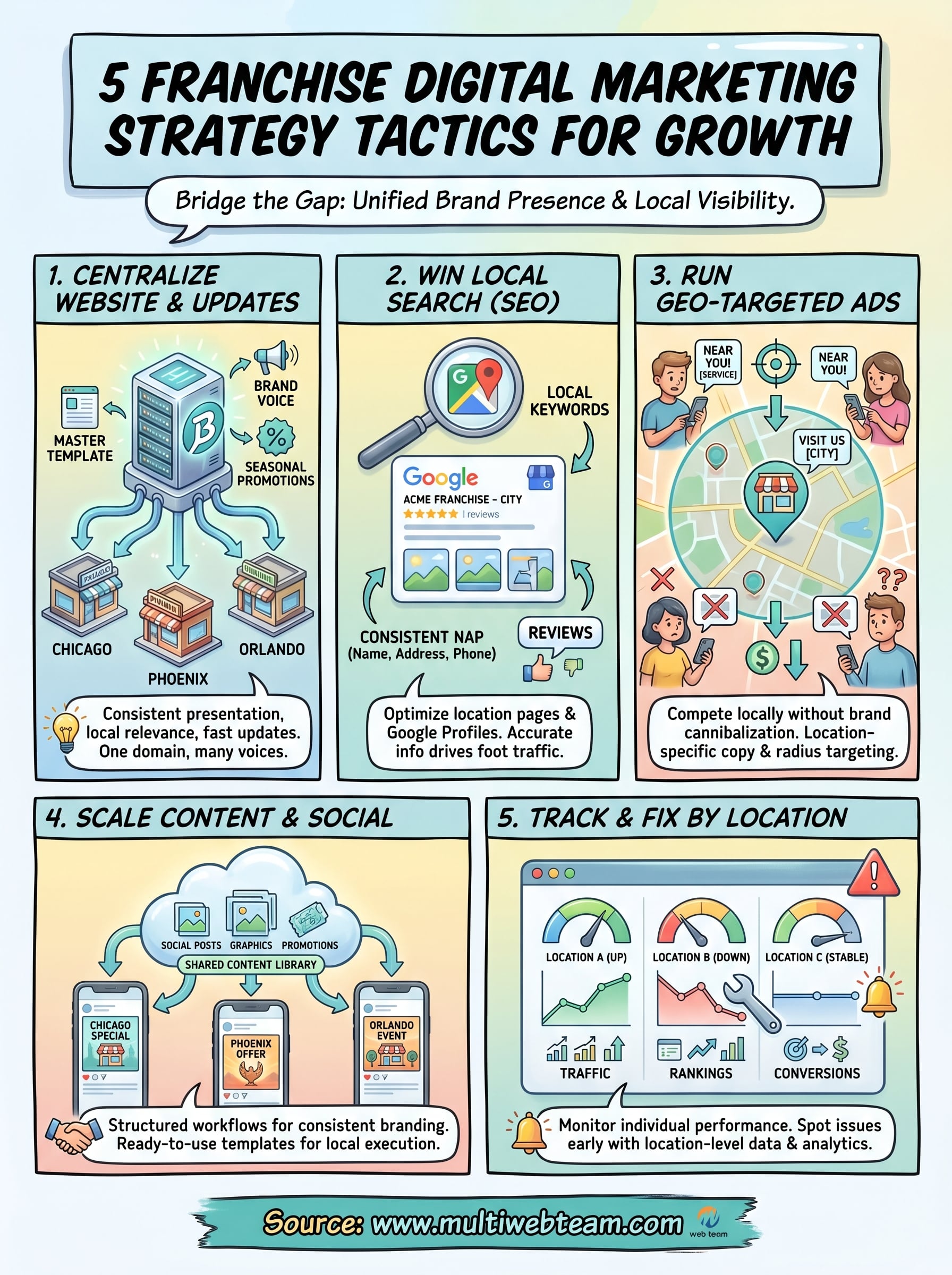
Running a franchise means juggling brand consistency across every location while still making each one feel local and relevant. A solid franchise digital marketing strategy bridges that gap, giving your brand a unified presence online without sacrificing the local visibility that drives foot traffic and phone calls to individual locations.

The challenge most franchise owners face isn't a lack of marketing options. It's the opposite. Between SEO, paid ads, social media, and content marketing, knowing where to focus (and how to keep everything aligned across 5, 50, or 500 locations) can stall growth before it starts. Spreading effort too thin is one of the fastest ways to burn budget with little to show for it .

At Multi Web Team, we build and manage websites for multi-location businesses and franchises, so we see firsthand which digital marketing tactics actually move the needle. This article breaks down five specific tactics that help franchises grow their online presence, attract more customers to each location, and keep brand messaging tight from corporate down to the local level .

1. Centralize your franchise website and updates

A centralized website structure is the foundation of any strong franchise digital marketing strategy . When all your locations live under one domain, you get consistent brand presentation while still letting each location page speak to its local market. Without this foundation, every other tactic you run fragments and loses impact.

What success looks like

Your franchise site is in good shape when it loads fast, carries the same brand voice across every location page, and makes it simple for visitors to find the nearest location. Individual location pages rank in local search for their city or neighborhood, and corporate controls the master template while local operators can freely update hours, photos, and promotions without breaking the design.

When every location page shares the same technical foundation, fixing a site-wide issue takes minutes instead of days.

Step-by-step setup

Start with a subfolder-based domain structure (like domain.com/locations/chicago) for the strongest multi-location SEO foundation . Build a master template that all location pages inherit, identify which fields local managers can edit, and set up a central update workflow so brand and promotion changes push to all locations at once.

  • Use subfolder URLs for location pages
  • Build a locked master template with editable local fields
  • Set a clear approval process for local content changes
  • Establish a regular cadence for seasonal promotions

Common pitfalls and fixes

Giving local operators too much editing freedom too fast is the most common mistake. When every location rewrites its own tagline or changes fonts, brand consistency breaks down across the network. Lock design elements at the corporate level and only open editing access for operational details like hours, team photos, and local promotions.

Watch out for duplicate content across location pages too. Each page needs its own original description , local details, and unique value statements rather than copy-pasted boilerplate.

Budget and staffing notes

You don't need a large internal team to manage this well. A subscription-based management service handles updates, maintenance, and optimization across all locations for a predictable monthly fee, which costs far less than hiring dedicated in-house staff for each location.

Per-change fees add up fast when multiple locations need frequent updates to menus, hours, or local promotions. Flat-rate management removes that unpredictability from your budget entirely and makes it easier to plan ahead.

2. Win local search with location SEO basics

Local search is where your franchise digital marketing strategy converts online visibility into real customers walking through the door. When someone searches "[service] near me," your individual location pages need to show up before your competitors do.

What success looks like

A well-optimized location page ranks in the top results for city-specific searches and pulls traffic from nearby neighborhoods. Google Business Profile listings for each location show accurate hours, photos, and reviews , and your website location pages match that information exactly.

Step-by-step setup

Claim and verify a Google Business Profile for every location, then build out each profile with photos, services, and a local description. Make sure each location page on your website includes the city name, address, and local keywords in the title tag, headers, and body copy.

  • Claim and verify Google Business Profile for each location
  • Add location-specific keywords to page titles and headers
  • Build consistent NAP (name, address, phone) across all directories
  • Collect and respond to customer reviews regularly

Consistent name, address, and phone information across every listing is one of the fastest wins in local SEO.

Common pitfalls and fixes

Many franchises skip duplicate content checks across location pages. Each page needs original local copy , not the same boilerplate text repeated across 50 cities.

Budget and staffing notes

Your budget for local SEO doesn't need to be large, but the work does require consistent attention to keep listings accurate and current as hours and staff change across locations.

3. Run geo-targeted ads that each location can win

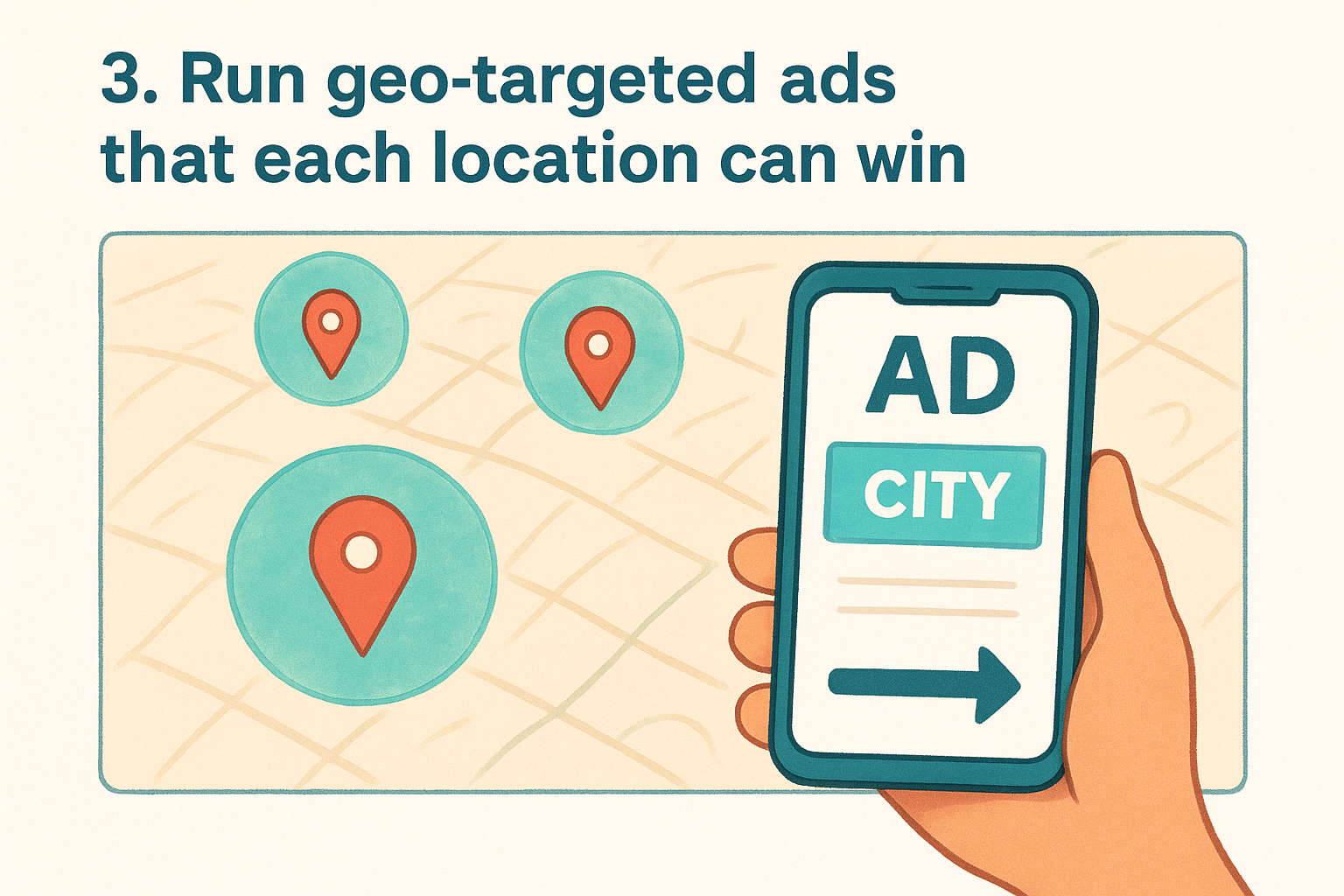
Geo-targeted paid ads let each location compete in its own backyard without cannibalizing the broader brand. When your franchise digital marketing strategy includes location-level ad campaigns, you stop paying for clicks that will never convert because someone is 40 miles away from the nearest store.

What success looks like

Each location runs ads that show only to people within a defined radius of that specific address. Click-through rates are strong because the ad copy references the local area, and cost per lead stays manageable because your budget targets people who can actually become customers.

Location-specific ad copy consistently outperforms generic brand ads when the audience is nearby and ready to act.

Step-by-step setup

Start by setting up a Google Ads location extension for each location and defining the target radius. Write ad copy that includes city or neighborhood names to make the ad feel relevant to the searcher.

  • Set a radius of 5-15 miles per location depending on market density
  • Use location-specific headlines and calls to action
  • Link ads to the correct individual location page, not the homepage
  • Review search term reports weekly to cut irrelevant spend

Common pitfalls and fixes

Sending all paid traffic to the homepage is a common mistake. Visitors land on a generic page and leave without converting. Always point ad clicks to the matching location page so the experience feels seamless from search to site.

Budget and staffing notes

You don't need a massive ad budget to see results. Starting small per location and scaling spend based on actual conversion data keeps risk low while you learn what works in each market.

4. Scale content and social without losing brand control

Content and social media are where brand consistency most commonly breaks down across franchise networks. Without a clear system, individual locations post off-brand graphics, make unauthorized claims, or go dark for weeks at a time. Building your franchise digital marketing strategy around structured content workflows lets you scale output across every location without handing over full creative control.

What success looks like

Your franchise has a content library that local operators can pull from, and corporate pushes ready-to-use posts, graphics, and promotion templates on a regular schedule. Every location maintains an active social presence that feels local without straying from approved brand standards.

A shared content library cuts the time local managers spend on marketing by half while keeping every post on-brand.

Step-by-step setup

Start by building a bank of pre-approved content templates for common scenarios like promotions, seasonal offers, and community posts. Distribute these through a shared folder system that each location manager can access.

  • Create approved post templates for recurring promotions
  • Build a shared image library with on-brand photography
  • Set clear guidelines on what local managers can and cannot change
  • Schedule monthly content drops so locations always have material ready

Common pitfalls and fixes

Leaving locations to create their own graphics from scratch produces inconsistent visual branding fast. Provide locked templates where only text fields are editable so design stays uniform.

Budget and staffing notes

A centralized content production model costs far less than funding individual location marketing efforts separately. Producing content once and distributing it across all locations multiplies your return on every dollar spent.

5. Track results by location and fix leaks fast

Most franchise owners track overall brand performance but miss what's actually happening at the location level. Your franchise digital marketing strategy only improves when you can see which locations are winning and which ones are quietly bleeding traffic, leads, or conversions every month.

What success looks like

You have a clear view of traffic, rankings, and conversion rates for each individual location page. When one location drops in search rankings or sees a spike in bounce rate, you catch it within days, not months, and you know exactly which fix to apply.

Spotting a problem early costs far less to fix than discovering it after six months of lost revenue.

Step-by-step setup

Set up Google Search Console and Google Analytics with location-level filters so you can segment data by page and see how each location performs individually.

  • Connect each location page to its own filtered view in Analytics
  • Monitor organic traffic and rankings monthly per location
  • Set up alerts for sudden traffic drops on any location page
  • Review conversion rates quarterly and compare across locations

Common pitfalls and fixes

Tracking site-wide averages hides individual location problems. One underperforming location drags down your numbers without triggering any alarm. Break every report down by location URL so nothing slips through.

Budget and staffing notes

Free tools handle most of this tracking work without adding software costs. The real investment is time spent reviewing the data consistently each month.

Next steps

These five tactics cover the core of what a strong franchise digital marketing strategy requires: a centralized website, location-level SEO, geo-targeted ads, structured content distribution , and consistent performance tracking. Each tactic builds on the others, so gaps in one area weaken the rest. The good news is that you don't need to fix everything at once. Start with your website structure and location pages, get those right, and the other tactics become much easier to execute and measure.

The biggest barrier most franchise owners face isn't knowing what to do. It's having the time and team to do it consistently across every location. That's exactly the problem Multi Web Team solves. If you're ready to build a web presence that works for every location in your network without managing it all in-house, talk to the Multi Web Team about what a subscription-based website management plan looks like for your franchise.

By cinchweb May 3, 2026
Learn how to optimize google business profile to boost local rankings. Master NAP consistency, reviews, and photos to win more customers in 2026.
By cinchweb May 3, 2026
Compare the 9 best local citation building service options for 2026. Find the right tool to manage your listings and rank higher in local search results.
By cinchweb May 3, 2026
Compare 11 small business seo packages for 2026. Find the right pricing and service features for your single-location shop or multi-location franchise.
By cinchweb April 29, 2026
Learn what is google business profile optimization and how to boost local rankings. This guide covers reviews, photos, and multi-location scaling.
By cinchweb April 28, 2026
Find out how much does website management cost in 2026. Compare monthly prices for small businesses, eCommerce, and franchises to plan your budget.
By cinchweb April 27, 2026
What is franchise marketing? Learn how to balance national brand power with local growth through targeted SEO and neighborhood-specific promotions.
By cinchweb April 27, 2026
Convert visitors into customers with 12 small business website best practices. Learn to optimize for local SEO, mobile users, and site speed to grow sales.
By cinchweb April 25, 2026
Compare the 15 best web design services for small businesses in 2026. Find the right agency or DIY tool to build your site and grow your online presence.
By cinchweb April 24, 2026
Learn how to get more google reviews with 8 easy tactics. Use automation, QR codes, and smart timing to boost your local ratings and scale your business.
By cinchweb April 23, 2026
Compare pricing for 7 monthly website maintenance plans to find the right fit. Learn how to balance cost, security, and SEO for your business in 2026.
SHOW MORE