Local SEO Optimization Services: What To Expect In 2026
Hiring the right team to handle your local search presence can be the difference between a location that thrives and one that gets buried beneath competitors. Local SEO optimization services have shifted significantly over the past few years, and what worked in 2024 looks noticeably different from what's driving results now. If you're shopping for a provider in 2026, you need to know what's actually worth paying for , and what's just recycled tactics with a new price tag.
For multi-location businesses and franchises, the stakes are even higher. Each location needs to rank in its own market, with its own optimized presence, while still maintaining brand consistency across the board. That's a challenge most general-purpose agencies aren't built to solve. At Multi Web Team, we handle local SEO management for multi-location businesses every day, it's core to what we do alongside custom web design and ongoing site management. So we have a clear, practical view of where this service category stands right now and where it's headed.
This article breaks down what local SEO optimization services actually include in 2026, how pricing and deliverables have changed, and what to look for (and avoid) when choosing a provider. Whether you're managing five locations or fifty , the goal here is to give you enough context to make a confident, informed hiring decision. No jargon walls, no vague promises , just a straight look at what to expect.
Why local SEO optimization services matter in 2026
Search behavior has shifted toward local intent faster than most businesses anticipated. Google reports that searches with location-based modifiers continue growing year over year, with a large share happening on mobile devices where users are ready to act immediately. If your locations aren't showing up in the Google Local Pack or Maps results , you're losing customers to competitors who are, often before those customers ever reach your website.
The search landscape favors proximity and relevance
Google's algorithm weighs proximity, relevance, and prominence when determining which local businesses appear in results. Proximity is how close your location is to the searcher. Relevance is how well your business information matches the search query. Prominence reflects how trusted and well-known your business appears online, based on reviews, citations, and links pointing to your site. Keeping all three factors in alignment across multiple locations requires ongoing work, not a one-time setup.
If your Google Business Profile is incomplete or inconsistent, proximity alone won't save you from being outranked by a competitor with a stronger, better-maintained online presence.
AI-generated search results are raising the bar
Generative AI features in search , including Google's AI Overviews, now pull directly from structured business data, reviews, and authoritative sources to build answers for users. If your business data is clean, consistent, and regularly updated , you stand a better chance of being surfaced in those responses. Messy or contradictory data across platforms gets filtered out before users ever see a list of options.
For multi-location businesses, this plays out at scale. A single inconsistent address format or outdated phone number repeated across dozens of directory listings can suppress visibility for an entire location. Local SEO optimization services that include citation management and profile auditing are no longer optional; they're a core part of staying visible in a search environment where AI does more of the filtering work.
Your competitors are not standing still
The businesses ranking above you right now are most likely actively managing their local SEO , not just setting it up once. In 2026, the barrier to entry in competitive local markets has risen. More businesses understand that reviews, location pages , and Google Business Profiles need regular updates, and they're paying for that ongoing work.
Consistent local SEO investment also compounds over time. A business that has maintained accurate citations, accumulated genuine reviews, and updated its location content steadily over two years will outperform one that recently tried to close the gap with a one-time fix. That time advantage is real , which is why strengthening your local search efforts now makes a measurable difference to your rankings and customer acquisition.
What local SEO optimization services include
Most providers package their work differently, but local SEO optimization services typically cover a consistent set of core activities. Understanding what those activities are helps you evaluate proposals , spot gaps in what you're being offered, and hold a provider accountable for actual deliverables rather than vague monthly reports.
Google Business Profile management
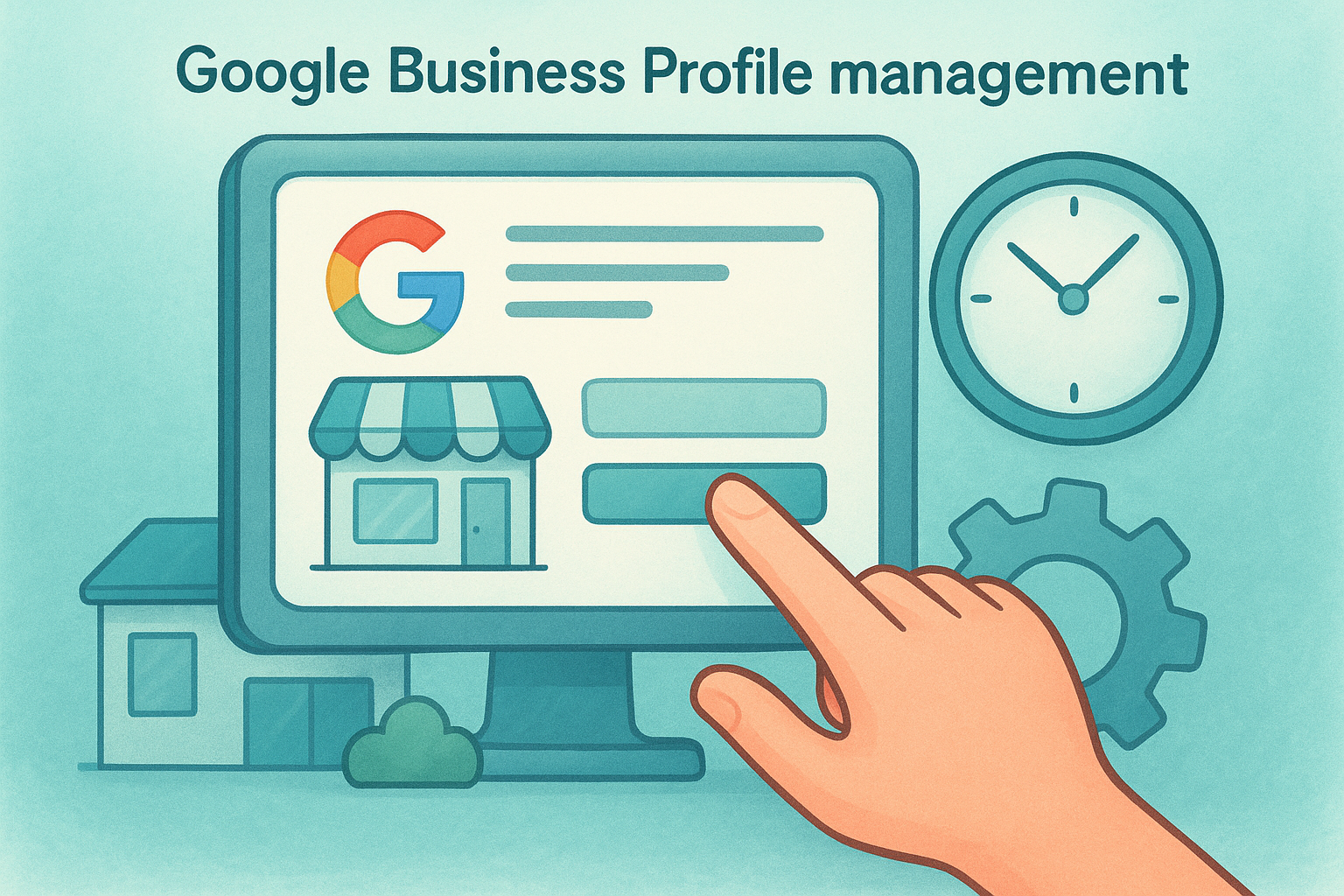
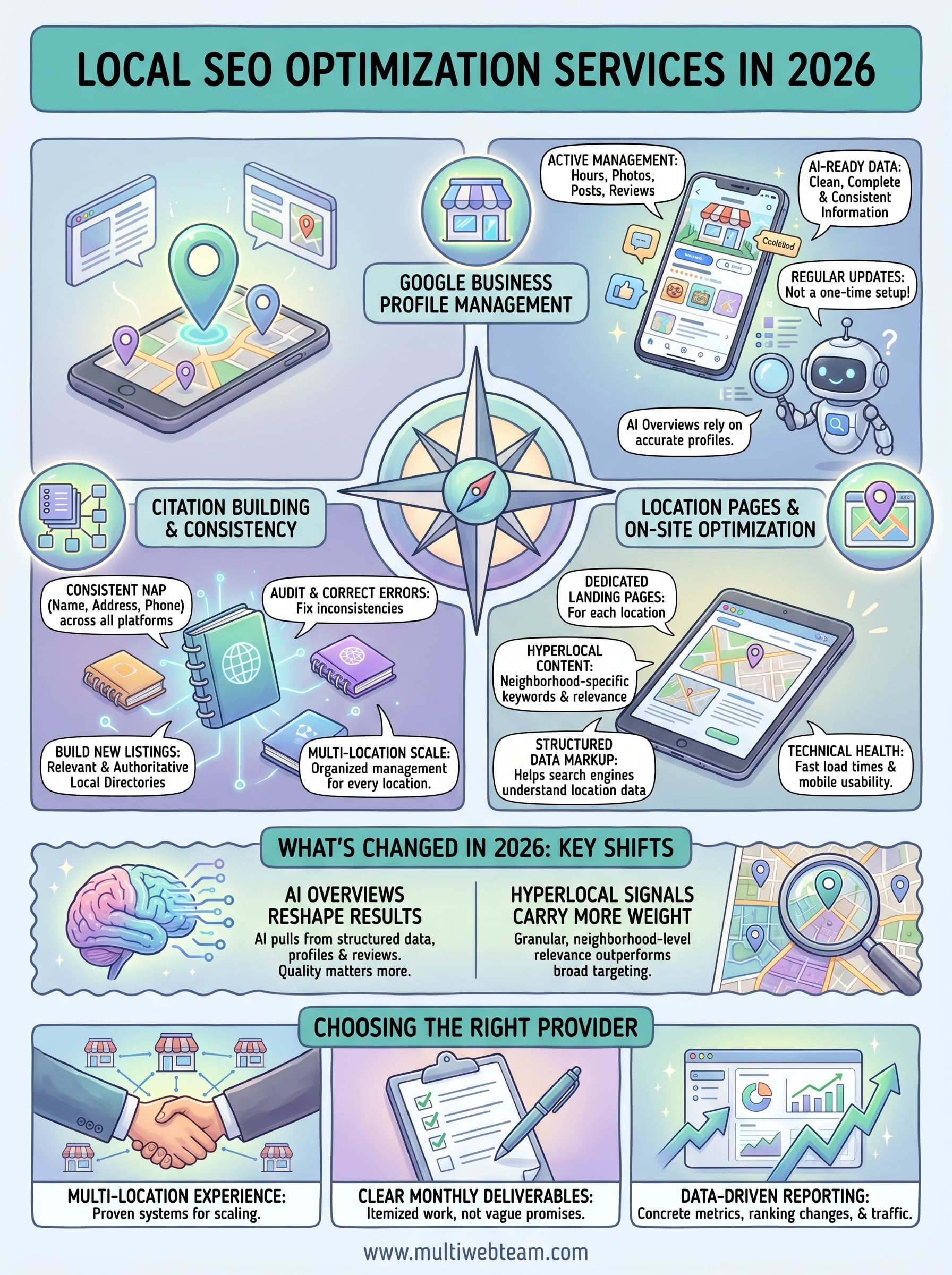
Your Google Business Profile is the single most visible piece of your local search presence. It controls what appears in the Local Pack, Google Maps, and increasingly, AI-generated search responses. A provider should be managing your profile actively, which means keeping business hours, photos, services, and posts updated on a regular cadence, not just setting it up once and leaving it alone.
An outdated or incomplete Google Business Profile can cost you ranking positions even when every other part of your local SEO strategy is solid.
Citation building and consistency
Citations are mentions of your business name, address, and phone number across directories, data aggregators, and review platforms. Inconsistent citations, even minor differences like "St." versus "Street," can confuse search engines and suppress your ranking. A solid provider audits your existing citations, corrects errors, and builds new listings in authoritative directories that are relevant to your industry and location.
For multi-location businesses, this work multiplies across every location you operate. Each location needs its own clean, consistent citation profile tied to its specific address, which requires organized, systematic management rather than occasional spot fixes.
Location pages and on-site optimization
Your website needs dedicated landing pages for each location, and those pages need to do more than list an address. Each page should include locally relevant content, embedded maps, structured data markup, and location-specific keywords that connect to what people in that area are actually searching for. On-site optimization also covers technical elements like page speed, mobile usability, and schema markup that help search engines correctly identify and categorize each location.
Providers that skip location pages or deliver generic, templated content across all locations are leaving a significant amount of local search visibility unclaimed for your business.
How local SEO optimization services work step by step
Most people shopping for local SEO optimization services don't have a clear picture of what the actual workflow looks like once you hire a provider. Understanding the process helps you set realistic expectations, track progress, and push back if a provider isn't delivering on what they promised.
Audit your current local presence
Before any optimization work begins, a provider needs to assess where you stand right now . That means pulling your existing Google Business Profiles, checking citation consistency across major directories, reviewing your location pages, and identifying technical issues on your site. The audit gives both sides a clear starting point and surfaces the highest-priority problems to fix first.
A thorough audit often reveals citation errors or duplicate listings that have been quietly suppressing rankings for months without the business owner knowing.
Fix and build your foundational assets
Once the audit is complete, the provider moves into cleanup and construction . This phase includes correcting citation errors, optimizing or creating Google Business Profiles for each location, building or improving location pages on your website, and adding structured data markup so search engines can accurately read your business information. For multi-location businesses, this phase scales with each location, so the timeline depends on how many profiles and pages need work.
Your website's technical health also gets addressed during this phase. Slow load times, missing schema tags, and poor mobile usability all affect how well your location pages compete in local results. Fixing these issues early creates a stronger foundation for everything that follows.
Maintain and improve results over time
Local SEO is not a project you finish; it's an ongoing process. After the foundation is set, a provider shifts into regular maintenance mode , which includes updating your Google Business Profiles with fresh photos and posts, responding to new reviews, monitoring ranking changes, and refreshing location page content to stay relevant. Search engines reward active, well-maintained business listings over static ones, which is why consistent management drives better long-term results than a one-time setup ever could.
What changes in local SEO in 2026
Several shifts in how search engines handle local results have taken effect in 2026, and they directly affect what local SEO optimization services need to deliver to stay effective. Some changes are technical, some behavioral, but all of them require providers to update their approach rather than running the same playbook from two years ago.
AI Overviews are reshaping how local results surface
Google's AI Overviews now appear for a growing share of local search queries, pulling business information directly from structured data, Google Business Profiles, and verified sources. Businesses with clean, complete, and consistently updated profiles get surfaced in these responses more reliably than those with sparse or outdated data. The implication is direct: profile quality matters more than it ever did when rankings were purely link-driven.

Businesses that treat their Google Business Profile as a set-it-and-forget-it task are getting filtered out of AI-generated responses in favor of competitors who actively manage their data.
Review signals have also grown heavier in AI-generated local results. The volume, recency, and quality of your reviews now influence whether AI features mention your location at all, not just where you rank in the traditional local pack.
Hyperlocal signals carry more weight
Search engines have become better at distinguishing neighborhood-level relevance from city-level relevance in 2026. A business optimized for "Dallas" is no longer competing on equal footing with one optimized for the specific neighborhood where a searcher is located. Providers that build location pages with granular, neighborhood-specific content consistently outperform those still relying on city-level keyword targeting alone.
This shift also affects how citations are evaluated. Listings in locally relevant directories , community platforms, and industry-specific sources now carry stronger signals than broad, generic directories that lump every business category together. Your provider needs to understand this distinction and structure your citation profile accordingly, especially if you're managing multiple locations across different markets where the relevant local directories vary from city to city.
How to choose the right local SEO provider
Choosing a provider for local SEO optimization services is not just about finding someone who knows the basics. You need someone who understands your specific business structure, delivers consistent work across all your locations, and reports results in a way that actually tells you something useful.
Look for multi-location experience
Not every SEO provider is built to handle multiple locations at scale . Many agencies operate well for a single-location business where one Google Business Profile, one set of citations, and one location page cover everything. When you add multiple markets to that picture, the workload multiplies and the coordination requirements become more demanding. You want a provider who has a clear system for managing location-level work without letting individual locations fall behind.
Ask directly how they handle clients with five, ten, or twenty-plus locations. A provider with genuine multi-location experience will describe a structured process , not improvise an answer on the spot.
Check what's actually included in the service
Some providers sell you on a monthly retainer and then deliver thin reports with little actual work behind them. Before signing anything, get a written breakdown of exactly what gets done each month : which profiles get updated, how many citations get audited or built, whether location pages get refreshed, and who handles review monitoring. Vague deliverables lead to disappointment.
A provider who hesitates to itemize their monthly work is usually one whose monthly work isn't worth itemizing.
Verify how they report results
Reporting quality separates providers who are accountable from those who are not. You should receive regular updates that show concrete metrics: ranking changes by location, Google Business Profile performance data, citation accuracy scores, and traffic trends for your location pages. If a provider's reporting style amounts to a summary paragraph with no supporting data, that's a problem.
Ask to see a sample report from a current or past client before you commit. A transparent provider will show you exactly how they communicate progress and where they track results, giving you a clear picture of what accountability looks like once the work is underway.
How much local SEO optimization services cost
Pricing for local SEO optimization services varies widely depending on the scope of work, number of locations, and how much active management you need each month. A basic single-location package from a freelancer might start around $300 to $500 per month , while a full-service agency handling ongoing Google Business Profile management, citation work, and location page optimization for multiple locations typically runs $1,000 to $3,000 per month or more . The range is wide because the work itself scales with your business size.
Single-location vs. multi-location pricing
A single-location business needs one profile managed, one citation profile maintained, and one set of location pages kept current. That's a contained scope, and pricing reflects it. Multi-location businesses pay more because every location requires its own optimized profile, citations, and content updates running in parallel. Some providers charge a flat monthly fee that covers all locations, while others price per location , which can add up quickly as you grow.
If you're managing ten or more locations, make sure you understand exactly how a provider structures pricing before you commit. A per-location fee that seems reasonable at five locations can become a budget problem at twenty.
What drives the price up
Several factors push the monthly cost higher beyond just location count. Market competitiveness plays a role: ranking in a saturated market like a major metro area requires more ongoing effort than ranking in a smaller market with fewer active competitors. The depth of citation cleanup needed also affects cost, especially if your existing data is inconsistent across dozens of directories and needs systematic correction.
Providers who charge less upfront but skip citation auditing or location page optimization tend to cost more in the long run when those gaps drag down your rankings.
What you should expect to get for your budget
At any price point, you should receive a clear list of monthly deliverables , regular reporting, and a dedicated point of contact who knows your account. Budget providers often automate work that should be done manually, which produces faster outputs and weaker results. Paying for quality work from a provider with real multi-location experience is almost always a better return than paying less for generic, templated activity that doesn't move rankings in your specific markets.
Next steps
You now have a clear picture of what local SEO optimization services actually cover, how pricing works, and what separates providers that deliver from those that don't. The next move is straightforward: audit your current local presence, identify where your locations are losing ground, and find a provider whose process matches the scale and structure of your business.
For multi-location businesses and franchises , the right fit is a team that already knows how to manage individual location visibility without letting any single market slip through the cracks. That's exactly what we do at Multi Web Team. We handle custom web design, location-specific SEO, and ongoing site management under one subscription, so you stop juggling vendors and start seeing consistent results across every location you run.
If you're ready to put your web presence in the hands of a team built for your business model, visit Multi Web Team to learn more.