

Local SEO Essentials: How To Build Local Citations In 2026
Your business exists in more places online than you probably realize. Every directory listing, every map pin, every mention of your name, address, and phone number across the web either helps or hurts your local search visibility. For multi-location businesses and franchises, the stakes multiply fast. Knowing how to build local citations correctly can mean the difference between showing up when a nearby customer searches for your services, or getting buried beneath competitors who did the work.
Local citations remain one of the most practical ranking factors in local SEO heading into 2026. They signal to Google that your business is real, established, and located exactly where you say it is. But when you're managing five, ten, or fifty locations, keeping every citation accurate and consistent becomes a genuine operational challenge. One wrong phone number or outdated address can quietly erode your rankings for an entire location. At Multi Web Team, we handle multi-location SEO management daily for our clients, so we've seen firsthand how proper citation building drives real local traffic.
This guide breaks down the full process step by step, from auditing your current citations and choosing the right directories, to submitting your business information accurately and maintaining it over time. Whether you're launching a new location or cleaning up years of inconsistent data, you'll walk away with a clear action plan you can start using right away.
What local citations are and why they still matter in 2026
A local citation is any online mention of your business's name, address, and phone number . Citations appear on formal directory sites like Yelp, Google Business Profile, and Apple Maps, but they also show up in local news articles, blog posts, chamber of commerce pages, and community websites. When you understand how to build local citations correctly , you're essentially creating a consistent digital footprint that search engines use to verify your business is real and located exactly where you say it is. The more authoritative sources confirm that information, the stronger the trust signal becomes.
The three parts of a citation: NAP
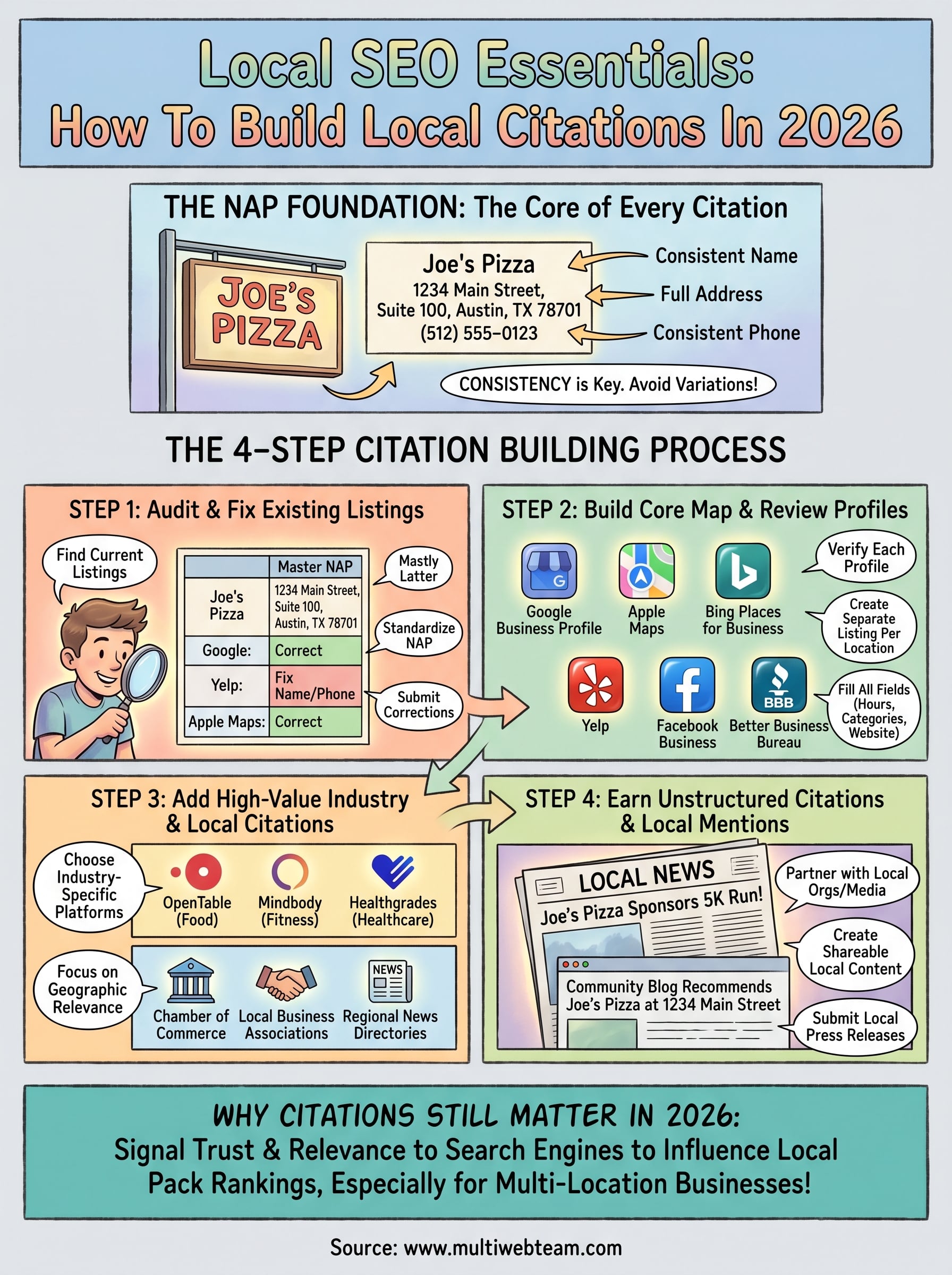
NAP stands for Name, Address, and Phone number , and these three data points form the foundation of every citation you'll ever build. Consistency across those three fields matters more than the total number of citations you have. If your business name appears as "Joe's Pizza" on one site and "Joe's Pizzeria LLC" on another, search engines treat those as two separate entities , which dilutes the trust signal each citation is supposed to generate.
Here's a simple example of a properly formatted NAP entry you should use everywhere:
Business Name: Joe's Pizza
Address: 1234 Main Street, Suite 100, Austin, TX 78701
Phone: (512) 555-0123
Lock this format in before you submit anywhere. Abbreviating "Street" to "St." on some platforms and spelling it out fully on others seems trivial, but those small variations compound quickly across dozens of directories and create inconsistency that weakens your citation profile over time.
Why citations still influence local rankings in 2026
Google's local search algorithm uses citation signals to determine how prominently to feature your business in local pack results . When authoritative directories consistently confirm your business name, location, and phone number, Google gains confidence that your listing is accurate and trustworthy. Google has detailed how business information and structured data factor into its systems in its Search Central documentation.
The more high-quality sources that confirm your business details, the more confidently Google surfaces your listings to nearby searchers.
For multi-location businesses and franchises , this dynamic plays out at scale. Each location needs its own independent citation profile built around that location's specific address and phone number. A franchise with 20 locations that only optimizes the flagship location leaves 19 storefronts competing at a disadvantage , regardless of how strong the brand is overall.
Structured vs. unstructured citations
Structured citations appear on formal directory and review platforms where your business information populates specific data fields: name, address, phone number, and website. Examples include Google Business Profile, Yelp, and Bing Places for Business. Unstructured citations show up inside written content, such as a local news outlet mentioning your business name and address in an event story or a neighborhood blog recommending your location. Both carry ranking value, but structured citations are easier to build systematically and verify at scale. As you work through the steps in this guide, you'll build both types deliberately rather than leaving either to chance.
Step 1. Audit your existing listings and fix NAP issues
Before you understand how to build local citations that actually move rankings, you need a clear picture of what already exists online. Duplicate listings, outdated phone numbers, and old addresses are common for businesses that have moved, rebranded, or expanded. Unresolved NAP inconsistencies undermine every new citation you add, so auditing and correcting existing data is always your first priority .
Find your current listings
Start by searching Google for your exact business name in quotes alongside your city and state. Work through the first few pages of results and note every directory listing you find. Also search for old addresses or previous phone numbers your business may have used, since those versions often persist in directories long after you've stopped using them.
Search your business name on Google Business Profile and Bing Places specifically to check whether duplicate listings exist under previous ownership or former addresses.
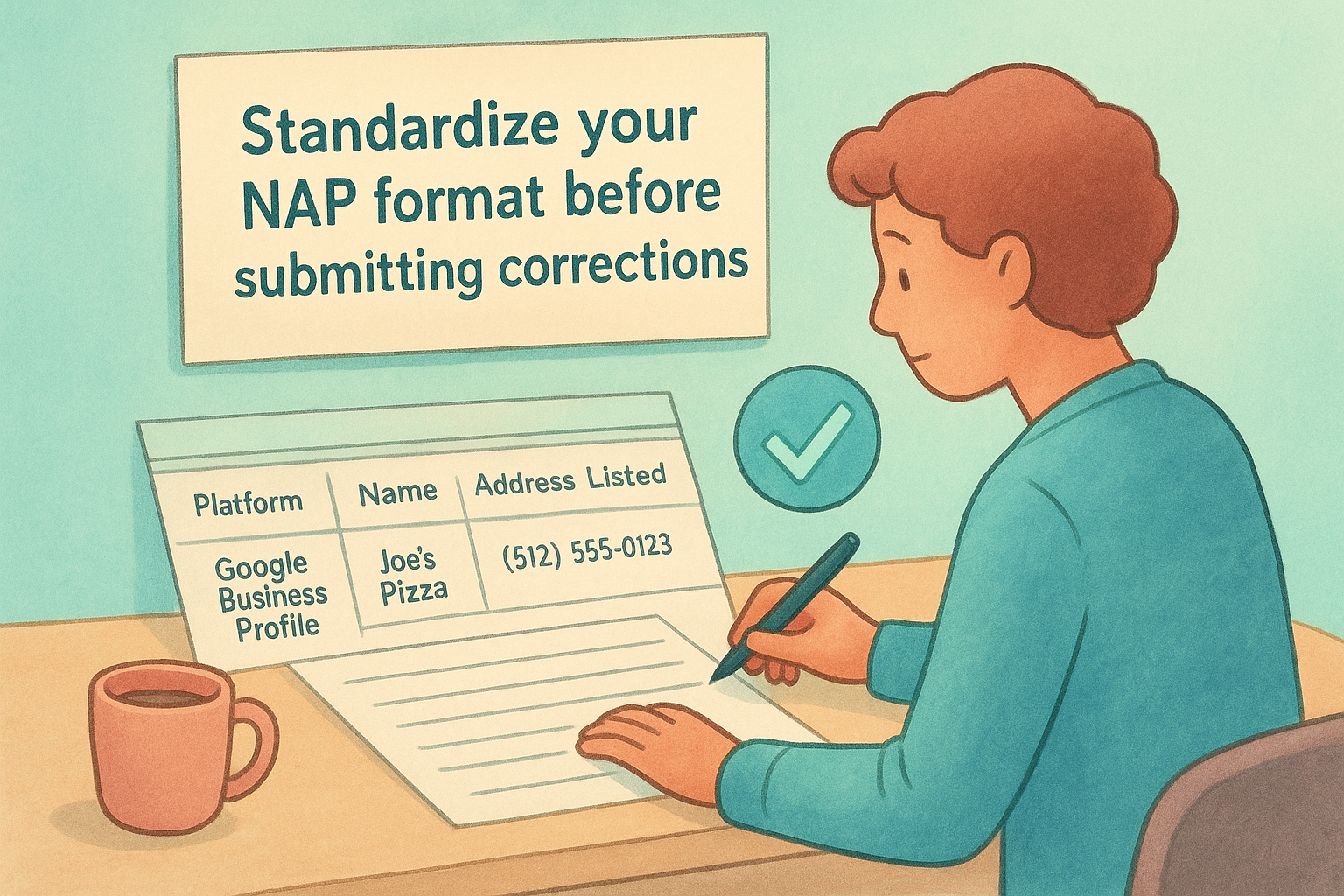
After your manual search, compile every listing into a tracking spreadsheet. Record the platform name, the NAP data currently shown, and whether each entry needs a correction, a claim, or removal.
Standardize your NAP format before submitting corrections
Once you have your full list, pick a single master NAP format and apply it everywhere. Use your legal business name exactly as it appears on official documents, write your full street address without abbreviations, and use one consistent phone number per location. For multi-location businesses, each location needs its own dedicated row in your tracking sheet with location-specific data.
Use this template as your starting point:
| Platform | Name Listed | Address Listed | Phone Listed | Action Needed |
|---|---|---|---|---|
| Google Business Profile | Joe's Pizza | 1234 Main Street, Austin, TX 78701 | (512) 555-0123 | Correct |
| Yelp | Joe's Pizzeria LLC | 1234 Main St, Austin | 5125550123 | Fix name + phone format |
| Apple Maps | Joe's Pizza | 1234 Main Street, Austin, TX 78701 | (512) 555-0123 | Correct |
Work through each row and submit corrections directly on the platform. Claim any unclaimed listings before editing them, since most directories require ownership verification before they allow changes to go through.
Step 2. Build your core citations on maps, reviews, and social
Once your audit is complete and your NAP format is locked in, you're ready to start building. The most impactful place to begin when learning how to build local citations that drive rankings is with map platforms, review sites, and social profiles . These properties carry the highest domain authority and are the first sources Google cross-references when verifying your business information. Getting these right sets a strong foundation before you move into industry-specific directories.
Start with the big three map platforms
Your three mandatory submissions are Google Business Profile, Apple Maps, and Bing Places for Business . Google Business Profile carries the most weight for local pack rankings, so claim and verify that listing first at business.google.com , where verification typically requires a postcard, phone call, or video confirmation. After Google, submit to Apple Maps Connect and Bing Places using the exact NAP format you standardized in Step 1.
Completing all three map platforms before moving to other directories ensures your most authoritative citations are accurate from the start.
For each location you operate , create a separate listing. Do not consolidate multiple locations under one profile. Each listing needs its own unique address, phone number, and a dedicated landing page URL pointing to that specific location on your website.
Add your review and social profiles
Yelp for Business, Facebook Business Pages, and the Better Business Bureau round out your core citation set. These platforms see heavy consumer traffic and are frequently crawled by data aggregators that feed information to smaller directories downstream. Claim each profile using your verified NAP data, and create a separate Business Page or listing for each location rather than listing multiple addresses under one account.
Fill every available field on each platform: business hours, categories, website URL, and a location-specific description . Incomplete profiles reduce the trust signal each listing sends to search engines, so treat every field as a ranking opportunity rather than an optional extra.
Step 3. Add high-value industry and local directory citations
After locking in your core map and review citations, the next layer of how to build local citations involves targeting directories specific to your industry and geographic area. These platforms carry real authority with Google because they attract visitors actively searching for your type of business, which means citations here signal relevance in addition to confirming your location.
Choose industry-specific directories that match your business type
Your industry determines which directories carry the most weight . A fitness studio benefits from listings on Mindbody and ClassPass, while a restaurant gains ground on OpenTable and Zomato. A healthcare business should be present on Healthgrades and Zocdoc. Match your submissions to where your actual customers search , not just where it's easiest to list.
Here are examples by industry:
| Industry | High-Value Directories |
|---|---|
| Food & Beverage | OpenTable, Zomato, TripAdvisor |
| Fitness & Wellness | Mindbody, ClassPass, Healthgrades |
| Home Services | Angi, HomeAdvisor, Houzz |
| Retail | Foursquare, Nextdoor, Chamber of Commerce sites |
| Healthcare | Healthgrades, Zocdoc, Vitals |
Submit your exact NAP format to each platform and complete every available profile field , including business categories, hours, and your location-specific website URL.
Submit to local and regional directories
Beyond industry platforms, local and regional directories add geographic relevance to your citation profile. Your city's chamber of commerce website, local business associations, and regional news outlet directories are all strong targets. These sources tend to carry high local authority because they focus exclusively on businesses within a specific area.
A citation from your city's chamber of commerce carries more geographic relevance than a general national directory, making it a high-priority submission for every location you operate.
To find local directories worth targeting, search Google for "[your city] business directory" or "[your industry] [your city] listings." Contact the organization directly if there's no self-serve submission option. Most local chambers and associations list businesses at low or no cost for members , which makes this one of the highest-value citation activities relative to the effort required.
Step 4. Earn unstructured citations and local mentions that count
Unstructured citations are the mentions of your business name, address, or phone number that appear inside written content rather than inside formal directory fields. A local news article covering a new location opening, a neighborhood blog recommending your services, or a community organization's event recap can all generate strong citation signals without a structured directory submission in sight. As you work through how to build local citations at this level, you're shifting from submitting data to actively earning coverage through relationships and content.
Partner with local organizations and media
Local sponsorships, charity partnerships, and community events are reliable ways to earn unstructured citations from high-authority local sources . When your business sponsors a local 5K or partners with a neighborhood association, the event organizer typically publishes your business name and address on their website. Reach out directly to local chambers of commerce, school booster clubs, and nonprofit organizations in each area where you operate and ask about sponsorship or partnership opportunities that include a website mention.
A single mention on a trusted local news site or community organization page can carry more geographic relevance than dozens of low-quality directory submissions.
Create content that earns natural mentions
Publishing genuinely useful local content gives bloggers, journalists, and community sites something worth referencing. A guide to local events in your city, a resource page for customers in a specific neighborhood, or a data-driven piece about your industry in your region are all formats that attract natural links and mentions over time. Publish this content on your own site and share it with local journalists and bloggers who cover your area.
You can also submit press releases to local news outlets when you open a new location, hit a business milestone, or launch a community initiative. Use the exact NAP format you established in Step 1 within every press release, so any publication that runs the story carries your accurate business information automatically.
Next steps
You now have a complete framework for how to build local citations that actually move your rankings: audit and fix what exists, lock in your NAP format, build your core map and review profiles, add industry and local directory listings, and earn unstructured mentions through real community relationships. Every step compounds the one before it , so work through them in order rather than jumping straight to directory submissions.
For multi-location businesses and franchises, this process scales across every location you operate. That means dozens of listings to claim, verify, and maintain on an ongoing basis, since citations go stale when phone numbers change, locations move, or new listings appear without your knowledge. Staying on top of that work is a real commitment.
If you'd rather hand that responsibility to a team that handles it daily, explore Multi Web Team's multi-location SEO management services to see how we keep every location's citation profile accurate and optimized.