10 Local SEO Best Practices to Rank in Every Location
Ranking one location in Google is hard enough. Now multiply that effort across five, ten, or fifty locations, each with its own competitors, search results, and customer base. That's the reality for multi-location businesses and franchises, and it's exactly why local SEO best practices matter more when you're scaling. Get them right, and each location becomes a magnet for nearby customers searching for what you offer. Get them wrong, and you're invisible in the places where it counts most.
Here's what makes local SEO tricky for growing businesses: Google treats each location as its own entity. A strategy that works for your flagship store won't automatically lift your newest one. Each location needs individual attention , its own optimized profile, localized content, consistent citations, and review management. That's a lot of moving parts, and it's one of the core reasons we built Multi Web Team around managing web presence for multi-location businesses . We handle this work daily for franchise owners and operators who'd rather focus on running their business than chasing algorithm updates.
This guide breaks down 10 proven local SEO practices that help businesses rank in every location they serve. Whether you're managing your SEO in-house or considering outside help, you'll walk away with a clear, actionable framework , not vague theory. Each practice is something we've applied across real multi-location sites, and we'll explain why it works and how to implement it so you can start making progress right away.
1. Run a managed multi-location website with Multi Web Team
Managing local SEO across multiple locations is not a one-time project. It's a continuous operation that requires consistent updates, location-specific content , and technical oversight across every page on your site. Multi Web Team is built specifically for this kind of work, handling web design, ongoing management, and local SEO for franchises and multi-location businesses under a single subscription model .
What this solves for multi-location brands
Most multi-location businesses hit the same wall: they build a website, launch a few location pages, and then struggle to maintain them. Outdated hours, stale promotions, and thin content pile up fast when no dedicated team owns the updates. Multi Web Team eliminates that gap by acting as your external web team , keeping every location page current and search-ready without adding internal headcount.
The biggest risk for multi-location brands is not getting started, it's losing momentum after launch.
How to set up a scalable location structure
Your website architecture determines how well Google can crawl, index, and rank each location. A dedicated URL for every location , such as yoursite.com/locations/city-name, gives Google a clear signal that each location is a distinct entity. Multi Web Team builds these structures from the ground up, so every location page has its own crawlable URL, locally relevant content , and proper internal linking to support rankings.
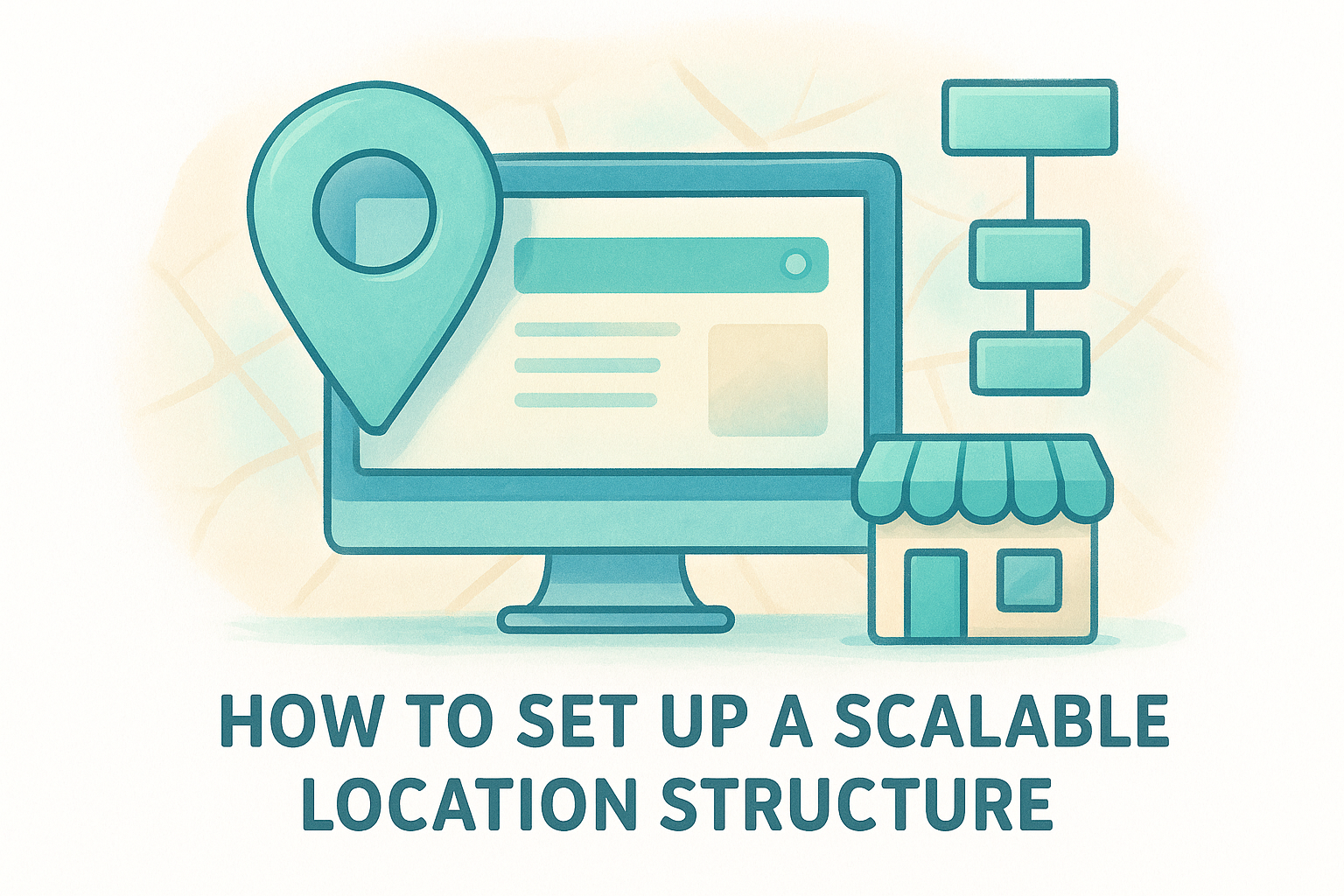
A disorganized site structure hurts your ability to follow local SEO best practices at scale. When your architecture is solid, adding a new location becomes a repeatable process rather than a scramble.
How to keep every location page updated without delays
Stale pages lose rankings. Outdated promotions or incorrect business hours damage both your SEO and customer trust. Multi Web Team's subscription model includes unlimited updates, so when a location changes its hours, adds a new service, or runs a seasonal offer, those changes go live fast without extra fees or approval queues.
Consistent, accurate, and current pages across every location give Google fresh signals to work with and give customers the information they need to act.
2. Optimize Google Business Profile for each location
Your Google Business Profile(GBP) is often the first thing a nearby customer sees when they search for your service. For multi-location businesses, each location needs its own fully optimized profile. Treating GBP as an afterthought is one of the fastest ways to lose local rankings, and one of the most common violations of local SEO best practices .
Choose the right categories and services per location
Your primary category carries the most weight in how Google decides when to show your listing. Pick the most specific category that accurately describes what that location does , and add secondary categories only when they genuinely apply. Beyond categories, fill out your services section with location-relevant offerings , since this helps Google match your listing to specific search queries in that market.
Use photos, posts, and Q&A to improve engagement signals
Photos drive clicks, and clicks send engagement signals back to Google. Upload real, location-specific photos of the storefront, interior, team, and products rather than generic stock images. Use the Posts feature to share current promotions and updates, and actively seed your Q&A section with common questions and clear answers before customers ask them.
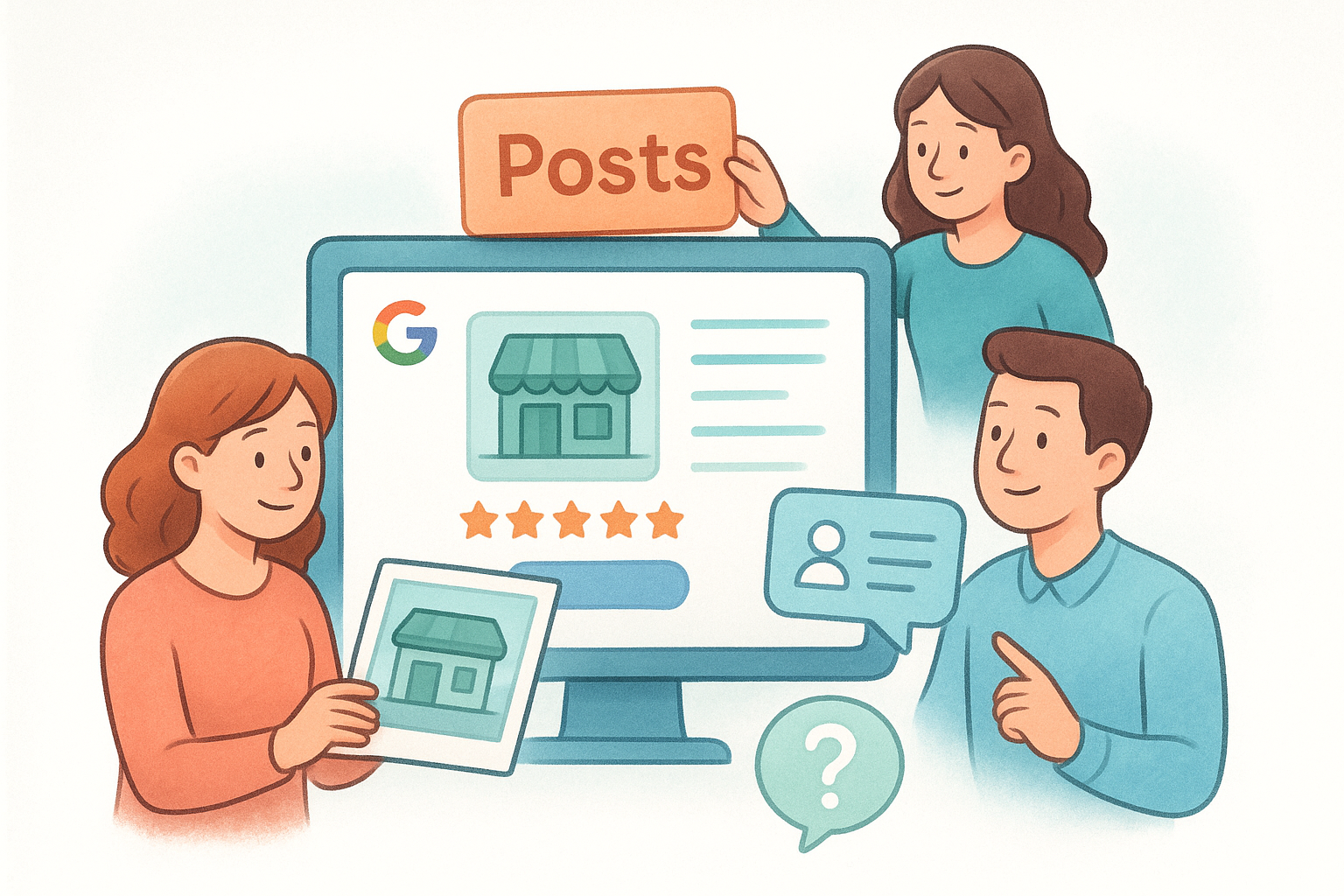
Profiles with regular photo updates consistently outperform stagnant listings in local map pack rankings.
Prevent duplicates, suspensions, and listing conflicts
Duplicate listings split your authority and confuse both Google and customers. Audit each location's profile regularly to catch duplicates, outdated information, or conflicting data. If a listing gets suspended, address it through Google's reinstatement process immediately, since unresolved suspensions wipe your visibility in that market.
3. Lock down NAP consistency and citations
NAP stands for name, address, and phone number, and inconsistent NAP data is one of the most common reasons local businesses lose rankings they should be winning. Google cross-references your business information across dozens of data sources, and conflicting details create confusion that quietly erodes your visibility across every location. Getting this right is a foundational part of any local SEO best practices checklist.
Standardize your name, address, and phone formats
Pick one format for your business name and stick to it everywhere. If your storefront reads "Metro Fitness Club," don't list it as "Metro Fitness" on Yelp and "Metro Fitness Club LLC" on Google . The same rule applies to your address: decide how you abbreviate "Street" vs. "St." and apply it consistently across every single citation without exception.
Build and clean up key directory listings
Start with the highest-authority directories: Google Business Profile, Apple Maps, Bing Places, and Yelp . Then audit secondary directories systematically, checking for outdated addresses, wrong phone numbers, or duplicate listings. Remove or merge duplicates rather than ignoring them , since split listings divide your authority and send conflicting signals to Google.
Duplicate or conflicting citations are often the hidden reason a location page underperforms despite solid on-page work.
Handle tricky cases like suites, call tracking, and relocations
Suite numbers, shared buildings, and call tracking numbers all introduce NAP friction. If you use a call tracking number for analytics , keep your real local number as the primary on Google Business Profile and use the tracker separately. When a location moves, update every citation at once rather than letting the old address linger in directories for months.
4. Build location pages that Google can index
Your location pages are the core of your local SEO best practices strategy, and a poorly built page will fail to rank no matter how strong your off-site signals are. Each page needs to give Google enough structured, unique information to understand exactly what you offer and where you offer it , and give visitors enough context to take action.
Include the on-page elements Google expects on location pages
Every location page should carry a location-specific title tag and H1 , a crawlable address, local phone number, and an embedded Google Map. Structure these elements in a consistent layout across all locations so Google can parse the pattern at scale. Missing or buried contact details are one of the most common reasons location pages underperform in local search.
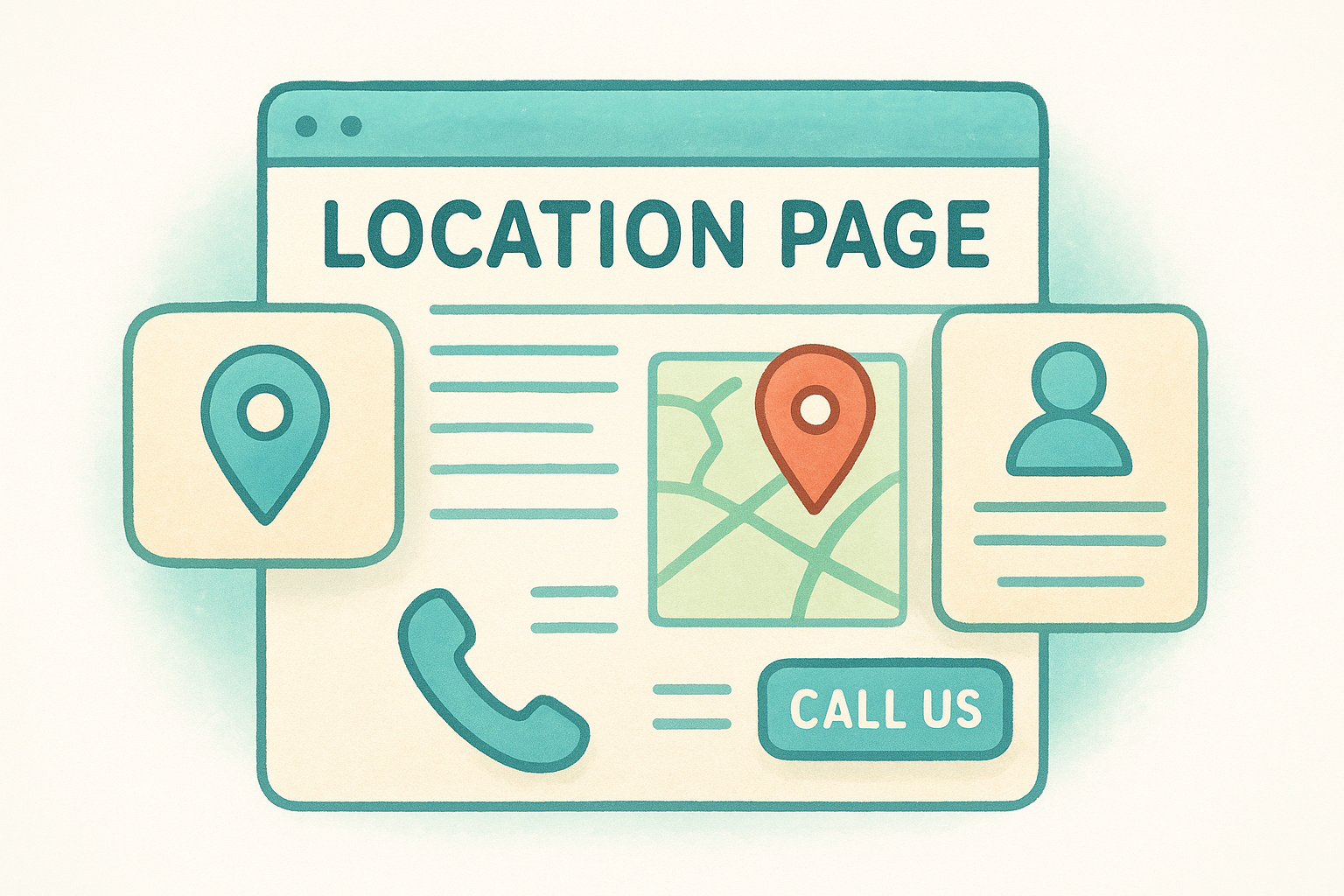
A location page with no unique signals beyond a city name swap is not a location page; it's a duplicate with a different URL.
Write unique, location-specific content without thin pages
Thin content is a real problem for multi-location sites. Write at least a few paragraphs specific to each location , referencing the neighborhood, local landmarks, services available at that branch, or team details. Avoid copy-pasting the same description and swapping city names since Google treats that as duplicate content and typically ranks none of the pages well.
Add conversion elements that match local intent
People landing on a location page are usually ready to act. Place your phone number, booking link, or contact form above the fold so visitors do not have to scroll to find it. Add clear calls to action tied to the specific service offered at that location, and make sure click-to-call works correctly on mobile.
5. Map local keywords to pages and intent
Keyword strategy for local SEO is not just about finding high-volume terms. You need to match specific keywords to specific pages and understand what a searcher actually wants when they type that phrase. Without this mapping, you'll either attract the wrong traffic or miss ranking opportunities your competitors are already capturing.
Find location modifiers and service keywords that convert
Start with service keywords combined with location modifiers , such as "HVAC repair in Denver" or "yoga studio Austin TX." These phrases signal buying intent far better than broad generic terms. Use Google's autocomplete and related searches to surface what real customers type in each market, then assign each keyword cluster to the right location page.
Common keyword patterns worth targeting at the location level:
- "[Service] + [City name]"
- "[Service] near me" (Google localizes this automatically)
- "[Neighborhood] + [Service type]"
Avoid keyword cannibalization across cities and neighborhoods
Cannibalization happens when two or more pages on your site target the same keyword and compete against each other in Google. This is one of the most common violations of local SEO best practices for multi-location sites. Assign one primary keyword cluster per location page and make sure your content, title tags, and internal links all reinforce that assignment.
Cannibalization quietly drains rankings from pages that should be performing well.
Optimize titles, headers, and internal links for local relevance
Your title tag and H1 should include both the service and the city name for every location page. This tells Google exactly what the page covers and where it applies.
Internal links from your main locations hub to individual location pages reinforce topical relevance and help Google understand the full geographic scope of your business across every market you serve.
6. Add local business schema across the site
Structured data gives Google a direct, machine-readable description of your business, and skipping it is one of the easier local SEO best practices wins to leave on the table. Schema markup does not guarantee rankings, but it helps Google match your pages to the right local queries with greater confidence, which matters when you're competing across multiple markets simultaneously.
Use the right schema types for locations and departments
Every location page should include LocalBusiness
schema
or a more specific subtype like Restaurant
, MedicalClinic
, or AutoRepair
depending on your industry. If individual locations have distinct departments with separate phone numbers, Department
schema
nested under the parent LocalBusiness
entity keeps those signals organized and avoids conflating separate entities in Google's index.
Using a generic schema type when a more specific subtype exists is a missed opportunity to clarify exactly what your location does.
Mark up hours, services, and service areas correctly
Your schema should include openingHoursSpecification
for each location rather than a plain text hours string. Add areaServed
to define the geographic reach of that location and list specific services using hasOfferCatalog
so Google understands what you offer without relying solely on your page copy.
Validate structured data and keep it in sync with listings
After implementing schema, run every location through Google's Rich Results Test to catch errors before they affect indexing. Schema that contradicts your Google Business Profile , such as different hours or an old address, sends conflicting signals that weaken both.
7. Systemize reviews and respond fast
Reviews are a direct ranking factor in local search, and Google weighs both review volume and recency when deciding which listings appear in the map pack. Building a consistent process around reviews is one of the highest-return local SEO best practices you can apply across locations.
Build a simple review request process for every location
Your team should ask for reviews at every positive touchpoint , whether that is after a completed service, a satisfied transaction, or a successful customer interaction. The request should include a direct link to that specific location's Google review form to remove any friction.
Standardize this across all your locations so no single branch falls behind on review count. A location with 12 reviews will almost always lose the map pack to a competitor with 200.
Respond to positive and negative reviews in a consistent voice
Responding to every review tells Google your listing is actively managed, which improves engagement signals. For positive reviews, thank the customer by name and reference something specific about their experience.
Reviews that go unanswered, especially negative ones, signal to both Google and future customers that no one is minding the store.
For negative reviews, acknowledge the issue directly and offer a clear path to resolution without being defensive. A calm, professional response often does more for your reputation than the original complaint does against it.
Use review trends to improve local pages and operations
When multiple customers at one location repeatedly mention the same issue or highlight , that pattern is useful data. Flag it and update that location's page content to address common questions proactively or surface what customers consistently praise.
8. Earn local backlinks that match each market
Backlinks from locally relevant sources carry more ranking weight than generic links from unrelated sites. For multi-location businesses, each location needs links that signal authority within its specific market , not just links pointing to your homepage. Treating link building as a single global exercise is one of the most common gaps in local SEO best practices for growing brands.
Prioritize local and industry-relevant link sources
Local link sources send geographic relevance signals that off-topic backlinks cannot replicate. Target local news outlets, regional business associations, and city-specific directories that align with each location's market. Industry-specific sources carry additional topical authority, since a link from a trade organization in your vertical tells Google exactly what your business does and where it does it.
Strong local link sources to target include:
- Local newspaper and community news sites
- Regional chambers of commerce and business associations
- Industry trade organizations with location-specific chapters
- Neighborhood and city-based event listings
Use partnerships, sponsorships, and PR for link opportunities
Partnerships with complementary local businesses create natural link-building opportunities that benefit both sides. Sponsor a local event, youth team, or community organization and request a link back from their site.
Earned links from local sources build market-specific authority that scales with your location count.
Local PR coverage from news sites and community publications generates authoritative, editorially earned links that paid directories cannot match.
Avoid low-quality link tactics that create risk
Link schemes and bulk directory submissions violate Google's spam policies and can trigger manual penalties that erase your rankings entirely. Focus on editorial quality over volume , since a handful of relevant, locally earned links to a location page consistently outperform dozens of low-quality ones.
Protect your site by auditing your existing backlink profile regularly and disavowing links that appear spammy or irrelevant before they create lasting damage.
9. Fix mobile UX and core web vitals
Most local searches happen on a smartphone, and Google uses mobile-first indexing , meaning it evaluates the mobile version of your pages when determining rankings. If your location pages load slowly or break on smaller screens, you're losing rankings and customers simultaneously, regardless of how well you've executed every other item on this local SEO best practices checklist.
Improve speed, navigation, and tap targets on mobile
Page speed directly affects both rankings and bounce rates . Use Google PageSpeed Insights to identify what's slowing each location page down, then prioritize fixes like compressing images, reducing render-blocking scripts, and enabling caching. Tap targets, including buttons, phone numbers, and menu links , need to be large enough that a user can tap them accurately without pinching or zooming.
A location page that frustrates mobile visitors will lose them to a competitor whose site simply works better on a phone.
Make contact actions easy from every location page
Every location page needs a visible click-to-call button that triggers the correct local phone number for that branch. Place your primary contact action above the fold so visitors do not have to scroll before they can reach you. Frictionless contact directly reduces the gap between a local search and a real customer interaction.
Clean up technical SEO issues that block local rankings
Crawl errors, broken internal links, and missing canonical tags all limit how well Google can index your location pages. Run a site audit regularly to catch redirect chains, duplicate content issues, and pages returning non-200 status codes, since any of these can silently suppress rankings across your entire location portfolio.
10. Track local rankings, calls, and leads
Executing every item on this local SEO best practices list means nothing if you cannot measure what's working and what isn't. Tracking gives you the data to make confident decisions rather than guessing which locations need attention and which are already performing well.
Track map pack and organic rankings by zip code and city
Local rankings vary by the searcher's exact location, so tracking at the city or zip code level gives you a far more accurate picture than checking rankings from your office. Use Google Search Console to monitor organic impressions and clicks by location page, then layer in position tracking to identify which markets are gaining ground and which are slipping before the drop becomes a real problem.
Ranking data without geographic context often hides the exact locations where your visibility is eroding.
Measure conversions that matter for local businesses
Rankings are a leading indicator, but calls, direction requests, and form submissions are what actually grow revenue. Set up conversion tracking in Google Analytics for every contact action on your location pages so you can tie specific pages and traffic sources to real customer interactions rather than just traffic volume.
Use reporting to spot winners, losers, and next actions
Pull a monthly report across all locations comparing rankings, traffic, and conversions side by side. Locations showing strong rankings but low conversions likely have a page content or UX problem , while locations with solid conversions but weak rankings need stronger off-page work to push visibility higher.
Next steps to keep your local SEO growing
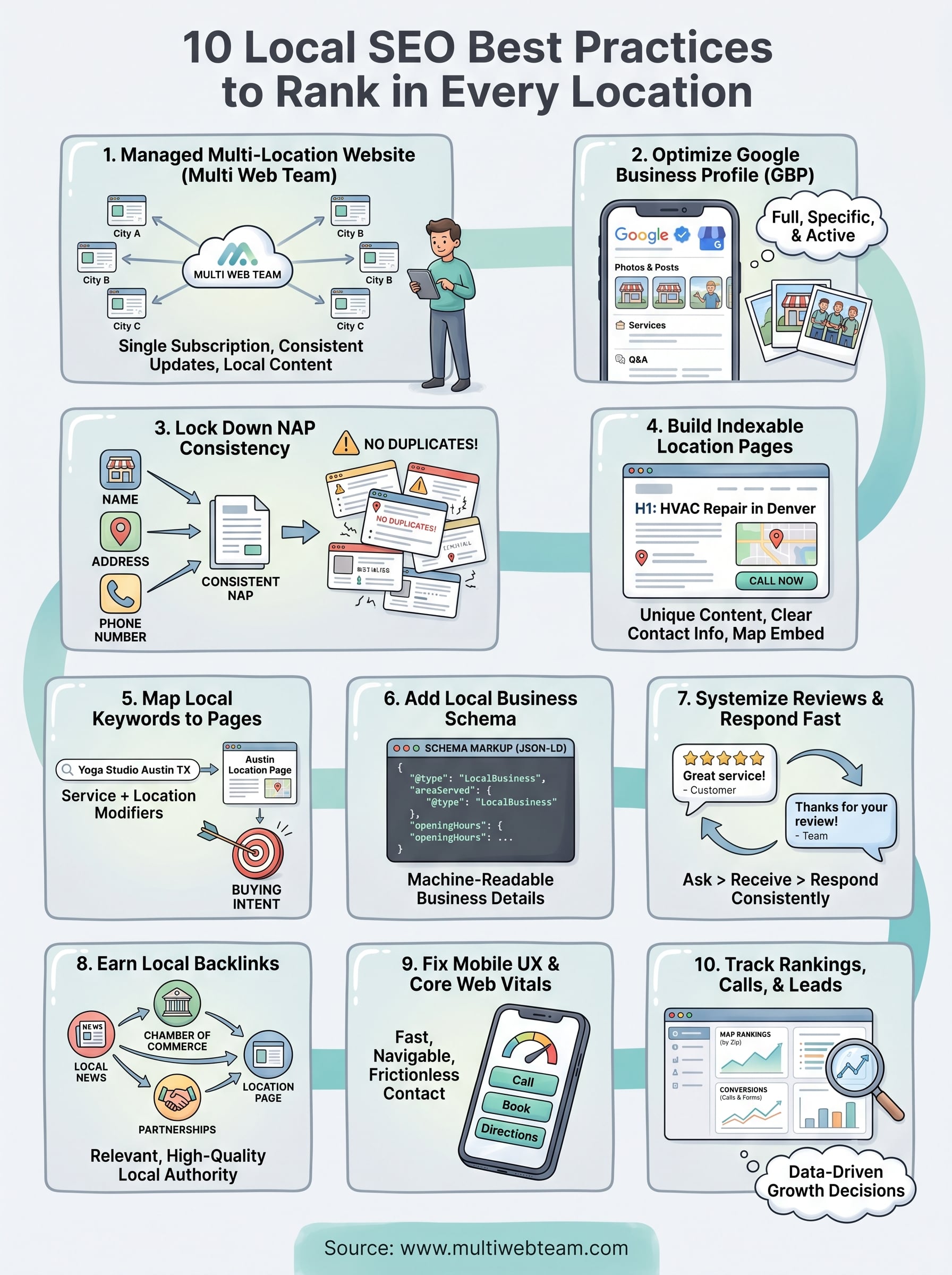
These 10 local SEO best practices give you a clear path from scattered visibility to consistent rankings across every location you operate. The work does not stop at implementation. Google rewards businesses that maintain their presence , update their pages, respond to customers, and build authority over time, not ones that set things up once and walk away.
Start by auditing what you already have. Identify the locations with the weakest ranking signals and treat them as your immediate priority. Fix citations, build out thin location pages, and get your Google Business Profiles fully optimized before expanding your link-building or schema efforts.
If managing all of this across multiple locations feels like more than your team can handle, Multi Web Team exists specifically to carry that load for you . See how we manage local SEO for multi-location businesses and find out what a dedicated external web team can do for your growth.