Local SEO vs Traditional SEO: Differences and When to Use
When someone searches "pizza near me," Google serves up a completely different set of results than when someone searches "how to make pizza dough." That distinction sits at the heart of local SEO vs traditional SEO , two strategies that target different audiences, use different ranking signals, and require different execution to get results . For multi-location businesses and franchises, understanding where one ends and the other begins isn't academic. It directly impacts whether customers find your individual locations or skip right past them.
At Multi Web Team, we build and manage websites for businesses operating across multiple locations, and SEO strategy is baked into every site we deliver. We see firsthand how a franchise with ten locations needs a fundamentally different approach than a single online retailer. The wrong strategy wastes budget. The right one fills stores.
This article breaks down the core differences between local and traditional SEO, explains the ranking factors unique to each, and helps you determine which approach fits your business model . If you operate even one physical location, the distinction matters more than you might expect, and getting it right can reshape your online visibility .
Why local and traditional SEO get mixed up
Both strategies live under the same SEO umbrella, and they share enough common ground that it's easy to treat them as interchangeable. Both involve keyword research, on-page optimization, and building authority through links and content. When you read a guide that covers "SEO basics," it almost always applies to both approaches in some way, which blurs the line between them. The confusion isn't a mistake on your part. It's a natural result of how the industry talks about search optimization without always specifying which type it means .
They share the same foundational tools
SEO tools don't always draw a hard line between local and traditional work. Platforms that track keyword rankings, audit your site structure, or analyze backlinks often handle both types of search in the same dashboard. When you run a keyword report, you see a mix of location-based terms and broad informational queries sitting side by side with no label to separate them. That presentation trains you to treat all keywords as equal , when in reality a query like "best gym in Austin" and a query like "how to build muscle" require completely different strategies to rank for.
Treating every keyword the same way, regardless of search intent, is one of the fastest ways to misallocate your SEO budget.
Your website also plays a role in both approaches. Technical performance, page speed, mobile usability, and structured content all matter whether your goal is local or broad visibility. When you optimize your site, many of those improvements benefit both strategies at once, which makes it harder to see where one approach ends and the other begins. That overlap creates a false sense that a single unified strategy is enough for every business type.
The terminology overlaps in confusing ways
When someone says "we do SEO," that phrase covers a wide range of activities. Link building, content creation, meta descriptions, and site architecture all fall under that label regardless of whether the goal is local or national visibility. Agencies and in-house teams sometimes run both approaches simultaneously without flagging which tactics serve which goal, which makes it hard for you to evaluate what's actually working and why.
In the local SEO vs traditional SEO conversation, this terminology problem creates real budget and strategy issues. A franchise owner who invests in broad content marketing may see strong traffic from informational searches but still struggle to drive foot traffic to specific locations. The content strategy worked, but it answered a different question than the one customers were asking when they searched for a location near them.
Why the distinction matters more for multi-location businesses
For a business with a single online store, the overlap between local and traditional SEO might not cause serious damage. Multi-location businesses face a different reality. Each location needs to appear in its own geographic search results, not just as a passing mention on a general website page. If your SEO approach focuses entirely on broad visibility without building location-specific signals , you can rank nationally and still be invisible to the customer standing two blocks from your nearest store.
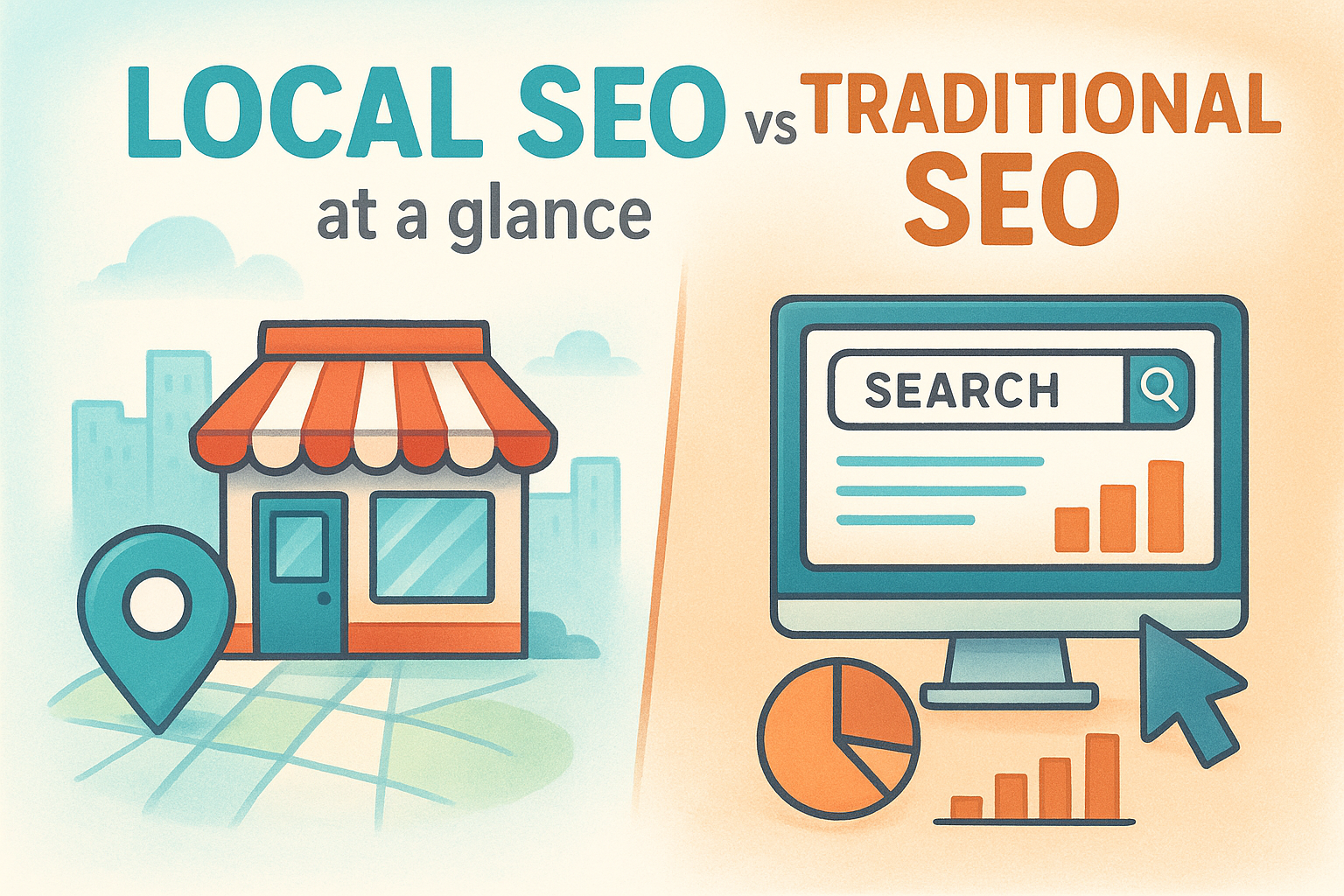
Local SEO vs traditional SEO at a glance
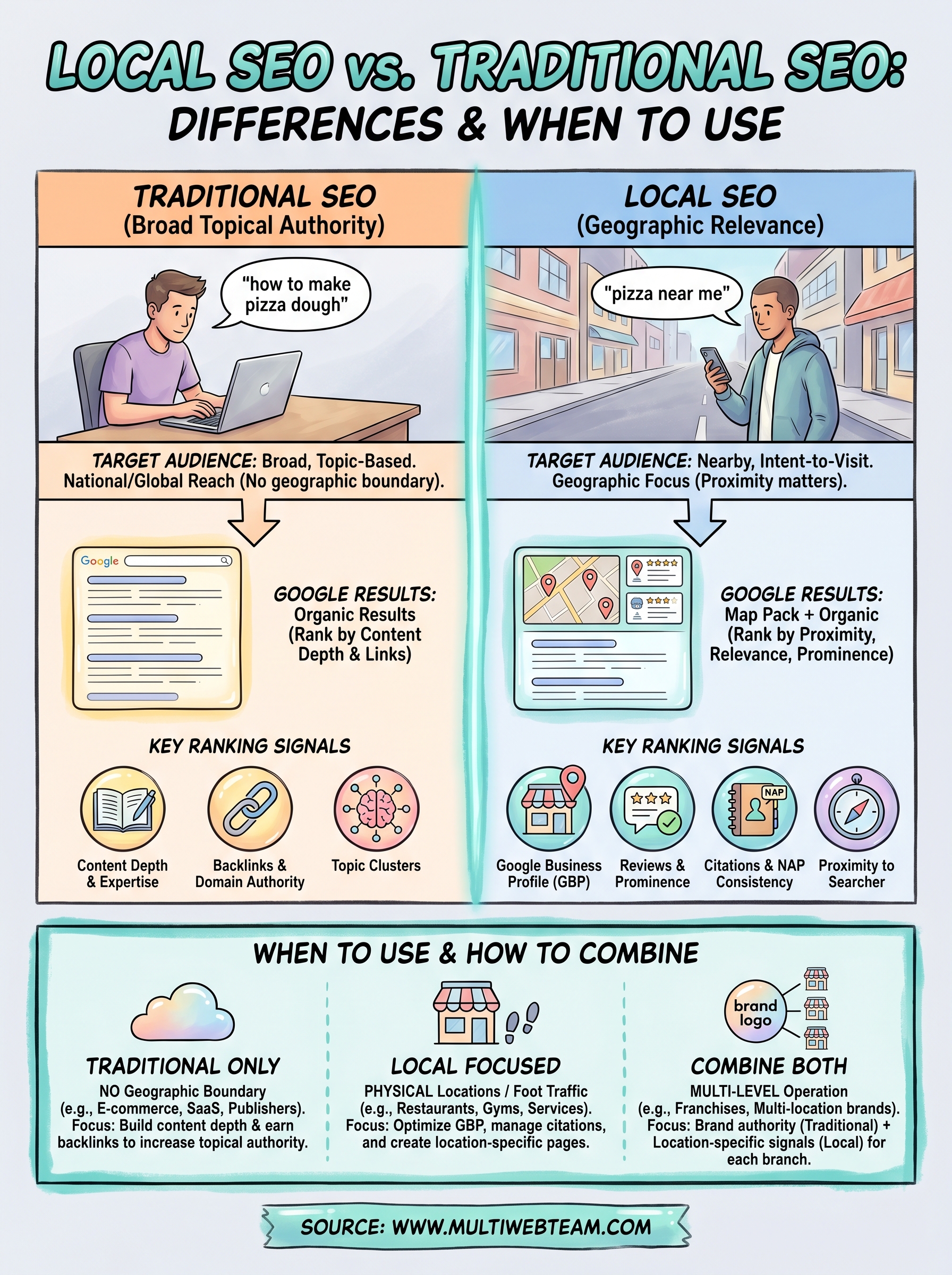
The clearest way to separate local SEO vs traditional SEO is to look at the audience each one tries to reach. Traditional SEO works to attract people searching for information, products, or services regardless of where they live. Local SEO works to attract people searching within a specific geographic area who are likely to visit or contact a physical location. Both strategies use overlapping techniques, but they optimize for fundamentally different outcomes.
What traditional SEO targets
Traditional SEO focuses on broad, topic-based visibility across a wide audience. You optimize for search terms that people type regardless of their location, such as "how to manage franchise operations" or "best software for inventory tracking." The goal is to rank on the first page of results for queries that can drive traffic from anywhere in the country or world. Success typically gets measured by organic traffic volume, keyword rankings, and how well your content converts that traffic into leads or sales.
Your content strategy drives most of the work in traditional SEO. Long-form articles, comparison pages, and educational guides help you build authority on broad topics. You also build backlinks from other websites to signal to Google that your content is credible and worth ranking. A single well-ranked page can generate traffic from multiple cities, states, or countries simultaneously.
What local SEO targets
Local SEO focuses on geographic relevance , and its goal is to surface your business when someone nearby is ready to act. You rank for location-modified queries like "coffee shop downtown Denver" or "auto repair near me" rather than broad terms. Google evaluates these searches differently, pulling results from a local index that weighs proximity, relevance, and prominence together. A strong local SEO setup includes your Google Business Profile, location-specific pages on your website, and consistent business information across directories.
If your business depends on people walking through the door or calling a local number, local SEO is not optional; it is the core of your search strategy.
| Factor | Traditional SEO | Local SEO |
|---|---|---|
| Target audience | Broad, location-independent | Geographic, near-location |
| Primary ranking signals | Content, backlinks, authority | Proximity, Google Business Profile, citations |
| Key search real estate | Organic results | Map Pack and organic |
| Best for | Online stores, publishers | Brick-and-mortar, franchises |
How Google decides what to show for local searches
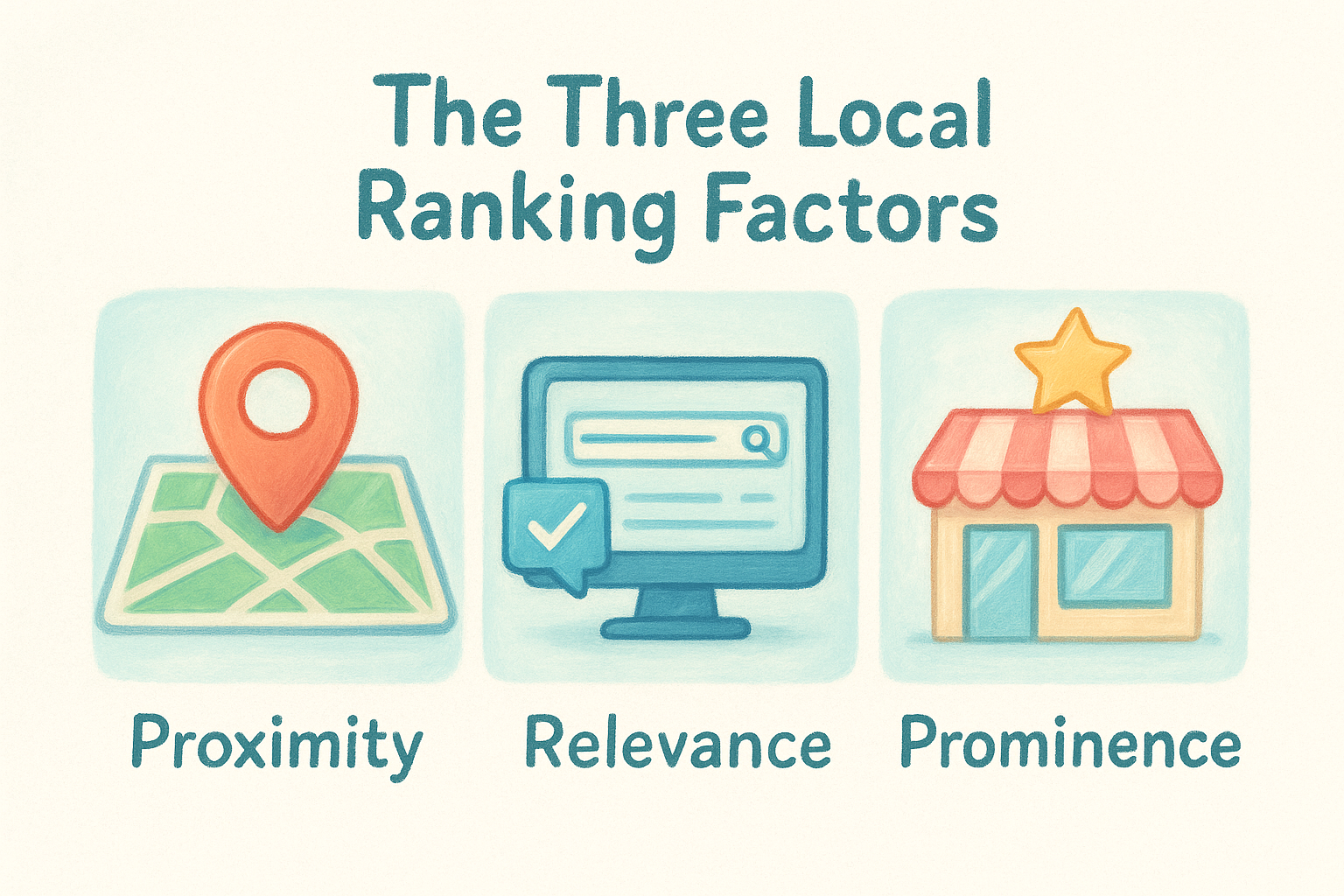
Google doesn't treat every search the same way. When it detects local intent, whether from a "near me" modifier or a city name in the query, it switches to a separate ranking system that weighs proximity, relevance, and prominence together. These three factors determine which businesses appear in the Map Pack, the block of three results that shows up above the organic listings for location-based queries. Understanding how Google evaluates each factor is the starting point for building a local presence that actually drives customers to your door.
The three local ranking factors
According to Google's own documentation, the core signals it uses to rank local results fall into three categories. Proximity measures how close your business is to the person searching, or to the location they specify in their query. You can't move your store, but you can make sure Google knows exactly where you are by keeping your Google Business Profile accurate and complete.
Your Google Business Profile is not a secondary asset. It is often the first thing a potential customer sees before they ever reach your website.
Relevance measures how well your business matches what the searcher is looking for. Google pulls this signal from your Business Profile categories, your website content, and the keywords you use to describe your services. Prominence measures how well-known your business is, drawing on review count, review ratings, backlinks to your site, and how consistently your name, address, and phone number appear across the web.
Why the Map Pack changes the local SEO vs traditional SEO dynamic
The Map Pack sits above standard organic results, which means local businesses can gain prime visibility without necessarily ranking at the top of traditional organic results. A business with a modest website but a strong Google Business Profile, consistent citations, and solid reviews can outperform a competitor with a bigger site and more content. This structural difference means winning locally doesn't always require the same content investment that dominates a traditional SEO strategy, which matters when you manage multiple locations and need each one to perform independently.
Signals that contribute to Map Pack prominence include:
- Total number of Google reviews and average rating
- Consistent business name, address, and phone number across directories
- Backlinks pointing to your individual location pages
- Completeness and ongoing activity within your Google Business Profile
What you optimize for in traditional SEO
Traditional SEO centers on ranking for topic-based queries that carry no geographic intent. When you examine local seo vs traditional seo side by side, the clearest execution difference is that traditional SEO asks you to build topical authority across a subject area rather than prove that you exist in a specific city. Your audience can be anywhere, so Google evaluates your content based on depth, credibility, and the strength of other websites linking back to yours.
Content depth and topical authority
The foundation of a traditional SEO strategy is producing content that thoroughly answers the questions your target audience searches for. You need to cover topics completely enough that Google recognizes your site as a credible source on that subject. This means publishing long-form guides, comparison articles, and educational resources that address different angles of the same topic rather than writing a single thin page and hoping it holds a ranking.
The more completely you cover a topic, the more Google trusts that your site deserves to rank for related queries in that space.
A strong content strategy also targets keyword clusters , groups of related queries that orbit the same topic. If you sell commercial fitness equipment, you don't just target "commercial treadmills." You build content around equipment maintenance, buying guides, and training program design that together signal to Google that your site understands the subject deeply. Each piece of content reinforces the authority of the others when they link to each other in a logical structure.
Backlinks and domain authority
Backlinks remain one of the strongest ranking signals in traditional SEO. When credible websites link to your content, Google interprets those links as votes of confidence in your expertise. You earn backlinks by creating content that other sites find worth referencing, publishing original research or proprietary data , or earning coverage through digital PR efforts.
Your site's domain authority grows over time as you accumulate quality links from reputable sources. A single authoritative backlink from a well-regarded publication can move rankings more than dozens of low-quality links ever will. This compounding, long-term nature of link building is why traditional SEO rewards consistent investment over months and years rather than short bursts of activity.
What you optimize for in local SEO
Local SEO shifts the optimization focus from broad topical authority to geographic relevance and trust signals that prove your business belongs in a specific location. Where local seo vs traditional seo diverges most sharply in execution is right here: instead of writing content to rank for industry topics, you build signals that tell Google your business is real, nearby, and ready to serve customers in a defined area. Each signal you strengthen increases the likelihood that your location shows up when someone nearby is searching with intent to visit or call.
Google Business Profile and citations
Your Google Business Profile is the single most important asset in a local SEO strategy. Filling it out completely, choosing accurate business categories, uploading photos, and posting updates regularly all send relevance and activity signals that Google uses to rank your listing. When customers leave reviews and you respond to them, you build prominence signals that Google weighs alongside proximity and relevance.
An incomplete or inconsistent Google Business Profile undermines every other local optimization effort you make.
Citations are the second major asset you manage. A citation is any online mention of your business name, address, and phone number , commonly called NAP consistency. Google cross-references these details across directories, data aggregators, and review platforms. When the information matches everywhere, it reinforces that your location data is accurate. Inconsistencies, even small ones like an abbreviated street name on one directory, can dilute the trust Google places in your listing.
Location pages and on-site signals
Each physical location your business operates needs its own dedicated page on your website. A single generic contact page listing multiple addresses does not give Google enough signal to rank individual locations in their respective markets. Each location page should include the address, phone number, hours, and locally relevant content that speaks to what customers in that area actually search for.
Structured data markup, specifically schema.org's LocalBusiness schema, helps Google read your location details precisely without guessing. Adding this markup to your location pages reinforces the NAP information already on the page and strengthens the connection between your website and your Google Business Profile.
When to use each and how to combine
The choice between local and traditional SEO isn't always either/or. Your business model determines which approach carries the most weight, and understanding local seo vs traditional seo as complementary strategies rather than competing ones helps you allocate effort where it will actually move results. Many multi-location businesses need both running at the same time , just with clear priorities set for each goal.
Use traditional SEO when your audience has no geographic boundary
Traditional SEO fits businesses that sell or serve customers regardless of where those customers live. If you run an e-commerce store, a software product, or a subscription service, your potential customers could be anywhere, and geographic signals won't help you reach them. Your focus belongs on content depth, keyword authority, and backlink acquisition that builds your site's credibility across the topics your audience searches for.
If nobody needs to visit your location to do business with you, investing heavily in local SEO signals is largely wasted effort.
Use local SEO when customers need to find you physically
Local SEO belongs at the center of your strategy when foot traffic or local calls are how your business generates revenue. Restaurants, fitness studios, service businesses, and retail locations all depend on nearby customers finding them first, not a broad audience reading informational content. If you manage multiple locations, each one needs its own local presence built through a dedicated Google Business Profile, a location-specific page, and consistent citation data spread across directories.
Building that infrastructure for every location takes time, but it directly ties each physical address to the searches happening around it. Skipping this work leaves your locations invisible to the customers most likely to convert.
Combine both when your business operates at multiple levels
Some businesses need visibility at both levels at the same time. A franchise with twenty locations wants each individual location to rank in its local market, but the brand also benefits from traditional SEO that builds authority on broader industry topics. You can publish educational content at the brand level while each location page handles the geographic signals that bring nearby customers through the door. Structured correctly, the two strategies reinforce each other rather than pull your budget in opposite directions.
What to do now
Now that you understand local seo vs traditional seo , the next step is applying that distinction to your own business. If you operate physical locations, building a Google Business Profile, creating location-specific pages, and maintaining consistent citation data are the highest-priority actions you can take today. If your business sells online without geographic boundaries, your energy belongs in content depth and backlink acquisition instead.
For multi-location businesses and franchises, both strategies need to work in parallel . Each location deserves its own local presence built from dedicated pages and accurate directory listings , while your brand website builds the topical authority that supports every location. Getting this structure right from the start saves you from rebuilding it later as your footprint grows.
If you want a team that handles both sides of this across every location you operate , see how Multi Web Team manages web design and SEO for multi-location businesses.