What Is Managed Website Hosting? Benefits Costs & Providers
You have a business to run, maybe multiple locations, maybe a growing franchise. The last thing you need is to spend your evenings troubleshooting server errors or figuring out why your site crashed during a lunch rush. That's exactly the problem that brings most people to ask what is managed website hosting , and it's a question worth getting right before you commit your budget. Managed hosting hands off the technical upkeep of your website's server environment, security patches, backups, performance optimization, to a provider who handles it for you.
At Multi Web Team, we build and manage custom websites for multi-location businesses and franchises. Hosting is one piece of that puzzle, and we've seen firsthand how the right hosting setup can make or break a site's performance across dozens of locations. We've also seen business owners overpay for services they don't need, or underpay and deal with constant downtime that costs them customers.
This article breaks down what managed website hosting actually includes, how it compares to unmanaged alternatives, what it typically costs , and which providers are worth considering. Whether you're evaluating hosting as a standalone service or as part of a full website management solution , you'll walk away with the information you need to make a confident decision.
Why managed hosting matters
When your website goes down, you lose more than traffic. You lose revenue, customer trust, and the local search ranking signals that took months to build. For a single-location business, that's painful. For a multi-location franchise or growing chain, it multiplies across every city, neighborhood, and market you serve. Understanding what is managed website hosting starts with recognizing what poor hosting actually costs you in the real world, not in theory, but in missed calls, lost orders, and customers who found your competitor first.
A single hour of downtime during peak business hours can cost a multi-location business more in lost leads and orders than a full month of managed hosting fees.
The real cost of website downtime
Most business owners treat hosting as a background expense, something you pay and forget. But server performance directly affects how quickly your pages load, whether your forms submit correctly, and how reliably customers can reach your location pages. Google's Core Web Vitals data shows that page load speed is a confirmed ranking signal , which means slow hosting isn't just a user experience problem. It's an SEO problem that compounds quietly over time.
The frustrating part is that most hosting issues stay invisible until they become critical. Your site might run slower than it should for weeks before anyone notices. By the time you see a drop in bookings or calls, the damage to your search visibility has already built up. A managed hosting provider monitors performance continuously and catches degradation before it becomes failure .
Multi-location businesses carry more risk
Running five locations means five sets of local landing pages, five sets of customer expectations, and five chances for a hosting failure to cost you business. Each location page competes in its own local market , and any performance issue on that page directly affects that location's ability to rank in neighborhood and city-level searches. Unmanaged hosting doesn't account for this complexity or the scale of what breaks when something goes wrong.
Here's what's typically at stake across a multi-location footprint when hosting underperforms:
- Slower page loads push visitors to competitors before they read your offer
- Downtime during peak hours means missed calls, orders, or reservation requests
- Security vulnerabilities expose customer data and can get your site flagged in search results
- Missed software updates break forms, maps, or booking integrations silently
When server problems become business problems
There's a common assumption that hosting failures are a technical problem someone else will catch and report. In reality, you are often the last person to find out your site is down. A customer tries to find your hours, hits an error page, and moves on. You never see the missed opportunity because it never reached you. Managed hosting shifts that responsibility to a provider who monitors your uptime around the clock and resolves issues before customers ever encounter them.
For franchise operators and multi-location owners, this matters even more than it does for a single-site business. You cannot personally check every location page every day, and your staff won't catch a broken contact form until customers stop coming in. You need infrastructure that watches itself , backed by a team that acts when something changes. That's the practical reason managed hosting isn't a premium option for businesses at your scale. It's the baseline that keeps you competitive.
What managed website hosting includes
When people ask what is managed website hosting , they're usually picturing just "someone else handles the server." The reality is more specific than that, and knowing exactly what's covered helps you evaluate whether any given provider actually delivers what you need. Managed hosting bundles a set of ongoing technical services that keep your server environment stable, secure, and fast without requiring your involvement in any of it.
Server management and security
Your hosting provider takes full responsibility for the server infrastructure , including the operating system, software stack, and security layers that run underneath your website. That means they apply security patches, manage firewall rules, and handle software updates as they're released, not when you remember to check. Security vulnerabilities appear constantly in web server software , and unpatched systems are one of the most common entry points for attacks that can take down your site or expose customer data.
Managed hosting eliminates the gap between when a security patch is released and when it gets applied, which is often the window attackers exploit.
Providers also configure and maintain SSL certificates and server-level malware scanning so your site stays in good standing with browsers and search engines. An expired SSL certificate doesn't just throw a warning to your visitors; it signals to Google that your site isn't trustworthy, which can knock your rankings.
Performance optimization and backups
Managed hosting providers actively tune your server environment for speed, which includes configuring caching layers, content delivery networks, and database performance settings. You don't set these up manually. Your provider monitors how your site performs under real traffic conditions and adjusts the configuration accordingly.

Automatic backups are another core component. Your data gets backed up on a regular schedule , typically daily, so that if something breaks during an update or a file gets corrupted, restoring your site doesn't require starting from scratch. For multi-location businesses with dozens of location pages, forms, and integrations, this protection matters more than most owners realize until they actually need it. Reliable backups are the difference between a quick recovery and days of rebuilding content from memory.
Managed vs unmanaged hosting
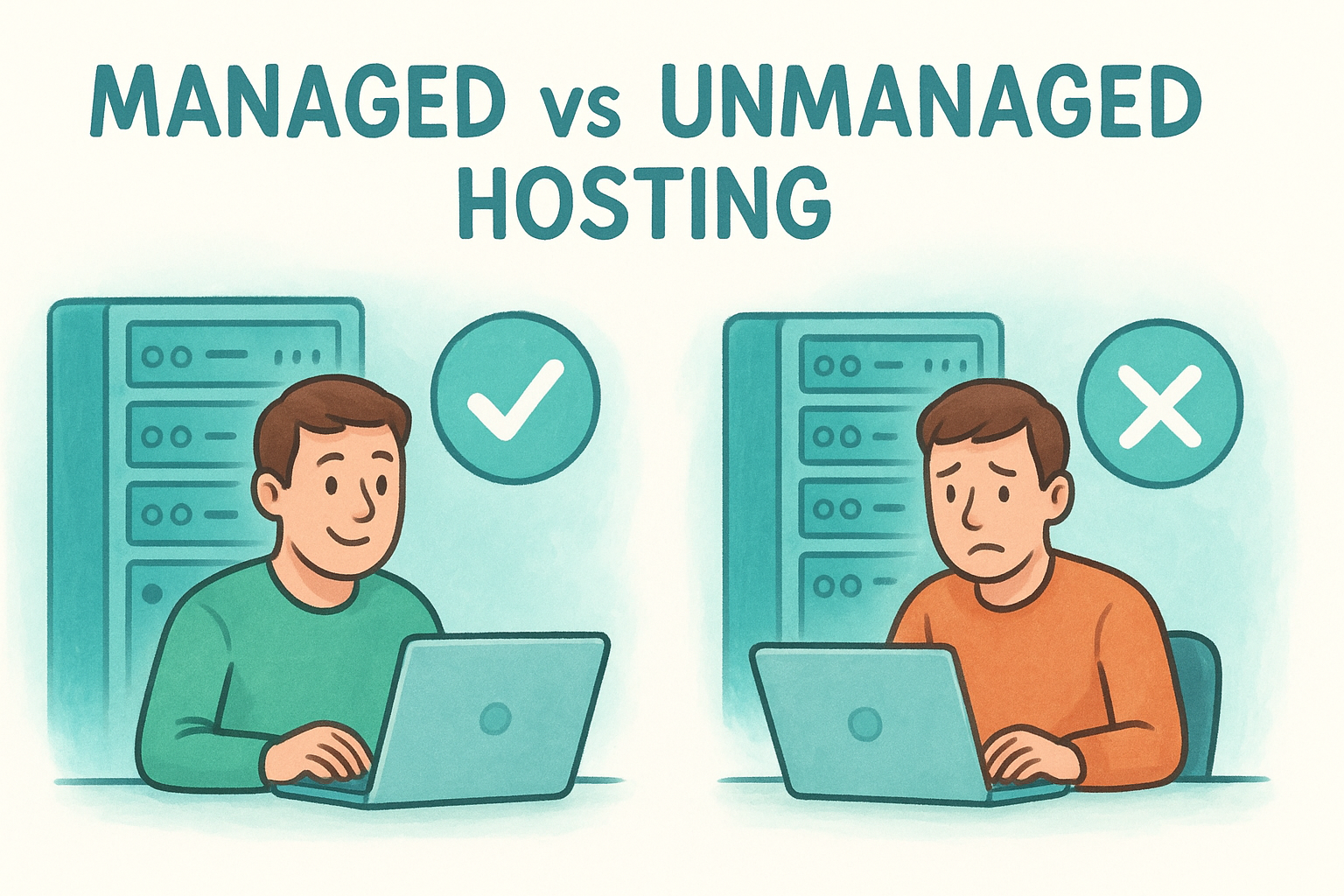
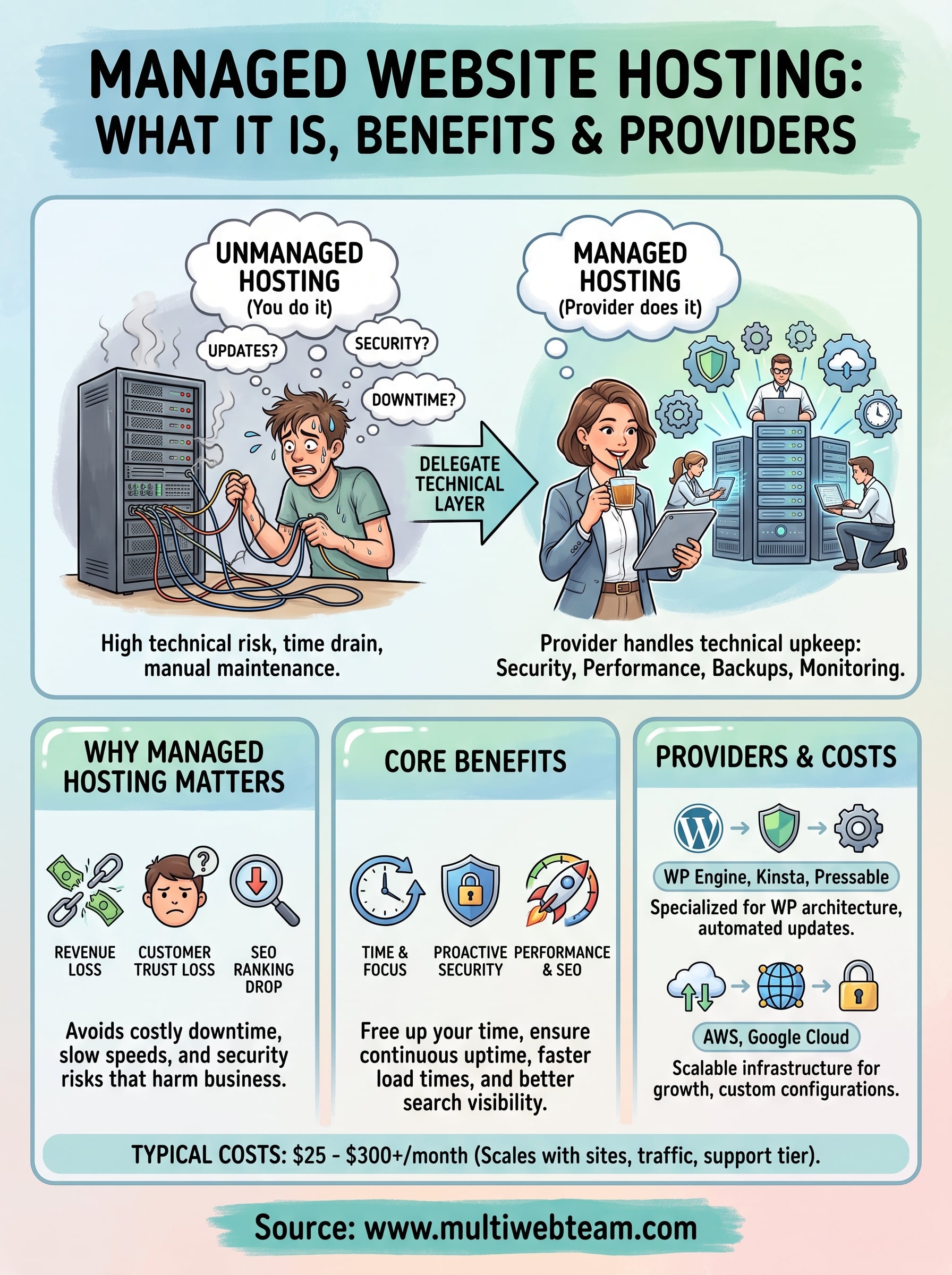
The core difference between managed and unmanaged hosting comes down to who does the work . With unmanaged hosting, you rent server space and take full responsibility for everything that runs on it: software configuration, security patches, performance tuning, backups, and troubleshooting. With managed hosting, your provider takes ownership of that entire technical layer so you can focus on running your business rather than maintaining your infrastructure.
What you handle with unmanaged hosting
Unmanaged hosting puts you in the role of a system administrator, even if you've never filled that role before. You're responsible for installing and updating server software , configuring security settings, setting up monitoring, and responding when something breaks. If a critical vulnerability appears in your server's operating system, you apply the patch. If your site slows down under traffic, you diagnose and fix it.
For developers who work with servers daily, that level of control makes sense. For business owners running multiple locations, it's a serious liability. Unmanaged hosting transfers technical risk directly to you , and that risk grows proportionally with every location page, contact form, and integration you add to your site.
Most security incidents on self-managed servers happen not because the technology failed, but because a patch wasn't applied in time.
Where managed hosting pulls ahead
When you understand what is managed website hosting in contrast to unmanaged alternatives, the practical advantages become clear. Your provider monitors uptime, applies updates, and responds to issues without you filing a ticket or even knowing there was a problem in the first place. That kind of proactive maintenance protects your site from the slow, invisible degradation that unmanaged setups often develop over months.
Cost comparisons between managed and unmanaged hosting often look misleading on a price-per-month basis. Unmanaged hosting plans are cheaper upfront, but they exclude the labor cost of actually running the server , which falls on you or someone you hire. When you add up the time, expertise, and risk involved in managing your own infrastructure, managed hosting typically delivers more value per dollar, especially for businesses that can't afford downtime or gaps in security coverage.
Managed hosting vs other hosting types
Understanding what is managed website hosting requires placing it in context against the other options you'll encounter on the market. Hosting types differ primarily in how server resources are allocated and who carries responsibility for maintaining them. Managed hosting can technically sit on top of shared, VPS, dedicated, or cloud infrastructure. The distinction isn't just the hardware underneath. It's the level of service and support wrapped around your environment that separates managed from everything else.
Shared hosting
Shared hosting puts your website on a server alongside dozens or hundreds of other sites, all drawing from the same pool of resources. It's the cheapest entry point, but it comes with real limitations that grow more serious as your business scales . If a neighboring site on your server experiences a traffic spike or a security breach, your site absorbs some of that impact. For multi-location businesses with location-specific pages and contact forms , shared hosting creates reliability problems you often can't trace back to their source until customers have already moved on.
Shared hosting's low price reflects shared risk. When resources are pooled, any site on the server can affect every other site running alongside it.
VPS, dedicated, and cloud hosting
A virtual private server (VPS) gives you a partitioned slice of a physical server with dedicated resources, which improves performance and isolation over shared hosting. Dedicated hosting goes a step further and gives you an entire physical server with no resource competition from other sites. Cloud hosting distributes your site across a network of servers , which improves redundancy and allows resources to scale automatically with traffic demand. You can explore cloud infrastructure basics directly through Google Cloud.
Each of these options can be either managed or unmanaged. A managed VPS or managed cloud plan means your provider handles the server administration, security, and maintenance layer on top of whatever infrastructure type you're running. An unmanaged version of any of these puts the technical work back on you. For multi-location businesses, the infrastructure type matters less than whether your provider actively monitors and maintains what runs on it , because that determines whether your site stays fast, secure, and available when customers need it.
Benefits you can expect
Once you understand what is managed website hosting, the benefits follow naturally from the definition. Your provider absorbs the technical work so that you're free to focus on running your business instead of maintaining infrastructure. Those benefits aren't abstract. They show up in specific, measurable ways across your site's performance, your team's workload, and your ability to compete in local search.
Time and focus you get back
Every hour your team spends troubleshooting server issues, chasing down update errors, or diagnosing slow page loads is an hour not spent on customers, operations, or growth . Managed hosting removes that drain entirely. Your provider monitors, patches, and maintains everything in the background, and you never need to log into a server dashboard to keep things running.
For multi-location businesses, that time savings multiplies significantly. You're not managing one site. You're managing a presence across multiple markets, and each location page represents a customer entry point that needs to stay fast and functional. Delegating the technical layer to a managed provider means your attention stays where it produces the most value.
Security and uptime protection
Managed hosting providers apply security updates as soon as they're available , which closes the window between when a vulnerability is discovered and when your server is exposed to it. That's not something you can reliably do yourself while running a business, and it's one of the most significant risk reductions managed hosting delivers. Your site stays patched and monitored without requiring your direct involvement at any point.
Consistent uptime and fast load speeds are ranking signals. Managed hosting protects both, while unmanaged setups leave them vulnerable to slow degradation that's easy to miss until it's already cost you customers.
SEO and performance advantages
Search engines reward fast, reliable websites , and managed hosting directly supports both of those qualities. Your provider tunes your server environment for speed, maintains caching configurations, and monitors performance under real traffic conditions. Those optimizations keep your Core Web Vitals scores competitive , which influences how your location pages rank in neighborhood and city-level searches.
Uptime also matters for search visibility. A site that returns errors or loads slowly during crawl cycles sends negative signals to search engines. Managed hosting reduces that risk by keeping your server environment stable and actively monitored , rather than leaving performance to chance.
How much managed hosting costs
Pricing for managed website hosting varies widely depending on the infrastructure type, the number of sites you're running, and how much support is included in the plan. Understanding what is managed website hosting in terms of real cost means looking beyond the monthly line item and accounting for the technical labor that unmanaged alternatives push back onto you . That context changes how the numbers compare.
Entry-level and mid-tier pricing
Basic managed hosting plans typically start between $25 and $100 per month for a single website on shared or entry-level cloud infrastructure. These plans usually include automated backups, security monitoring, and performance caching, but they cap you on traffic, storage, or the number of sites you can run. For a single-location business with moderate traffic, this tier often covers what you need.

As soon as you add multiple locations, the cost structure changes because you're no longer managing one site but a network of location pages that each need reliable performance.
Mid-tier managed hosting plans run between $100 and $300 per month and typically offer better resource allocation, faster support response times, and more flexibility with custom configurations. For multi-location businesses, this range is where most providers start offering plans designed for multiple sites or higher-traffic environments , which reflects the actual scale you're operating at.
What drives the price up
Several factors push managed hosting costs above the base rate. The number of sites or location pages you're running is the most direct driver, since each additional site requires its own resources and monitoring. High-traffic periods, like seasonal promotions or regional marketing campaigns, can also require temporary resource scaling that some providers charge for separately .
Support tier is another significant variable. Plans that include faster response times, dedicated account managers, or priority escalation paths cost more than standard plans where your ticket joins a general queue. Your site's reliability directly depends on how quickly your provider responds when something breaks, so support quality is worth factoring into the price comparison rather than treating it as an optional upgrade.
A managed plan priced at $200 per month that prevents two hours of downtime during a busy week can easily justify its cost against a $30 unmanaged plan that leaves security updates and server maintenance entirely on your plate .
How to choose a managed hosting provider
Picking the right managed hosting provider means going beyond the price comparison and looking at what's actually included . Once you understand what is managed website hosting, you can evaluate providers against a concrete checklist rather than relying on marketing language that's hard to verify until something breaks.
Check what's actually included in the plan
Not every managed hosting plan covers the same services. Some providers include automated backups, security patching, and performance optimization as core features, while others treat those as add-ons that push your monthly cost well above the advertised rate. Before you commit, request a written breakdown of exactly what your plan covers and what triggers an extra charge.
The cheapest managed plan on paper often becomes the most expensive once you add the features you actually need to keep your site reliable.
Response time guarantees and support availability are equally important to review before you sign. A provider that offers 24/7 monitoring but only responds to tickets during business hours is not giving you the protection the plan implies. Clarify what "managed" actually means in practice before you hand over your infrastructure.
Match the plan to your site's actual scale
Multi-location businesses have different requirements than single-site operations. You need a provider that handles multiple location pages without performance degradation and can accommodate traffic spikes from regional promotions or seasonal campaigns. Ask directly how your provider handles sudden traffic increases and whether resource scaling costs extra.
Migration support and onboarding assistance also matter more than most buyers expect. Moving an established multi-location site to a new hosting environment introduces risk, and a provider who walks you through the process reduces the chance of downtime during the transition. Look for providers who include migration as part of the onboarding package rather than billing it separately.
Here are the specific questions worth asking any provider before signing:
- What does your uptime guarantee cover, and how do you handle compensation if you miss it?
- How quickly do you apply security patches after a vulnerability is disclosed?
- What does the backup schedule look like, and how long does a full restore take?
- Does your plan support multiple sites or location pages, and at what threshold does pricing change?
Top managed hosting providers for 2026
Once you know what is managed website hosting, choosing the right provider comes down to matching their strengths to your actual business setup. The market offers dozens of options , but most fall into two meaningful categories: providers built specifically around WordPress environments and providers that run on scalable cloud infrastructure. Your site's complexity, traffic patterns, and number of locations should guide which category fits you best.
WordPress-focused managed hosts
WordPress powers a large share of business websites, and several managed hosting providers have built their entire infrastructure around it. WP Engine and Kinsta are the most widely recognized in this category. Both offer automated backups, staging environments where you can test changes before pushing them live, and performance optimization tuned specifically for WordPress architecture. Kinsta runs entirely on Google Cloud infrastructure , which gives it strong global performance and reliability that matters when customers across multiple locations are loading your pages simultaneously.
WordPress-specific managed hosts apply updates and security patches within the WordPress ecosystem itself, which reduces the risk of plugin conflicts or theme breakage that generic hosts often miss.
Pressable and SiteGround also compete in this space at lower price points. Pressable suits smaller multi-location setups where per-site cost is a more pressing concern, while SiteGround includes managed features in its core plans without pushing them into a separate tier. Both are worth evaluating if your site runs on WordPress and your traffic volumes don't yet justify a premium plan.
Cloud-based options for scale
If your business runs on custom-built web infrastructure rather than WordPress, or if you need resources that scale automatically under heavy traffic, cloud-managed hosting through providers like Amazon Web Services or Google Cloud gives you more flexibility. Both platforms offer managed service tiers where their teams handle server configuration, patching, and monitoring on top of global infrastructure. You can review Google Cloud's managed hosting options or AWS managed services directly to compare what each plan covers.
These enterprise-grade options come at a higher cost , but they're worth evaluating if your franchise or multi-location business expects rapid growth, runs complex integrations, or needs infrastructure that absorbs large traffic spikes without manual intervention. The tradeoff is that setup and configuration require more technical involvement upfront , which is why many businesses pair cloud infrastructure with a dedicated web management partner rather than handling it independently.
Wrap-up and next steps
Understanding what is managed website hosting gives you a clearer picture of what you're actually buying when you evaluate providers, and what you're giving up when you cut costs on unmanaged alternatives. Your server environment directly affects your site's speed, security, and search visibility, especially across multiple locations where a single hosting failure multiplies into lost customers across every market you serve.
The right hosting setup is only one piece of a competitive web presence. Multi-location businesses and franchises also need custom design, ongoing content updates, and location-level SEO to stay visible where customers are searching. If you're looking for a team that handles all of that under one subscription without surprise fees or per-update charges, explore what Multi Web Team offers. You focus on running your locations , and we handle everything it takes to keep your website working for you every day.