How To Do SEO For Small Business: A Step-By-Step Guide 2026
Most small business owners know they need to show up on Google. Fewer know exactly how to do SEO for small business without wasting months on tactics that don't move the needle. The good news? SEO isn't reserved for companies with massive budgets or dedicated marketing departments. You can absolutely do it yourself , if you know where to focus.
At Multi Web Team, we handle SEO day in and day out for multi-location businesses and franchises across the country. We've seen what actually drives rankings and traffic for local businesses, and we've also seen plenty of owners spin their wheels on outdated advice. That hands-on experience is exactly what shaped this guide. Whether you're a single-location shop or growing into multiple markets , the fundamentals we're covering here apply across the board, because strong SEO starts with the same core principles , no matter your size.
This step-by-step guide walks you through everything from keyword research and on-page optimization to local SEO, link building, and tracking your results. Each section gives you specific actions you can take right now , not vague theory. By the end, you'll have a clear roadmap to improve your search visibility and start bringing in customers who are already looking for what you offer. Let's get into it.
SEO basics that matter most in 2026
Before you jump into tactics, you need a clear picture of what SEO actually involves right now. Google's ranking systems have shifted dramatically over the past few years, and approaches that worked in 2020 often do nothing, or actively hurt you, today. Understanding the current landscape helps you put your time into the right places rather than chasing advice that is already out of date.
How Google ranks content today
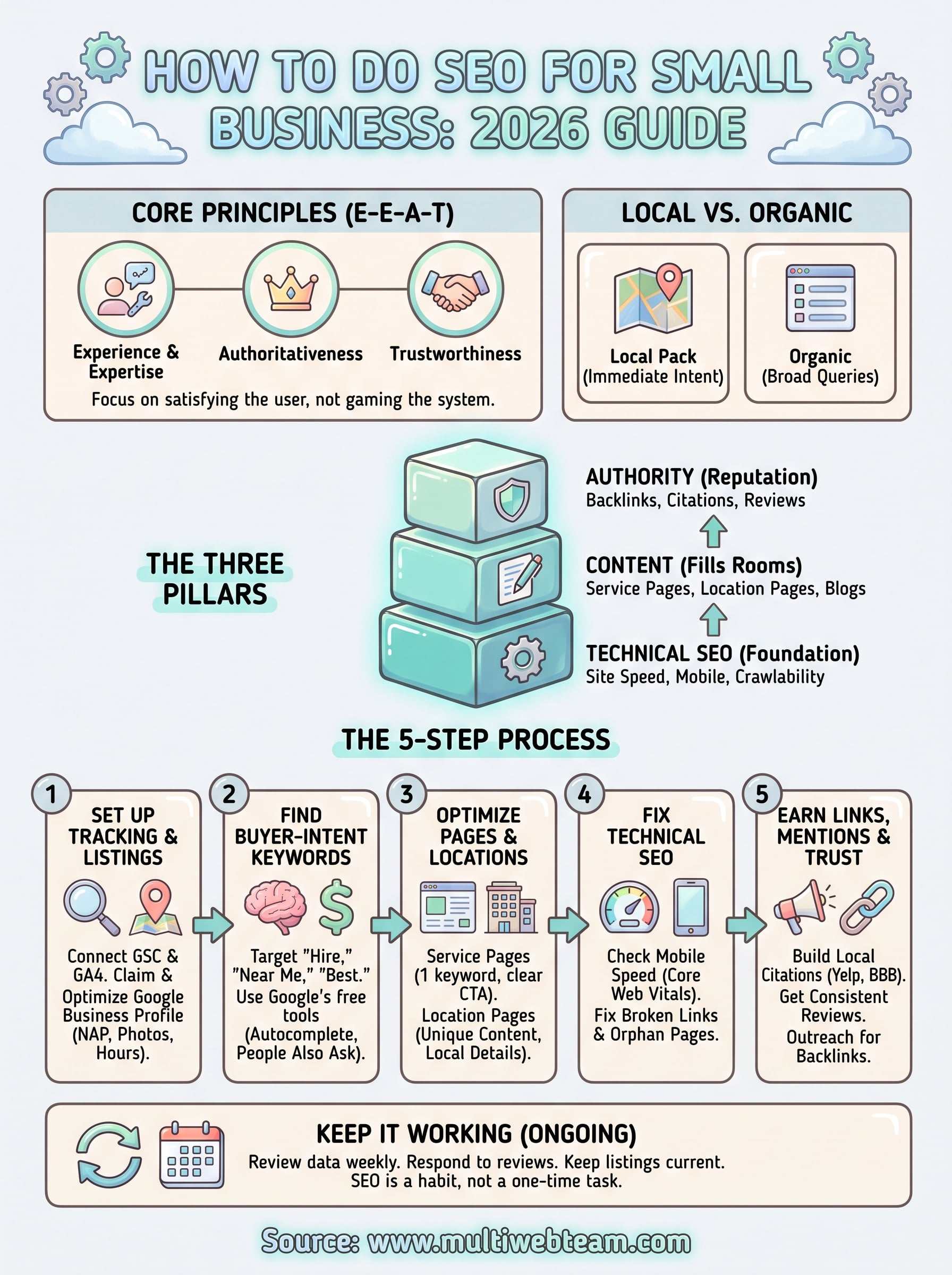
Google's core job is to surface the most helpful, trustworthy result for any given search. To evaluate that, its systems look at a framework called E-E-A-T: Experience, Expertise, Authoritativeness, and Trustworthiness . This isn't a single switch you can flip. It's a collection of signals that together tell Google whether your business deserves to rank.
For small businesses, E-E-A-T often comes down to local credibility: consistent business information, genuine customer reviews, and content that reflects real-world experience rather than recycled generic copy.
What this means practically is that thin, surface-level pages no longer perform. Google rewards content that demonstrates first-hand knowledge and gives visitors a complete answer without pushing them to search again. When you learn how to do SEO for small business correctly, you focus on satisfying the person reading , not gaming the algorithm crawling.
Local SEO vs. organic SEO
Many small business owners treat these two as the same thing. They're related, but they target different types of search results . Organic SEO focuses on ranking in the standard search results for broader queries. Local SEO focuses on the Google Maps pack and location-based searches like "dentist in Denver" or "pizza near me."
For most brick-and-mortar or service-area businesses, local SEO delivers faster and more direct results. Someone searching "electrician open now" is ready to hire , not just browsing. Prioritizing local SEO first gets you in front of buyers with immediate purchase intent , then you build broader organic content on top of that foundation.
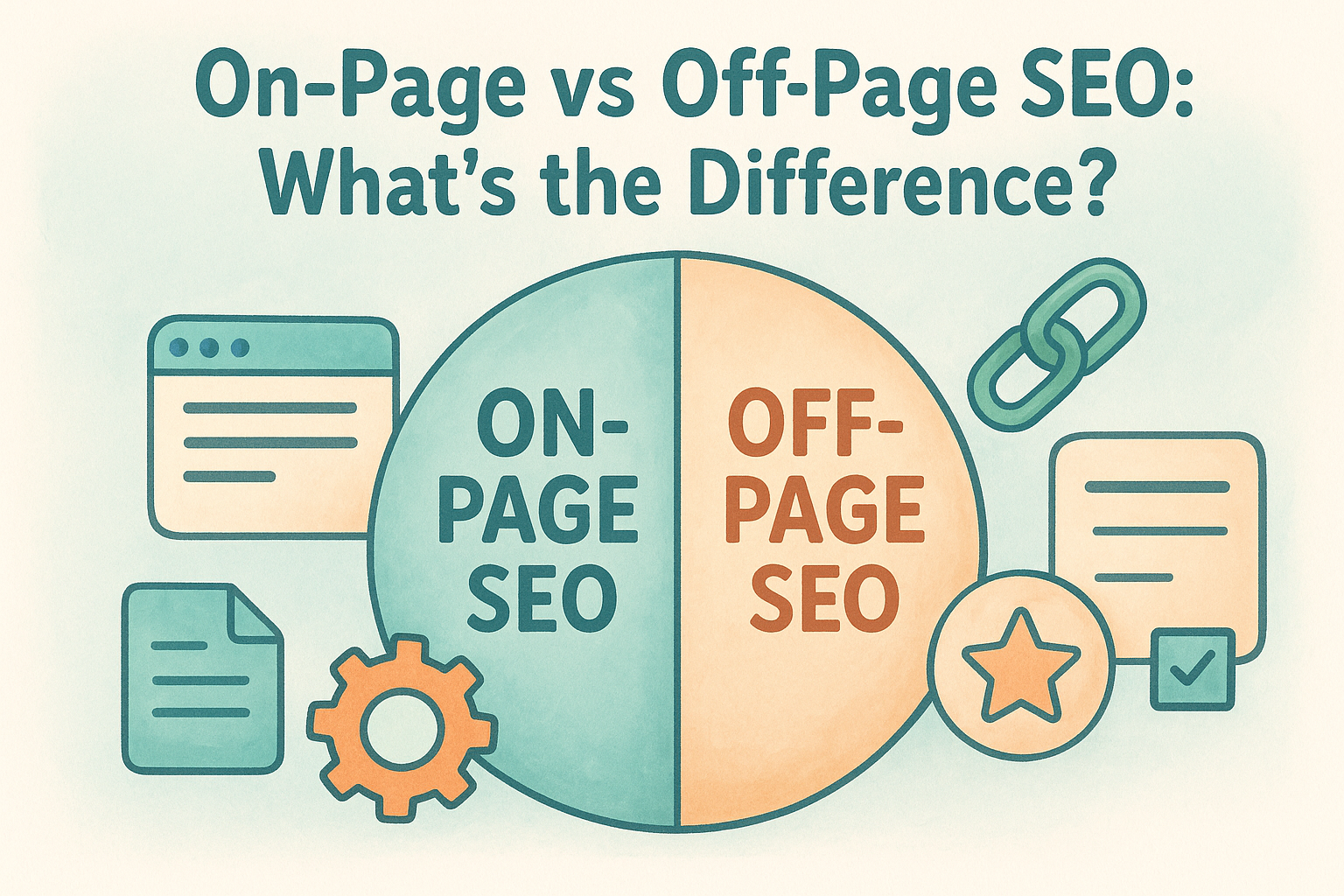
The three pillars every small business needs
Every effective SEO strategy rests on three pillars. Neglect any one of them and the other two underperform, regardless of how much effort you put in.
| Pillar | What it covers | Why it matters |
|---|---|---|
| Technical SEO | Site speed, mobile usability, crawlability, indexing | Google cannot rank a site it cannot access or read |
| Content | Service pages, location pages, blog posts, FAQs | Tells Google and visitors exactly what you do and where |
| Authority | Backlinks, citations, reviews, brand mentions | Signals that outside sources trust your business |
Think of technical SEO as the foundation your site sits on . If it's broken, nothing built on top of it performs well. Content is what fills the rooms, and authority is the reputation that makes people and search engines trust you in the first place. The steps in this guide walk through all three pillars in a sequence that builds each layer without overwhelming you.
Step 1. Set up tracking and local listings
You cannot improve what you do not measure, and you cannot rank locally without telling Google where you are. This step lays the data foundation and puts your business on the map before you touch a single page. Skip it and you'll have no reliable way to know whether any of your later efforts are working.
Connect Google Search Console and Analytics
Google Search Console (available free at search.google.com/search-console) shows you exactly which queries drive visitors to your site, which pages are indexed, and any crawl errors blocking your rankings. Google Analytics 4 shows you what visitors do after they arrive, whether they call, book, or leave immediately.
Setting both up takes under 30 minutes:
- Go to Google Search Console and add your site as a property using your full domain
- Verify ownership by adding a DNS record or inserting an HTML tag in your site's
<head> - Submit your sitemap under the Sitemaps tab (usually
yoursite.com/sitemap.xml) - Create a Google Analytics 4 account and install the tracking snippet on every page
- Link Search Console to Analytics so both tools share data in a single dashboard
Check Search Console at least once a week once it is live. It surfaces keyword opportunities and indexing issues you would otherwise miss entirely.
Claim and optimize your Google Business Profile
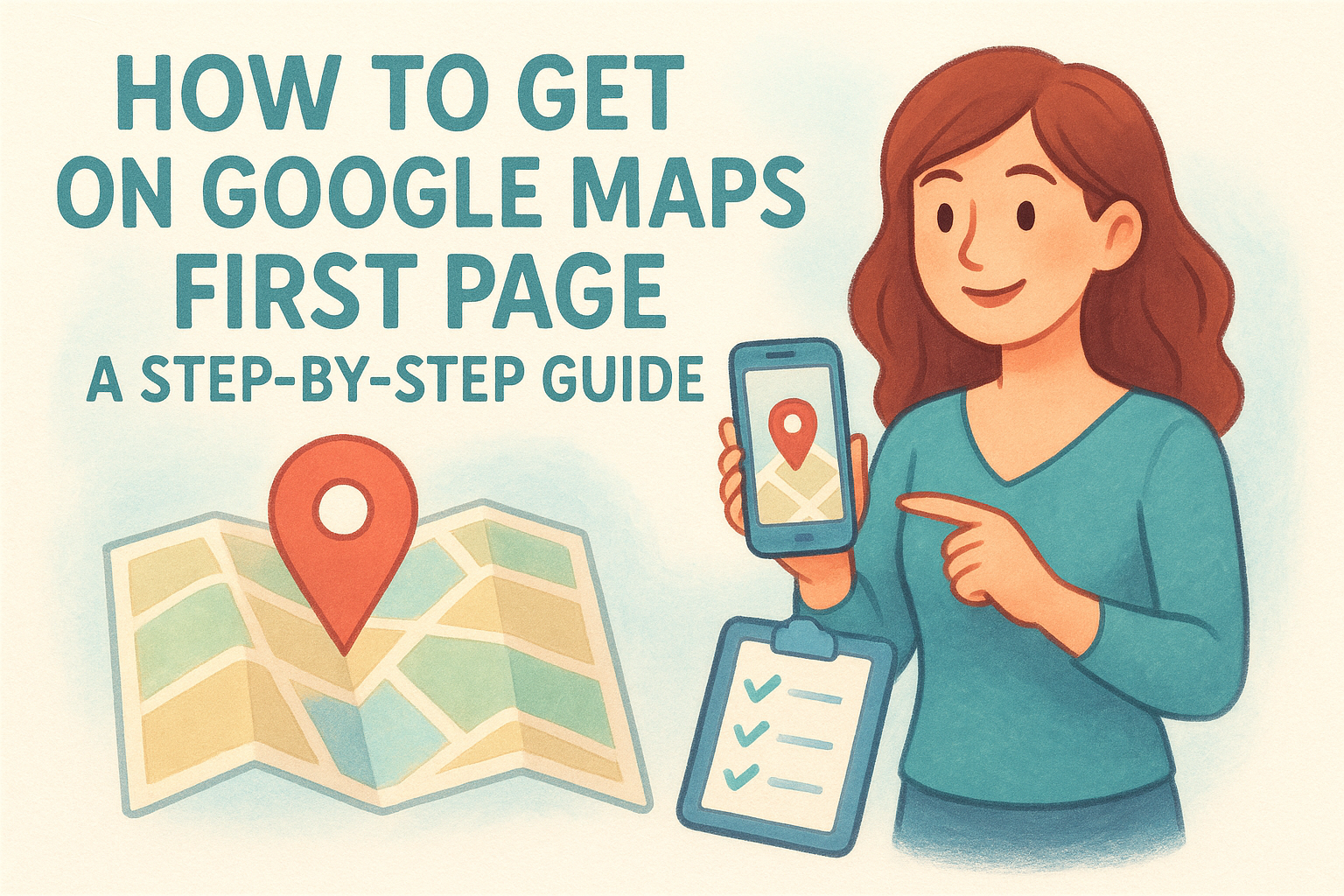
Your Google Business Profile is the single highest-impact local SEO asset you control. It powers your placement in Google Maps and the local pack results that appear above standard organic listings. Learning how to do SEO for small business effectively means treating this profile as a priority, because it is often the first thing a buyer sees before they ever click your website.
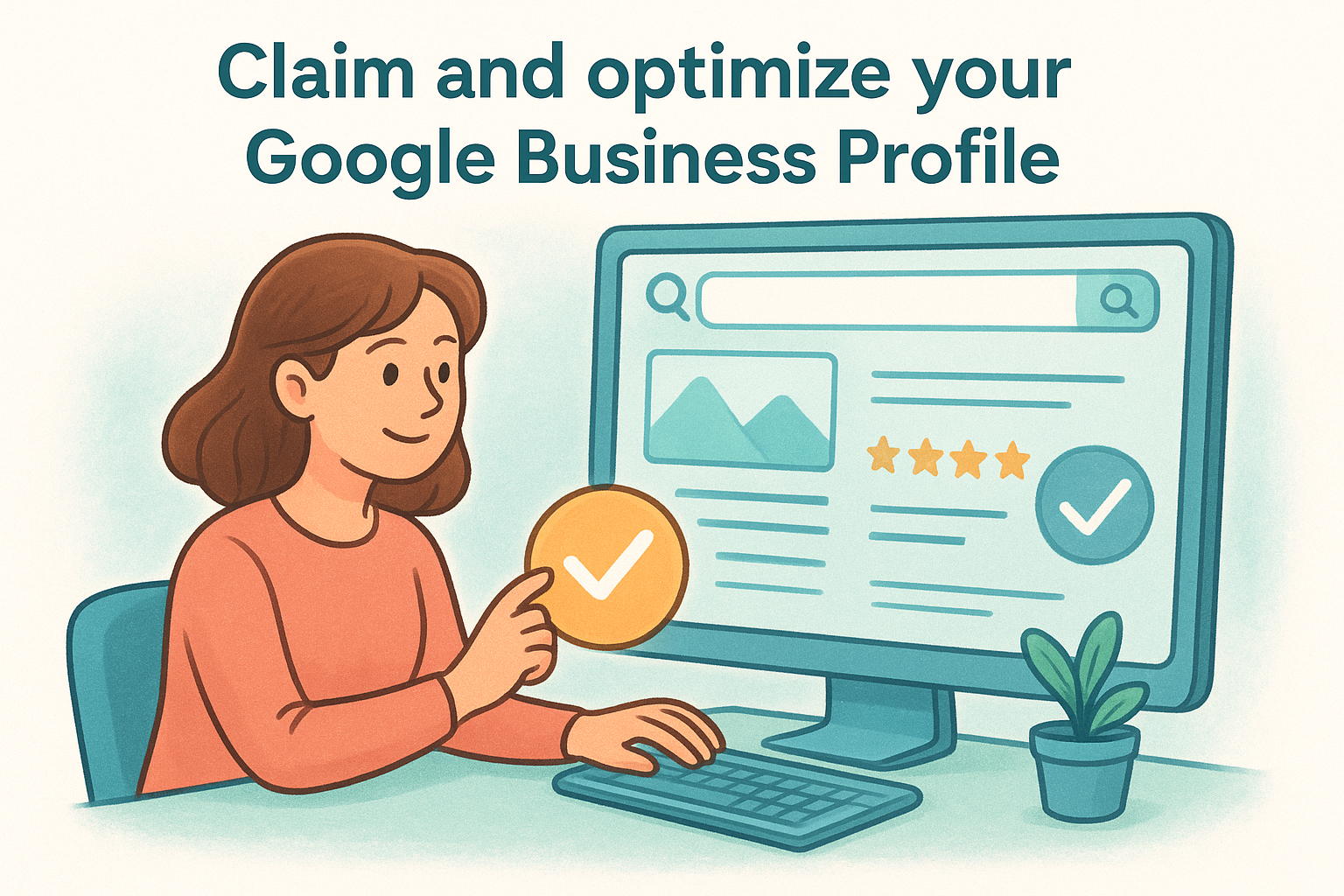
Go to business.google.com, claim your listing, and complete every available field:
- Business name, address, and phone exactly matching your website
- Primary and secondary categories that reflect your actual services
- Business hours , updated for holidays and seasonal changes
- Photos of your location, staff, and products refreshed monthly
- A description of 250 to 750 characters covering your core services and city
Keep all details identical across your website and your profile. Google compares both, and any mismatch reduces your local authority.
Step 2. Find keywords that bring buyers
Keyword research sounds complex, but the core idea is simple: find the exact phrases your potential customers type when they are ready to buy , not just when they are browsing. Most small business owners target keywords that are too broad or too competitive, which means they attract visitors who never convert. When you learn how to do SEO for small business the right way, you prioritize intent over volume , meaning you want searches that signal a clear need rather than just curiosity.
Target buyer-intent keywords first
Not all keywords are equal. Buyer-intent keywords include phrases like "hire," "near me," "best," "cost," or "service" alongside your core offering. A search for "plumber in Austin" signals far more purchase readiness than "how does plumbing work." Focusing on these high-intent phrases means your traffic is far more likely to turn into paying customers rather than quick bounces that never reach your contact page.
Look at three types of keywords to build your initial list:
- Transactional : "HVAC repair Dallas," "order birthday cake online"
- Local service : "accountant near me," "auto body shop in Portland"
- Comparison : "best gym membership prices," "top-rated dog groomer Chicago"
The more specific the keyword, the less competition you typically face and the more likely the searcher is to take action on your site.
Use Google's free tools to build your list
You do not need an expensive paid subscription to find solid keywords. Google Search itself gives you meaningful research data at no cost. Type your main service into Google and read the autocomplete suggestions, the "People also ask" box, and the "Related searches" section at the bottom of results. Each of those surfaces real phrases that real people are typing , which makes them far more reliable than guesswork.
Google Search Console , once your site has a few weeks of data, shows you exactly which queries already bring visitors to your pages. Sort by impressions to surface keywords where you appear but rank below position ten. Those represent low-hanging opportunities where a targeted content update or a stronger page can push you into positions that actually receive clicks.
Step 3. Optimize pages and location pages
Once you know which keywords to target, you need to put them to work on your actual pages. On-page optimization means structuring each page so Google understands exactly what it covers and visitors can quickly find what they need. This is where learning how to do SEO for small business pays off most visibly, because well-optimized pages rank faster and convert better than generic, unfocused content.
Write service pages that rank and convert
Each service you offer deserves its own dedicated page. Cramming multiple services onto one page splits your keyword focus and makes it harder for Google to understand what that page is actually about. Your service page should target one primary keyword , answer the most common questions buyers have, and include a clear call to action above the fold.
Use this structure as your starting template for each service page:
- H1 : Primary keyword + location (e.g., "Roof Repair in Denver, CO")
- First paragraph : State who you serve, what you do, and where, within the first 100 words
- Meta title : Keep it under 60 characters and lead with the primary keyword
- Meta description : 140 to 155 characters summarizing the page with a clear reason to click
- H2 subheadings : Break the page into logical sections covering benefits, process, and FAQs
- Body copy : 400 to 700 words with buyer-intent keywords woven in naturally
- CTA : Phone number, contact form, or booking link visible without scrolling
Write every service page as if the reader arrived knowing nothing about your business but is already ready to hire someone today.
Build location pages that rank in every market
If your business serves more than one city or neighborhood, a dedicated location page for each area dramatically improves your visibility in local search results. Generic "we serve the whole region" copy does not rank for specific local queries. Each location page needs unique content covering that city specifically, not a copy-paste template with only the city name swapped out.
Include the street address, local phone number, neighborhood landmarks, and any location-specific services or hours on each page. Connect each location page directly to your Google Business Profile for that location. This reinforces the geographic relevance signal Google uses to decide which businesses appear in the local pack for a given area, which directly affects how often nearby buyers actually find you.
Step 4. Fix technical SEO and site structure
Technical SEO is the part of how to do SEO for small business that most owners skip because it feels invisible. You never see it on the page, but Google's crawlers see it constantly , and a slow, disorganized site signals low quality even when your content is solid. Fixing the core technical issues removes barriers that silently hold your rankings back, often producing faster results than any content update.
Check your site speed and mobile usability
Page speed and mobile performance are confirmed Google ranking factors, meaning a sluggish site on a phone actively costs you positions. Run your site through Google PageSpeed Insights to get a free report covering both desktop and mobile scores. Pay close attention to the Core Web Vitals : Largest Contentful Paint (LCP), Interaction to Next Paint (INP), and Cumulative Layout Shift (CLS). These three metrics measure how fast your page loads visually, how quickly it responds to user input, and whether elements shift unexpectedly while loading.
A mobile score below 50 on PageSpeed Insights means you are losing rankings and potential customers on the device that handles the majority of local searches.
The fastest fixes that consistently move the needle:
- Compress images before uploading using Google's Squoosh tool to cut file sizes without visible quality loss
- Enable browser caching through your hosting provider's settings or a caching plugin
- Load JavaScript asynchronously so scripts do not block the page from rendering
Structure your site so Google can navigate it
Your internal linking structure tells Google which pages matter most and how they connect to each other. Every service page and location page should be reachable within two clicks from your homepage. Orphan pages (pages no internal links point to) receive little crawl attention and rarely rank, regardless of content quality.
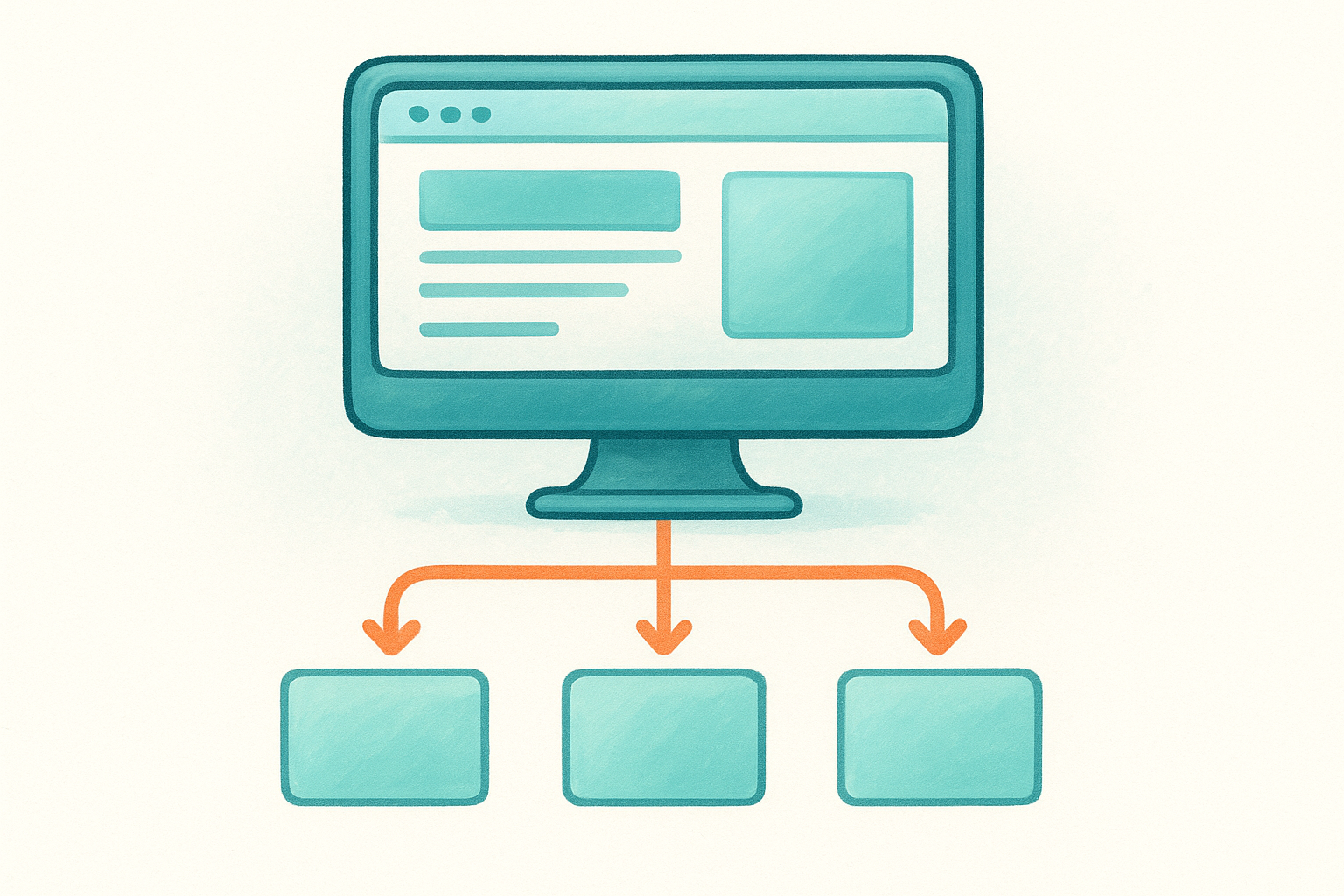
Follow this basic structure for a local service business:
- Homepage links to all main service category pages
- Service category pages link to individual service pages and related location pages
- Location pages link back to relevant service pages for that area
Keep your navigation clean and your URLs short and descriptive , and eliminate duplicate pages caused by URL parameters or multiple domain versions loading at the same time.
Step 5. Earn links, mentions, and trust signals
Links, mentions, and reviews are how Google decides whether your business deserves to rank above the competition. No amount of well-written content will compensate for a weak authority profile when you compete against established local businesses. Understanding how to do SEO for small business means recognizing that what others say about you carries more weight with Google than what you say about yourself.
Build local citations across trusted directories
A citation is any online mention of your business name, address, and phone number (NAP) . Consistent citations across directories reinforce your local authority and help Google confirm your business is real and accurately represented. Inconsistent NAP information across the web confuses Google's systems and actively reduces your local ranking potential.
Start by submitting your business to these high-authority directories:
- Google Business Profile (keep it updated as covered in Step 1)
- Apple Maps via the Maps Connect portal
- Bing Places to capture Microsoft search traffic
- Yelp at biz.yelp.com
- Better Business Bureau at bbb.org
Check every existing listing and correct any address, phone, or name variations before you build new ones.
A single inconsistent phone number across 20 directories can undermine months of other SEO work, so audit before you expand.
Earn reviews and reach out for backlinks
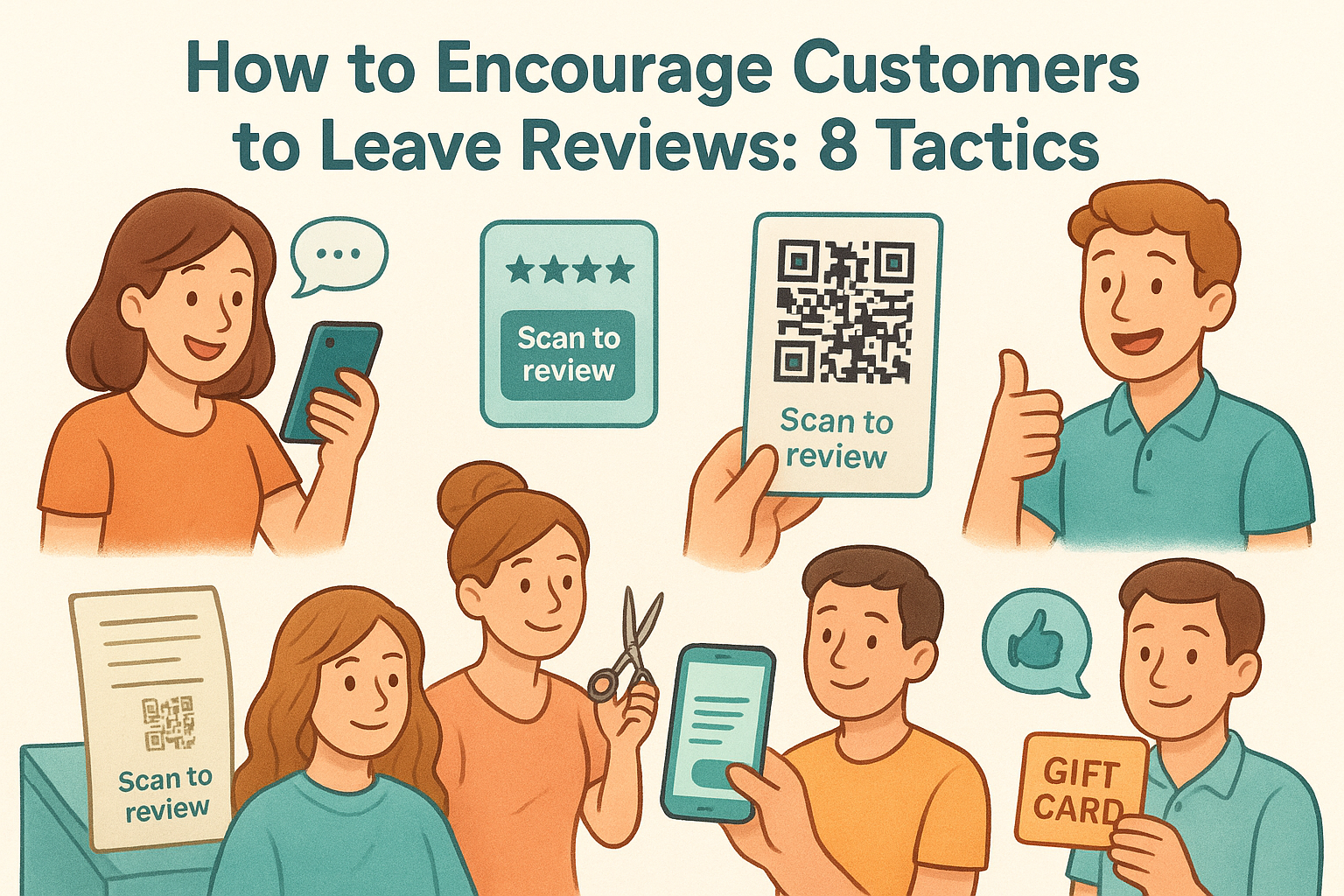
Customer reviews function as trust signals for both Google and the people searching for your services. Ask every satisfied customer to leave a Google review within 24 hours of completing the job, while the experience is still fresh. A steady stream of new reviews , even short ones, outperforms a large batch from two years ago in terms of local ranking impact.
For backlinks, a direct outreach email to a local supplier, partner, or industry association works far better than any automated link scheme. Use this proven outreach template to keep your request short and specific:
 Subject: Quick favor - link from your website
Hi [Name],
We've worked together for [X time] and wanted to ask if you'd be willing
to add a link to our website on your partners or resources page.
Our URL is [yoursite.com]. Happy to return the favor if useful.
Thanks,
[Your name]
Keep your SEO working
SEO is not a one-time project. Rankings shift, competitors update their pages, and Google rolls out algorithm changes throughout the year. The businesses that stay visible are the ones that treat SEO as an ongoing habit rather than a box to check once and forget. Block 30 minutes each week to review your Search Console data, respond to new reviews, and check that your Google Business Profile information stays current.
When you learn how to do seo for small business the right way, you build momentum rather than chasing quick fixes. Start with the steps in this guide , execute each one consistently, and you will see compounding gains over three to six months. If you run multiple locations and want a team handling all of this for you without the overhead of an in-house hire, explore what Multi Web Team offers and see how we keep local businesses ranking month after month.