On Page SEO Optimization Services: What’s Included & Costs
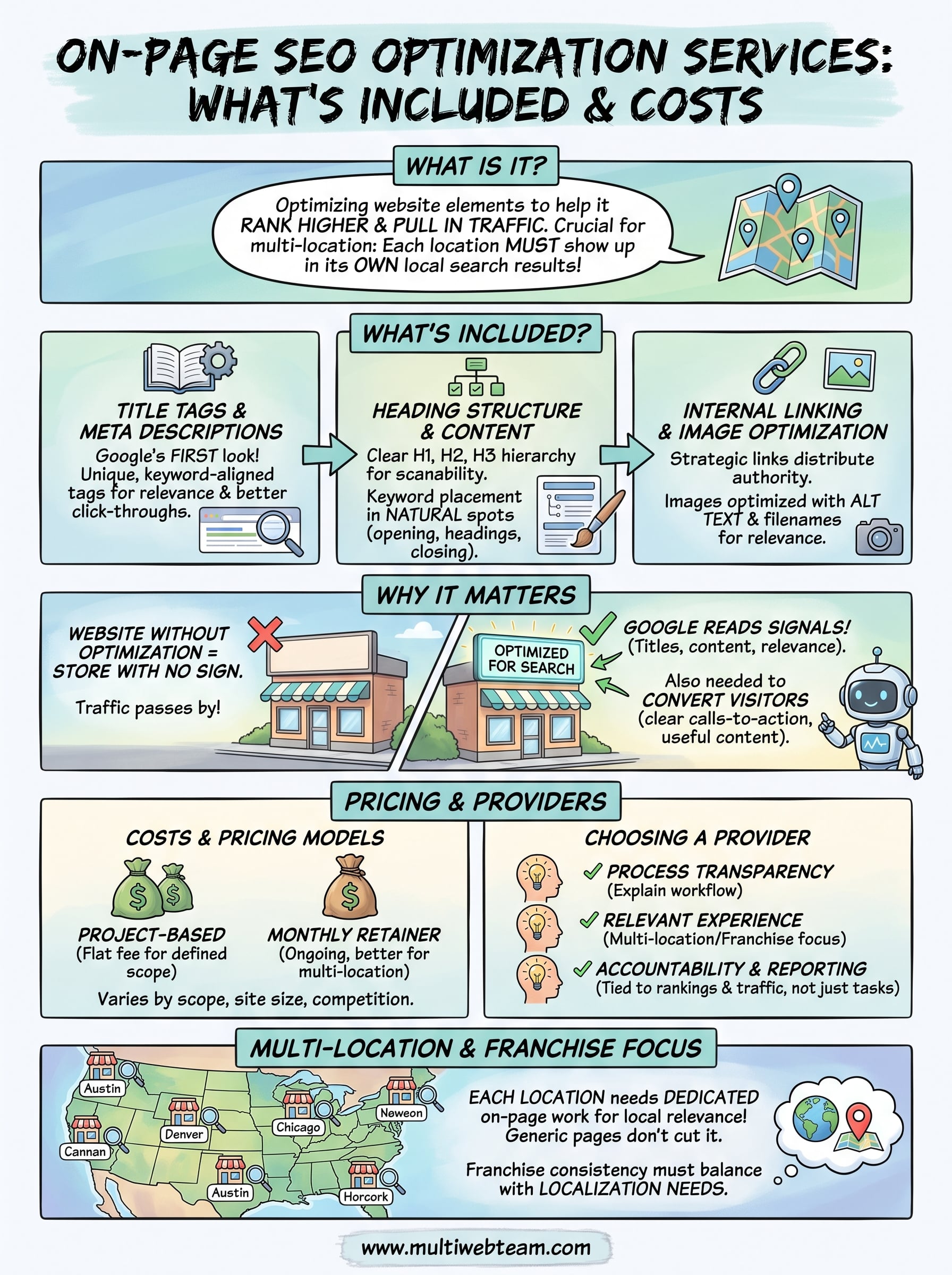
Your website might look great, but if the pages themselves aren't optimized for search engines, potential customers won't find you. That's where on page SEO optimization services come in, they focus on everything that happens on your website to help it rank higher and pull in the right traffic. For multi-location businesses and franchises, this matters even more because each location needs to show up in its own local search results , not just compete under one umbrella.
But what do these services actually include? How much should you expect to pay? And how do you tell the difference between an agency that delivers real results and one that's recycling the same checklist for every client? These are fair questions, especially when you're managing multiple locations and every dollar in your marketing budget has to pull its weight. Understanding what's involved helps you make a smarter hiring decision , whether you're bringing on a specialist or working with a full-service team like ours at Multi Web Team, where on-page SEO is built into every website we design and manage for franchise and multi-location brands.
This article breaks down what on-page SEO services typically cover, what they cost, what to look for in a provider, and how these services directly impact your rankings and conversions. No jargon-heavy sales pitch , just a clear look at what you're paying for and whether it's worth the investment .
Why on-page SEO services matter
Most business owners assume that publishing a website is enough to start ranking on Google. In reality, a website without on-page optimization is like a store with no sign out front : traffic can pass right by without stopping. On-page SEO services exist to close that gap by making sure every element Google evaluates when it crawls your pages is clearly signaling what you do, where you do it, and why your site deserves to rank for the searches your customers are running.
Google reads your pages, not your intentions
When Google sends its crawlers to your site, they're looking for specific signals: page titles, heading structure, keyword placement, internal links, image descriptions, and content relevance . If those signals are missing, weak, or contradictory, Google has a harder time deciding where to rank you, and it often defaults to ranking a competitor instead.
According to Google's own documentation on how search works, relevance signals from page content are among the core factors used to determine ranking order.
This is why on-page SEO isn't a one-time fix. Search algorithms update frequently, and your content, metadata, and structure need regular attention to stay aligned with what Google currently rewards. Hiring a team that provides ongoing on page SEO optimization services means your pages stay competitive instead of drifting down the rankings as conditions change.
Rankings are only half the story
Even if your pages rank well, they still need to convert the visitors who land on them. A page that ranks for the right keywords but fails to clearly communicate what you offer is wasting the traffic it earns. On-page SEO services that are done well address both sides: making pages visible to search engines and making them useful to real people.
This means optimizing the way your content is organized, how fast your pages load, whether your calls-to-action are clear, and whether the page answers the question a searcher actually had when they clicked. Ranking and converting are two different goals , but both depend on how well your pages are built and maintained.
Multi-location businesses carry extra complexity
If you run a single-location business, on-page SEO is fairly straightforward. But when you operate multiple locations, each one competes in its own local search market , and a generic website with one set of optimized pages simply won't cut it. Someone searching for your service in Austin expects different results than someone searching in Denver, and Google serves them accordingly.
Each location page needs its own optimized title tag, localized content, and relevant internal linking structure to stand a real chance at ranking in that specific market. Without that, you're essentially asking one page to win every local race, and that's not how local search works.
The businesses that struggle most with local visibility often have the same problem: they built a website once and assumed it was done . In practice, multi-location businesses need an ongoing strategy that treats each location as its own SEO asset. That's the core reason so many franchise and multi-location operators turn to specialized agencies rather than trying to manage this in-house, because the volume of work required to do it properly is significant.
What on-page SEO services include
When you hire a provider for on page SEO optimization services , you're paying for a structured process that covers several distinct areas of your website. The exact scope varies between agencies, but most reputable providers work through a consistent set of core deliverables that directly influence how search engines understand and rank your pages . Understanding what's in that scope upfront helps you evaluate proposals, ask better questions, and hold any provider accountable for actual results.
Title tags and meta descriptions
Every page on your site has a title tag and a meta description, and these are among the first elements Google reads when crawling a page . Your title tag tells search engines what the page is about, while your meta description gives searchers a reason to click through. Poorly written or duplicate tags across multiple pages dilute your relevance signals and reduce your click-through rate in search results. A solid on-page service will audit existing tags, rewrite underperformers, and make sure every page carries a unique, keyword-aligned title and description that reflects what the page actually delivers.
Getting your title tags right is one of the highest-return fixes in SEO because a single change can improve both your rankings and your click-through rate at the same time.
Heading structure and content
Your headings (H1, H2, H3) give both users and search engines a structured roadmap through your page. A clear heading hierarchy signals topic relevance and makes your content far easier to scan. On-page services typically review your heading structure and rewrite or reorganize it to match the way people actually search for your topic. Beyond headings, providers also examine keyword placement within the body content itself , checking whether your target terms appear naturally in the right locations, including the opening paragraph, subheadings, and the closing section.
Internal linking and image optimization
Internal links help Google discover pages across your site and understand how they connect to each other. A structured internal linking strategy distributes ranking authority across your pages and keeps visitors moving deeper into your site instead of bouncing. On-page services map these connections and add or correct links where they're missing or broken. Images carry SEO weight too, through alt text and file naming conventions , and a thorough service optimizes these so every image contributes to your page's relevance rather than being skipped by crawlers entirely.

What they do not include
Knowing the scope of on page SEO optimization services also means knowing where the scope ends. Many businesses run into budget misalignments because they assumed their on-page package covered work that actually falls under a different service category. Understanding these boundaries upfront helps you build a complete strategy without paying for overlaps or leaving critical gaps unaddressed.
Off-page and technical SEO
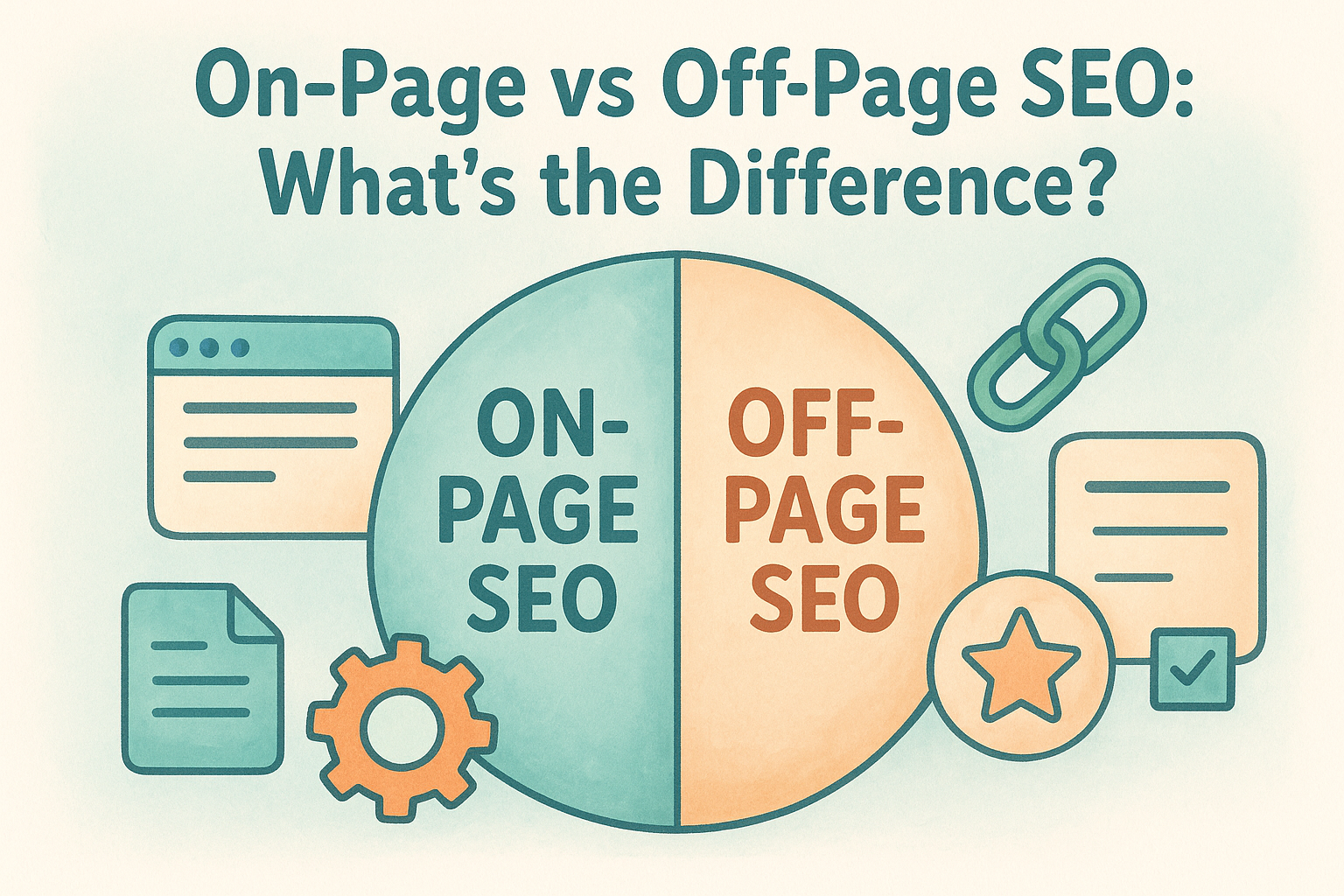
On-page SEO focuses exclusively on what lives on your actual pages , not on the signals that come from outside your site. Link building, for example, is an off-page activity that involves earning backlinks from other websites. This work happens entirely outside the scope of on-page services, and no amount of title tag optimization replaces the authority that strong external links provide . You typically need a separate off-page strategy running alongside your on-page work to get the full benefit of both.
Technical SEO, which covers things like crawl errors, server response times, XML sitemaps, and Core Web Vitals infrastructure, also sits in its own lane and requires different tools and expertise to address properly.
Similarly, fixing broken site architecture or resolving indexing issues at the server level falls under technical SEO, not on-page optimization. If you bring on an on-page provider and your site has serious technical problems underneath, those problems can limit the impact of every other improvement that provider makes.
Content creation and copywriting
Most on-page SEO providers optimize the content that already exists on your pages rather than writing new pages from scratch. Rewriting a title tag is different from producing a full-service page with original copywriting, imagery direction, and strategic positioning. If your site is missing key pages, or if your existing content is thin and needs to be rebuilt rather than adjusted, you will likely need a separate content or copywriting engagement alongside the on-page work.
Paid advertising and conversion rate optimization
On-page SEO improves your organic search visibility , not your paid traffic. Running Google Ads or managing a paid media budget is a completely separate service. Likewise, deep conversion rate optimization(CRO) , which involves user behavior testing, heat mapping, and A/B testing landing page variants, typically sits outside what a standard on-page engagement covers. Some agencies bundle these together, but you should confirm what's included in writing before signing any agreement.
How an on-page optimization project runs
Most businesses sign up for on page SEO optimization services without a clear picture of what the actual workflow looks like week to week. Knowing the typical project sequence helps you set realistic timelines, give useful feedback at the right stages, and measure whether the agency you hired is moving through the work in a logical order or just checking boxes.
The initial audit
Before any changes get made, a competent provider runs a full audit of your existing pages to understand what's working, what's broken, and what's missing entirely. This involves crawling your site to map every page, reviewing title tags, heading structures, content quality, internal link patterns, and image optimization across your entire domain. The audit output gives both sides a shared starting point and sets the priority order for everything that follows.
Skipping a proper audit and jumping straight to changes is one of the most common ways on-page projects waste budget on low-impact fixes while leaving bigger problems untouched.
You should expect the audit phase to take anywhere from a few days to two weeks depending on the size of your site. For multi-location businesses, this phase is especially important because each location page needs its own assessment rather than a single sitewide sweep.
Implementation and updates
Once the audit is complete, the provider moves into active optimization work across your pages. This typically follows a priority order based on which pages drive the most traffic or sit closest to conversion. High-traffic pages, service pages, and location-specific pages usually get addressed first. Your provider should be communicating with you throughout this phase so you can approve any significant content or structural changes before they go live.
Implementation is rarely a single burst of activity. Ongoing on-page services treat optimization as a continuous process rather than a one-time project, returning to pages as rankings shift or new opportunities emerge.
Reporting and ongoing maintenance
A reliable provider ties all of this together with clear reporting on what changed and why . You should receive updates that connect specific optimizations to movement in rankings or traffic, not just a list of tasks completed. Strong reporting also surfaces what needs attention next, keeping your on-page strategy forward-looking rather than reactive.
Costs and pricing models
On page SEO optimization services vary widely in price depending on the scope of work, the size of your site, and the pricing model your provider uses. Understanding how agencies structure their fees helps you evaluate quotes accurately and avoid paying for packages that don't match your actual needs . There is no universal rate, but knowing the common models puts you in a stronger position when comparing options.
Project-based pricing
Some providers charge a flat fee for a defined scope of work , such as optimizing a set number of pages or completing a single sitewide audit. Project-based pricing typically ranges from a few hundred dollars for small sites to several thousand dollars for larger engagements with dozens of pages to address. This model works well if your site is already in reasonable shape and just needs a targeted round of improvements , but it does not include ongoing maintenance once the project is complete.
If you choose a project-based engagement, get a clear deliverable list in writing so you know exactly what pages and elements are covered before work begins.
Monthly retainer pricing
A monthly retainer model keeps a provider working on your site continuously rather than delivering a one-time batch of changes. Retainers for on-page SEO typically range from a few hundred dollars per month for basic plans to well over a thousand dollars monthly for more comprehensive coverage, particularly for businesses with large or complex sites. This model suits multi-location businesses especially well because the ongoing nature of the work matches the ongoing nature of managing multiple location pages across changing search conditions.
What drives the price up or down
Several factors shift where your quote lands within the typical range. The number of pages your site contains is the most direct cost driver since more pages mean more audit work, more rewrites, and more ongoing maintenance. Competitive industries where rankings require stronger signals also tend to command higher fees because the optimization work needs to be more thorough and consistent to move the needle. Agencies that specialize in specific business types, like franchises or service-based businesses, may charge more than generalist providers but often deliver more relevant results because their process is already tuned for your situation.
The size and reputation of the agency itself also factors in. Larger firms with established track records will cost more than freelancers or newer agencies, and that difference in price often reflects real differences in experience, tooling, and accountability.
How to choose an on-page SEO provider
Picking the right provider for on page SEO optimization services comes down to more than comparing prices. The agency or specialist you hire needs to demonstrate a clear process, relevant experience, and genuine accountability before you commit to any agreement. Asking the right questions during your evaluation separates providers who deliver consistent results from those who rely on vague promises and recycled tactics that look the same regardless of your industry or site structure.
Look for process transparency
A trustworthy provider explains their workflow before you sign anything. You should be able to get a clear answer to how they run an audit, what order they prioritize fixes, and how they handle communication throughout the engagement. If a provider is vague about their methodology or skips straight to pricing without walking you through how they actually work, that is a warning sign worth taking seriously.
Ask any prospective provider to show you a sample audit or a redacted report from a past client so you can evaluate the depth of their work before committing to a contract.
Relevant experience in your specific business type also matters significantly. An agency that has worked with multi-location businesses or franchise models will have a more practical understanding of location page optimization than a generalist who applies the same template to every client regardless of how their site is structured or how local search affects their revenue.
Ask about reporting and accountability
Strong providers tie their reporting directly to ranking changes, traffic movement, and page-level improvements rather than delivering a flat task list. You want to see that the work completed actually moved something measurable, not just that someone updated a title tag and marked it done. Ask specifically what metrics your reports will include and how frequently you will receive them.
Also confirm who owns the work after the engagement ends. If you end your contract, all optimizations applied to your site should remain in place without any additional fees to retain them. Some providers structure agreements in ways that create dependency, which works directly against your long-term interests. Clarifying ownership terms before you sign protects you from losing months of progress if you need to change providers down the road.
On-page SEO for multi-location and franchises
Multi-location businesses and franchises face a version of on page SEO optimization services that is fundamentally more demanding than what a single-location business needs. Every location you operate sits in its own local search market , and Google evaluates each one based on the relevance signals it finds on the corresponding page. A single optimized homepage cannot carry the weight of twenty different markets, which means your SEO strategy has to treat each location as its own asset.
Each location needs dedicated on-page work
Generic location pages that swap out only the city name are not enough to rank well in competitive local searches. Google's local ranking systems reward pages that demonstrate genuine relevance to a specific area , and that requires more than a text replacement. Each location page needs its own optimized title tag referencing the actual city or neighborhood, localized content that speaks to the people in that area, and internal links that connect the location page to relevant service pages on your site.
According to Google's documentation on how local results are ranked, relevance, distance, and prominence all factor into local search visibility, and the content on your pages directly affects how well Google can assess relevance.
Building this structure across ten, twenty, or fifty locations requires a systematic process rather than a manual page-by-page approach . Providers who specialize in multi-location businesses typically build templates that maintain consistent structure while allowing for the localized content differences that actually move rankings.
Franchise consistency versus local relevance
Franchise businesses carry an additional challenge that independent multi-location operators do not always face: brand consistency requirements that can conflict with local optimization needs . Corporate guidelines often restrict what franchisees can change on their pages, which limits how much localization is possible without proper coordination between the brand and its individual locations.
The solution is a clear framework that separates brand-controlled elements from location-specific fields . Your title tags, headings, and core content blocks can follow a consistent structural pattern while still containing location-specific language that helps Google match each page to the right local searches. Working with an agency that understands franchise web management, the way the team at Multi Web Team does, means you get a process built for this exact challenge rather than a generic template applied without regard for how franchise structures actually work.
Next steps
You now have a clear picture of what on page SEO optimization services cover, how they're priced, and what to look for when choosing a provider. The next move is to take an honest look at your current site and ask whether each location page is actually doing the work it needs to do in local search. If your pages lack optimized title tags, localized content, or a clear internal linking structure , you're likely leaving rankings on the table right now.
For multi-location businesses and franchises, this work adds up fast. Managing dozens of location pages without a dedicated team behind you means things get missed, pages go stale, and competitors gain ground while your attention is elsewhere. The team at Multi Web Team handles exactly this, building and maintaining optimized websites designed for multi-location growth. If that sounds like the right fit for your business, get in touch with Multi Web Team to talk through what your site needs.