Local Search Ranking Factors: How Google Ranks Local Results
Every local business competes for the same real estate: the top of Google's local results. Whether someone searches for "pizza near me" or "best gym in Dallas," Google decides which businesses show up first, and which get buried. The signals behind those decisions are called local search ranking factors , and understanding them is the difference between a location that gets found and one that gets ignored .
Google uses a specific set of criteria, proximity, relevance, prominence, and dozens of smaller signals, to determine local rankings. Some of these factors you control directly, like your Google Business Profile and on-page SEO. Others, like online reviews and backlinks, require a longer-term strategy. Knowing what actually moves the needle helps you stop guessing and start making changes that produce measurable results across every location you operate.
At Multi Web Team, we build and manage websites for multi-location businesses and franchises, with local SEO baked into every page. We work with these ranking factors daily, optimizing individual locations to rank in their own markets while keeping everything organized under one roof. That hands-on experience shapes everything in this guide, it's not theory, it's what we see working right now .
This article breaks down the major local search ranking factors Google uses in 2026, explains how each one affects your visibility, and gives you a clear picture of where to focus your efforts. Let's get into it.
Why local search ranking factors matter
When someone searches for a business near them, they rarely scroll past the first few results . Google's local search results have some of the highest purchase intent of any search type, meaning the people searching are ready to spend money. If your location does not appear in those top spots, you are handing customers directly to your competitors. Understanding what drives those rankings is not optional for any business that depends on local foot traffic or local service inquiries.
The revenue gap between ranking and not ranking
The difference between ranking in the local pack and not ranking there is not a minor inconvenience. Click-through rates drop sharply as you move down the results, and the top three positions in the local pack capture the majority of clicks before most users ever look further. For a multi-location business, this gap compounds across every market you operate in. A business with ten locations that ranks poorly in even half of them is losing a measurable share of potential revenue every single month, not once, but continuously.
The local pack occupies the most prominent real estate on a Google results page, and the businesses filling those spots are the ones customers call, visit, and buy from.
Local search ranking factors determine not just whether you appear, but how prominently you appear relative to your direct competitors. Signals like your Google Business Profile completeness, the volume and recency of your reviews, and how well your website reflects local search intent all contribute to whether you land in a high-visibility position or sit below businesses that have invested more deliberately in these areas.
Why multi-location businesses face compounded challenges
For a single-location business, managing local SEO is a focused effort. For a franchise or multi-location operation , the challenge scales with every new location you add. Each location needs its own optimized presence, its own review activity, and its own local signals to rank in its specific market. A franchise in Austin competes against a completely different set of businesses than your location in Denver, and Google evaluates each location independently based on signals specific to that geographic area.
This is exactly why local search ranking factors carry so much weight for growing businesses. Without a clear and consistent strategy for each location, some will rank well while others underperform, creating uneven customer traffic across your entire network. A location that ranks poorly in a competitive market will consistently lose customers to businesses that have paid closer attention to the same signals.
Neglecting these factors at scale creates compounding problems. Inconsistent business information, outdated citations, and ignored review profiles all send weak or contradictory signals to Google, reducing your chances of ranking across the board. The businesses that dominate local search in competitive markets treat ranking signals as an ongoing operational priority, not a one-time setup task they completed at launch.
How Google builds local results
Google does not pull local results from a single source. It crawls the web continuously , collects signals from multiple data points, and runs those signals through its local ranking systems to decide what shows up and in what order. Understanding how that process works gives you a clearer picture of why certain local search ranking factors carry more weight than others and where your attention makes the biggest difference.
The two result types Google serves locally
When someone runs a local search, Google typically returns two distinct sets of results on the same page: the local pack (also called the map pack) and local organic results. The local pack appears near the top of the page and shows a map alongside three business listings. Local organic results appear below that, formatted like standard web results but filtered by local relevance. Both are valuable, and they respond to different signals , which means a well-rounded local strategy needs to address both.
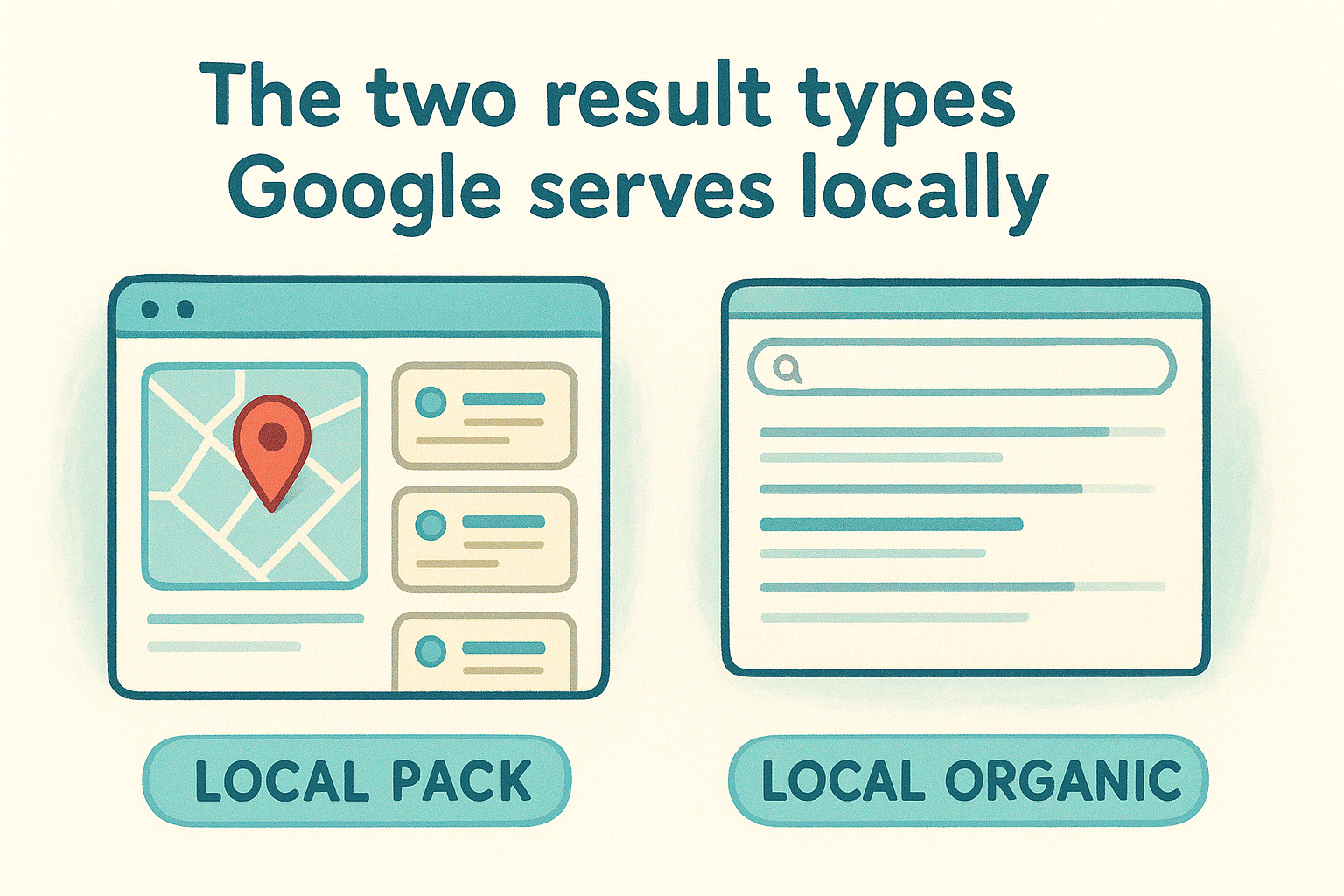
The local pack pulls primarily from Google Business Profile data , meaning your profile completeness, category selection, review activity, and proximity to the searcher all influence whether you show up there. Local organic results, on the other hand, draw more heavily from your website's on-page signals, backlink profile, and content relevance. A business can rank in the local pack without a strong website, and it can rank in local organic results without a fully optimized Google Business Profile, but combining both gives you the strongest overall visibility .
How Google collects and evaluates local data
Google gathers local business information from several sources simultaneously. It reads your Google Business Profile directly , but it also crawls your website, scans third-party directories and data aggregators, processes user-generated content like reviews and photos, and monitors behavioral signals like clicks and calls. All of that data feeds into its ranking systems, where it gets weighed against what competitors in the same geographic area have signaled.
The businesses that rank consistently well are not relying on a single strong signal; they maintain accurate, consistent, and active data across every source Google pulls from.
What matters most is consistency and completeness across all of those touchpoints. When Google sees the same business name, address, phone number, and category information confirmed across your website, your Google Business Profile, and reputable third-party sources, it builds confidence in your listing. Conflicting or incomplete data creates ambiguity, and Google responds to ambiguity by ranking you lower.
The three pillars of local rankings
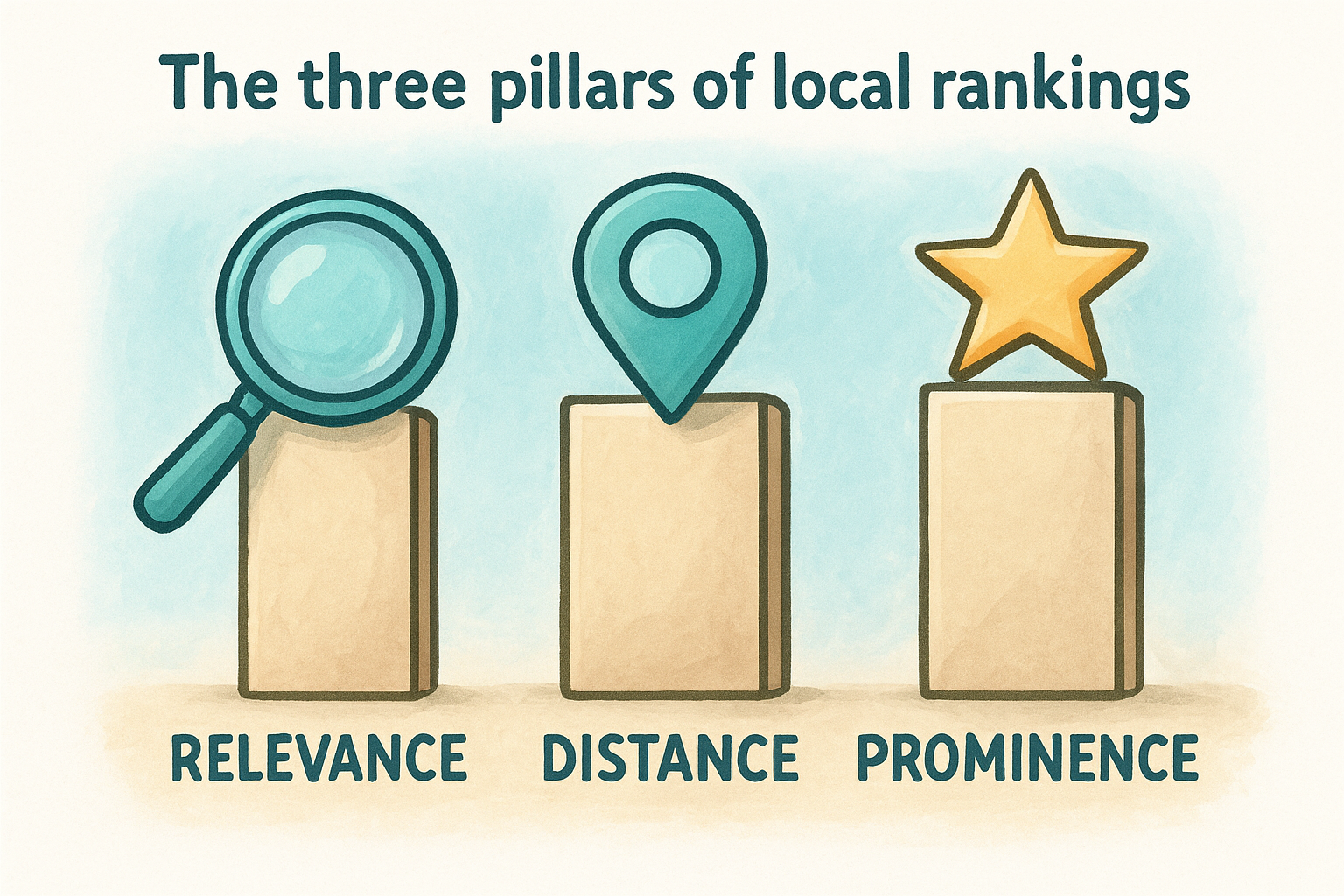
Google publicly identifies three core factors that drive local search results: relevance, distance, and prominence . Every local search ranking factor you will read about in this guide connects back to one or more of these three pillars. They work together rather than independently, so a strong performance in one area can partially offset a weaker signal in another, but the businesses that consistently rank at the top tend to score well across all three .
Relevance
Relevance measures how closely your business matches what the searcher is actually looking for. Google evaluates your Google Business Profile categories, your website content, and your service descriptions to determine whether your business fits the query. If someone searches "emergency plumber," Google looks for businesses that have clearly signaled through their profile and website that emergency plumbing is a service they actually provide.
Improving your relevance score means being specific and complete in how you describe your business . A vague category selection and a thin business description give Google little to work with. The more precisely you communicate what you do and who you serve, the more confidently Google can match your listing to the right searches.
Distance
Distance refers to how far the searcher is from your business location at the time of the search. When someone runs a search without specifying a location, Google estimates their location from their device and factors proximity into the results. Businesses closer to the searcher get a natural advantage for that particular search, but distance alone does not determine the outcome.
Google can rank a more distant business above a closer competitor when the relevance and prominence signals for the distant business are significantly stronger.
This means you cannot fully control the distance factor, but you can build stronger relevance and prominence signals that compensate for it in competitive markets. For multi-location businesses, this is particularly valuable, since having a physical presence closer to each local market remains one of the clearest ways to improve distance-related signals across your network.
Prominence
Prominence reflects how well-known and trusted your business is , both online and offline. Google measures prominence through your review volume and ratings, the quality and quantity of links pointing to your site, how often your business appears across reputable directories, and overall brand authority. Established businesses with strong reputations tend to rank higher because Google treats widespread recognition as a signal of reliability and trustworthiness .
Local pack vs local organic rankings
Google serves two distinct types of local results on the same page, and each one responds to a different set of signals . Treating them as interchangeable leads to gaps in your strategy. The local pack and local organic results reward different investments, and understanding what separates them helps you allocate your effort more effectively across both.
What the local pack actually shows
The local pack appears near the top of a search results page and displays a map alongside three business listings . Each listing shows your business name, star rating, address, phone number, hours, and sometimes a short description or photo. Google pulls this information almost entirely from your Google Business Profile , which means your profile completeness, category accuracy, review activity, and proximity to the searcher all directly influence whether you appear in those three slots.
The local pack captures the most visible real estate on the page. Most searchers make their choice before scrolling past it, which is why businesses that consistently appear there see higher call volume and more direction requests than competitors ranked below them in organic results. For multi-location businesses, earning a pack placement in each market is one of the highest-value local SEO outcomes you can target.
How local organic results work differently
Local organic results sit below the local pack and look like standard blue-link search results, but Google filters them based on local relevance . Your website's on-page content, internal linking structure, backlink profile, and how clearly you communicate your service areas all influence whether you rank here.
Local organic rankings reward the businesses that invest in their website, not just their Google Business Profile.
These results matter because not every search triggers a local pack , and users who scroll past the pack often have higher research intent, meaning they are comparing options before committing. Ranking in both positions gives your business two separate opportunities to appear on the same page.
Why you should target both
The local search ranking factors that drive pack visibility and the ones that drive organic visibility overlap but do not duplicate each other. A strong Google Business Profile lifts your pack rankings , while a well-optimized website with location-specific content builds your organic presence. Businesses that invest in only one of the two leave visibility and traffic on the table.
Combining both means you occupy more real estate on a single results page , which increases the probability that a searcher encounters your business before they reach a competitor.
Google Business Profile signals that move rankings
Your Google Business Profile is the single most influential asset for local pack visibility. Google reads every field you fill out , from your primary category to your business hours, and uses that information to determine whether your listing matches what a searcher needs. Treating your profile as a one-time setup task is one of the most common mistakes multi-location businesses make. The local search ranking factors tied to your profile require consistent attention and regular updates to stay competitive.
Profile completeness and category selection
A fully completed profile signals to Google that your business is legitimate and actively managed. Fill in every available field , including your service list, business description, website URL, and accepted payment methods. Incomplete profiles leave Google with less data to work with, which translates directly to lower confidence and weaker rankings.
Your primary category carries the most weight of any single profile field . It tells Google the core nature of your business and determines which searches you are eligible to appear for. Choose it carefully based on what your business primarily does, not what sounds the most impressive. Secondary categories let you capture additional search types, but they should only reflect services you genuinely provide , not aspirational additions that dilute your relevance signal.
Review volume, recency, and responses
Reviews are one of the strongest prominence signals your profile can generate. A high volume of recent, positive reviews tells Google that real customers are actively engaging with your business, which supports both your ranking position and your click-through rate once you appear in results. Recency matters as much as total count, so a steady stream of new reviews outperforms a large batch of old ones that has gone quiet.
Responding to every review, positive or negative, signals to Google that you are an active and engaged business owner, which reinforces your profile's trustworthiness.
Businesses that ignore reviews or let months pass without a response are leaving a meaningful trust signal completely unused. For multi-location operators, building a process that prompts reviews at each location and routes responses back through the right profile keeps every location active in Google's eyes.
Photos and Google Posts
Regularly uploading photos of your location, products, and team signals an active business and gives Google fresh content to associate with your listing. Google Posts, which appear directly on your profile, let you share promotions, events, and updates that keep your listing current and give searchers a reason to engage before they even visit your site.
Website and on-page signals for local organic
Your website plays a central role in local organic rankings, and the local search ranking factors tied to it are ones you have full control over. While your Google Business Profile drives pack visibility, your website's on-page signals determine how Google evaluates your relevance and authority for local organic results. Weak on-page optimization means you lose the second major opportunity to appear on a results page, even when your profile performs well.
Location pages and NAP consistency
Every location your business operates needs its own dedicated page on your website. A single generic "Contact" page listing multiple addresses does not give Google enough location-specific information to rank each location independently. Build separate pages for each location and populate them with unique content that reflects the local market , including the city name, service area, nearby landmarks, and location-specific details rather than copy-pasted text duplicated across every page.
NAP consistency, meaning your business name, address, and phone number appearing exactly the same way across your website and your Google Business Profile, is one of the clearest trust signals you can send Google.
Any variation between your website and your profile creates conflicting signals that reduce Google's confidence in your listing. Check every location page to confirm the name, address, and phone number match your Google Business Profile precisely, including formatting details like abbreviations and suite numbers. Small discrepancies compound into real ranking problems at scale.
Title tags, headers, and local keyword signals
Title tags and H1 headers are among the strongest on-page signals Google reads when evaluating a page for local relevance. Each location page should carry a title tag that includes your primary service and the city you serve, formatted clearly and without keyword stuffing. Your H1 header should reinforce that same combination so Google sees consistent topical and geographic alignment across the most prominent content elements on the page.
Your body content should naturally reference the location you serve, the services you provide there, and details genuinely specific to that market. Thin or duplicated content across location pages signals to Google that those pages do not offer distinct value, which suppresses rankings for all of them. Treat each location page as the primary representative of that market, and give it the depth a local customer would actually find useful when comparing their options.
Reviews and reputation signals that drive clicks
Reviews are one of the most visible local search ranking factors you can actively influence. Google treats review volume and star ratings as prominence signals , and they directly affect both where you rank and whether searchers choose to click on your listing. A business sitting at 4.8 stars with 200 reviews will consistently outperform a competitor with 3.9 stars and 40 reviews, even when other signals are comparable between the two.
How review volume and recency affect rankings
Google does not treat a review from three years ago the same as one from last week. Recency signals that real customers are actively engaging with your business right now, which matters for a search engine trying to surface currently active businesses. A burst of reviews followed by months of silence actually weakens your signal over time as the recency advantage fades.
Building a consistent review cadence matters more than chasing a high total count in a single push. Ask for reviews at the right moment, specifically right after a customer completes a transaction or expresses satisfaction, and make the process easy by sending a direct link to your Google Business Profile review form . For multi-location businesses, every location needs its own active review pipeline rather than relying on one strong location to carry the others.
Why responding to reviews signals trust
Responding to every review, whether positive or negative, tells Google you run an active and engaged business. It also tells searchers the same thing before they ever contact you. A string of unanswered negative reviews looks like abandonment, while thoughtful replies show that you take customer experience seriously.
Your review responses are public-facing content that every potential customer reads before deciding whether to call or visit.
Negative reviews handled professionally can actually strengthen trust rather than damage it. Searchers understand that no business is perfect; what they watch for is how you handle problems. A direct, respectful response that acknowledges the issue and offers a resolution demonstrates accountability . Ignoring negative reviews signals indifference and reinforces whatever concern the reviewer raised in the first place.
Links, citations, and AI visibility signals
Links and citations belong to a group of local search ranking factors that operate outside your own website and Google Business Profile. What other authoritative sources say about your business carries real weight in Google's prominence calculations, and as AI-powered search experiences grow, these external signals now influence a second layer of visibility that multi-location businesses cannot afford to ignore.
Citations and NAP consistency across directories
A citation is any mention of your business name, address, and phone number on an external website. Data aggregators, industry directories, and local chamber websites all feed citation data into the broader web of information Google reads when evaluating your business. Consistent citations across those sources reinforce confidence in your listing. Inconsistent ones, where your phone number differs between directories or an old address still appears on a major aggregator, send conflicting signals that dilute your prominence score .
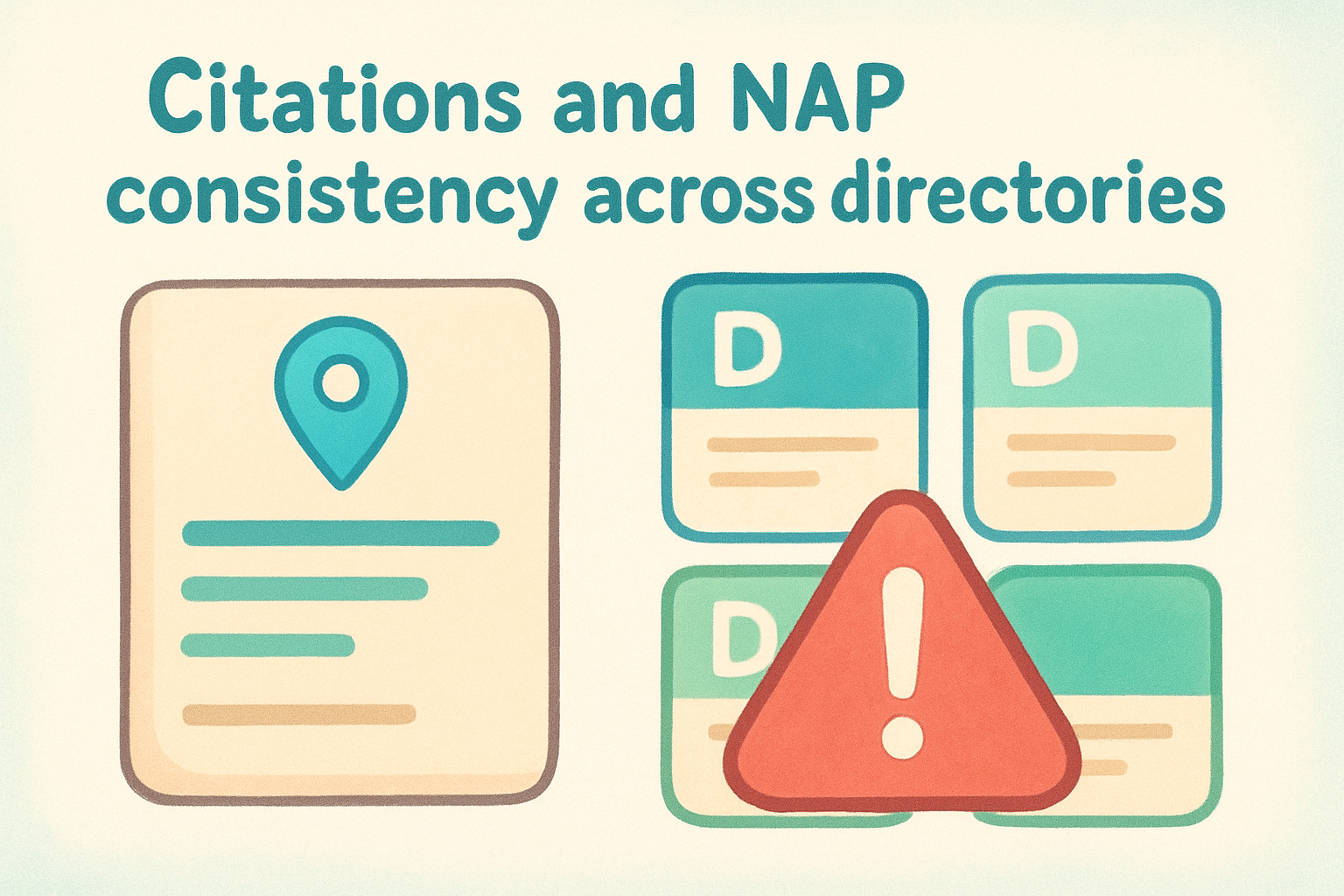
Fixing citation inconsistencies is one of the highest-return cleanup tasks a multi-location business can perform, because a single outdated record on a major data aggregator can propagate across dozens of smaller directories.
For businesses with multiple locations, each location needs its own accurate citation footprint tied to the correct address and local phone number. Mixing up address details or using a central corporate number across all locations weakens the geographic relevance signal for every individual site.
Links as authority signals for local rankings
Backlinks from locally relevant and authoritative websites signal to Google that your business holds real-world standing in its community. A link from a local news outlet, a regional business association, or a civic organization tells Google that your location is recognized beyond your own digital properties. The quality of those links matters far more than the quantity , so one link from a credible local source outperforms dozens from low-authority directories.
For multi-location businesses, building local links means thinking market by market. Sponsorships, community partnerships, and local event participation create natural opportunities for coverage that generates links tied directly to the geographic area where each location operates.
AI visibility signals and structured data
AI-powered search experiences like Google's AI Overviews pull structured, verifiable information from sources they can confidently attribute . Structured data markup on your location pages, particularly schema for local businesses, gives these systems clear signals about your address, hours, services, and geographic coverage. Without that structured layer , your location pages compete at a disadvantage when AI systems are deciding which businesses to surface and describe in generated responses.
Behavioral signals and engagement metrics
Google does not rely solely on what you publish about your business. It also watches how real people interact with your listing and website once they find it in search results. These behavioral signals feed back into Google's local ranking systems as real-world evidence that your business is relevant and worth showing to more searchers. Among the full set of local search ranking factors , behavioral signals are the ones most directly shaped by actual customer activity rather than deliberate optimization work.
Click-through rate and what it tells Google
When Google shows your listing and someone clicks it, that action reinforces the relevance match between your listing and the query that triggered it. A consistently high click-through rate signals that your listing accurately reflects what searchers want, which gives Google more confidence in continuing to surface it prominently. A low click-through rate , even at a strong ranking position, can gradually erode that position as Google reads the gap between impressions and clicks as a relevance mismatch.
Your listing title, star rating, review count, and photos all contribute to whether someone clicks your result or moves to the next option on the page.
Improving your click-through rate starts with your Google Business Profile presentation . A complete and accurate profile with recent photos, a competitive star rating, and current hours gives searchers more reasons to click before they even compare you to the next result. Photo quality and quantity are a practical lever most multi-location businesses underuse, even though Google's own data shows that listings with more photos generate more clicks and direction requests.
Direction requests, calls, and on-site engagement
Direction requests and phone calls made directly through your Google Business Profile are strong engagement signals because they indicate a searcher moved from discovery to action. Google tracks these interactions as evidence that your listing converted real intent into real behavior. When your location generates these signals consistently, it builds a usage pattern that supports higher visibility over time for similar searches in the same geographic area.
On your website, time on page, pages visited per session, and bounce rate all tell Google something about whether your content satisfied the search intent that brought someone there. A visitor who lands on your location page, reads your services, and then calls or submits a contact form is sending a positive engagement signal. Thin pages that send visitors back to search results within seconds do the opposite, signaling that your content did not deliver what the searcher needed.
Myths, negative factors, and suspension risks
Not every tactic you read about actually moves your rankings, and some of the most widely repeated advice actively works against you. Separating confirmed local search ranking factors from myths keeps you focused on what produces results rather than busywork that delivers nothing.
Common myths that waste your time and budget
The most persistent myth is that keyword-stuffing your business name in your Google Business Profile will improve your rankings. Adding "Best Pizza Dallas TX" to your business name when your legal name is "Marco's Pizza" violates Google's guidelines and can trigger a suspension. Your business name should reflect what customers actually see on your storefront or invoice , nothing more.
Another widespread misconception is that adding as many secondary categories as possible increases your chances of ranking across more searches. In reality, irrelevant secondary categories dilute your relevance signal and tell Google your business lacks a clear focus. Choose categories that genuinely describe services you provide, and keep the list tight.
What actually hurts your rankings
Negative factors are just as real as positive ones, and ignoring them produces ranking declines that compound over time . Thin location pages with duplicated content across every location, incomplete Google Business Profiles, and unresolved citation conflicts all send weak signals that allow competitors with cleaner data to outrank you.
A business that actively contradicts its own information across directories, its website, and its profile gives Google no reliable signal to work with.
Allowing reviews to pile up without responses also signals an inactive business, and inactivity is one of the clearest ways to lose ranking ground to competitors who treat their profiles as a live, managed asset. Fake reviews, whether positive ones you solicited or negative ones from bad actors, carry serious penalties if Google detects them, including listing removal.
How Google suspends and flagged listings
Google suspends listings that violate its guidelines , and a suspended listing disappears from search results entirely until the issue is resolved. Common triggers include mismatched business addresses that do not match what Google can verify, keyword stuffing in the business name, and operating a service-area business while listing a location that does not meet Google's physical address requirements.
Reinstatement requires submitting a reinstatement request through Google and providing documentation that confirms your business legitimacy , such as business licenses, utility bills, or storefront photos. The process takes time, and for a multi-location business, a single suspended listing means that market goes dark until the appeal clears.
Key takeaways and next steps
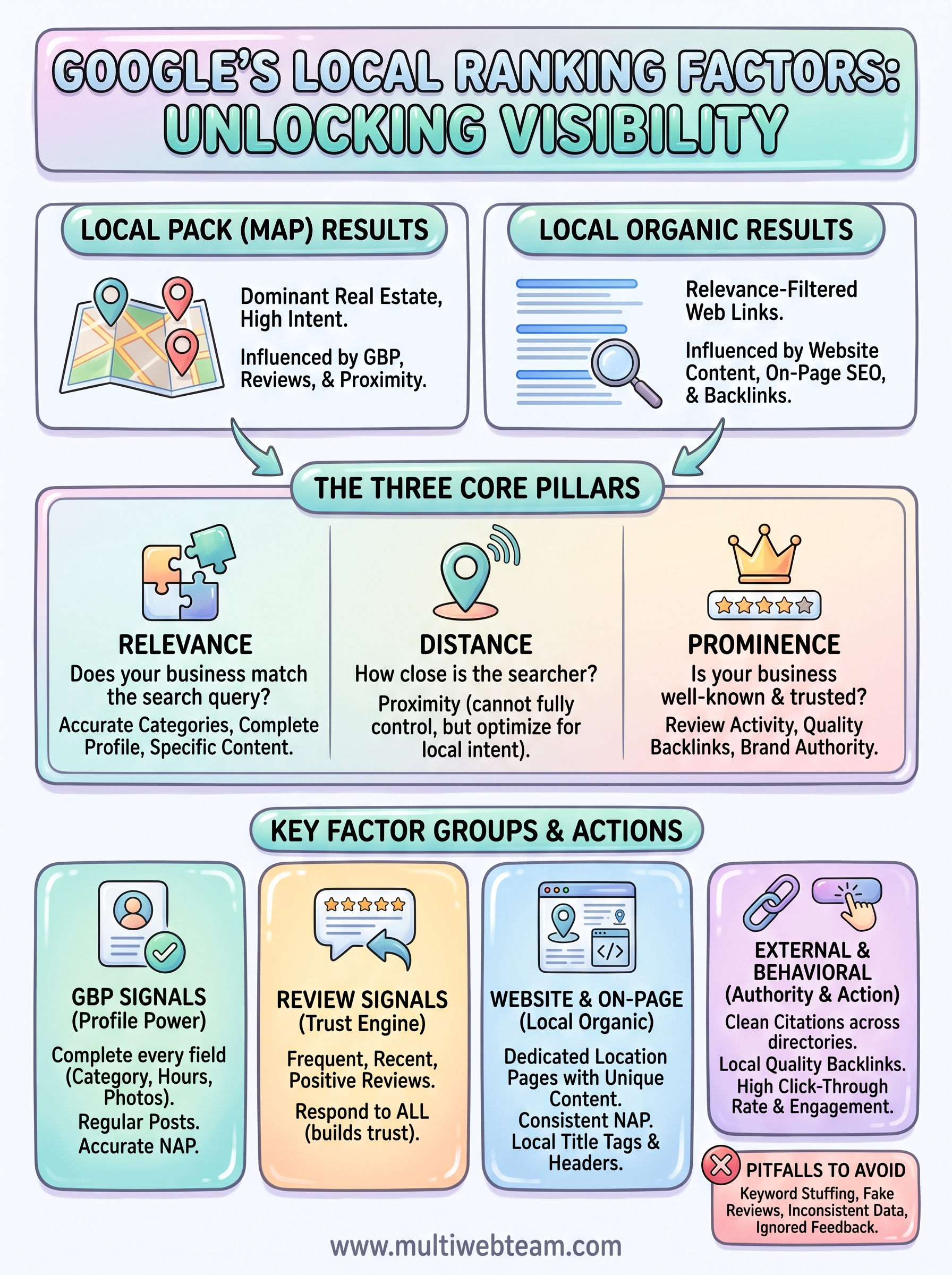
Local search ranking factors work as a system, not a checklist. Relevance, distance, and prominence each contribute to where your locations rank, and neglecting any one of them creates gaps that competitors with more complete strategies will fill. Your Google Business Profile, your website's location pages, your review activity, your citations, and your behavioral signals all feed into the same ranking calculation. Treating any of these as optional leaves real visibility on the table across every market you operate in.
For multi-location businesses, the challenge scales with growth. Every new location needs its own active presence built on accurate, consistent, and regularly updated signals. That requires a process, not a one-time launch. If you want a partner who handles this work at scale, without per-update fees or an internal team to manage, explore what Multi Web Team does for multi-location businesses and see how it fits your operation.