Small Business SEO Services Pricing In 2026: What To Pay
You searched for small business SEO services pricing because you want a straight answer, what should you actually expect to pay in 2026? That's fair. SEO pricing has always been murky, and the range between "suspiciously cheap" and "enterprise-level expensive" is wide enough to make budgeting feel like guesswork .
Here's what makes it tricky: pricing depends on your business model, the number of locations you're optimizing for, the competitiveness of your market, and whether you're paying for one-off projects or ongoing work. A single-location coffee shop and a franchise with 30 locations have very different SEO needs, and very different price tags. At Multi Web Team, we build and manage websites for multi-location businesses and franchises, and SEO management is baked into our subscription model , so we see firsthand how pricing structures vary across the industry.
This guide breaks down the actual cost ranges, pricing models, and key factors that determine what you'll pay for SEO services as a small business in 2026. By the end, you'll know what's reasonable, what's a red flag , and how to evaluate any proposal that lands on your desk.
Why SEO pricing varies so much in 2026
When you research small business SEO services pricing, the range you find can swing from $200/month to $5,000/month or more , and both numbers can be legitimate depending on what's included and who's asking. The wide gap isn't smoke and mirrors; it reflects real differences in market conditions, service depth, and the people doing the actual work.
Your market's competitive landscape
Local competition is one of the biggest drivers of price. If you run a plumbing business in a mid-size city with a dozen competitors, ranking locally takes less work than ranking in a market like New York or Los Angeles, where hundreds of businesses are fighting for the same keywords. Competitive markets require more content, stronger link profiles, and more frequent technical updates , which means more hours and a higher monthly cost to move the needle.
The more competitors are investing in SEO in your area, the more you need to invest to keep up or get ahead.
Beyond geography, your industry matters too. Legal, financial, and medical niches consistently see higher SEO pricing because the content requirements are stricter and the value of ranking in those niches is significant. A contractor in a rural town and a personal injury attorney in Chicago will receive very different quotes for the same type of local SEO service.
Your current site's starting condition
Where your website stands today changes how much work an SEO provider needs to put in upfront. A site with hundreds of technical errors, zero backlinks, and pages untouched for years requires a heavier lift than one that is already well-structured and carries some existing authority. Providers account for this in their pricing because the first few months often involve intensive remediation before any growth strategy can take hold.
Content gaps also factor in heavily. If your site has thin pages, duplicate content, or no location-specific landing pages , those problems need to be fixed before search engines will trust the site enough to rank it. A provider quoting you a higher number may simply be accounting for the groundwork that has to happen first.
Who performs the work
The three main options, a large agency, a solo freelancer, or a specialized boutique firm , each come with different cost structures. Large agencies carry overhead: project managers, account managers, and multiple specialists, all of which drive up the monthly retainer. Freelancers typically charge less but may not have the bandwidth or range of skills to handle technical SEO, content, and link building at the same time.
Boutique firms and niche specialists often sit in the middle price range and tend to offer more focused attention per account. For multi-location businesses in particular, a provider who understands how to build and optimize location-specific pages at scale brings more value than a generalist who applies the same template to every client.
What the service actually includes
Not every SEO proposal covers the same things. One provider's $800/month retainer might include keyword research, monthly content, and technical maintenance. Another provider's $800/month might cover only a single blog post and a basic analytics report. The lack of standardization across the industry makes it hard to compare quotes on price alone without dissecting what each line item actually delivers.
Ongoing management, reporting frequency, link building, and content production each add to the cost separately in some pricing models, while others bundle everything together. Understanding exactly what you are paying for is the only reliable way to evaluate whether a quote is fair for your situation.
Typical SEO price ranges for small businesses
Understanding small business SEO services pricing starts with knowing the baseline numbers the industry actually operates within. Most small businesses in the U.S. spend somewhere between $500 and $3,000 per month on SEO services, with the median for ongoing monthly retainers landing around $1,000 to $1,500 . These numbers have shifted upward compared to prior years as the floor for quality content and technical work has risen, and as competition in local search has intensified.
Monthly retainer pricing
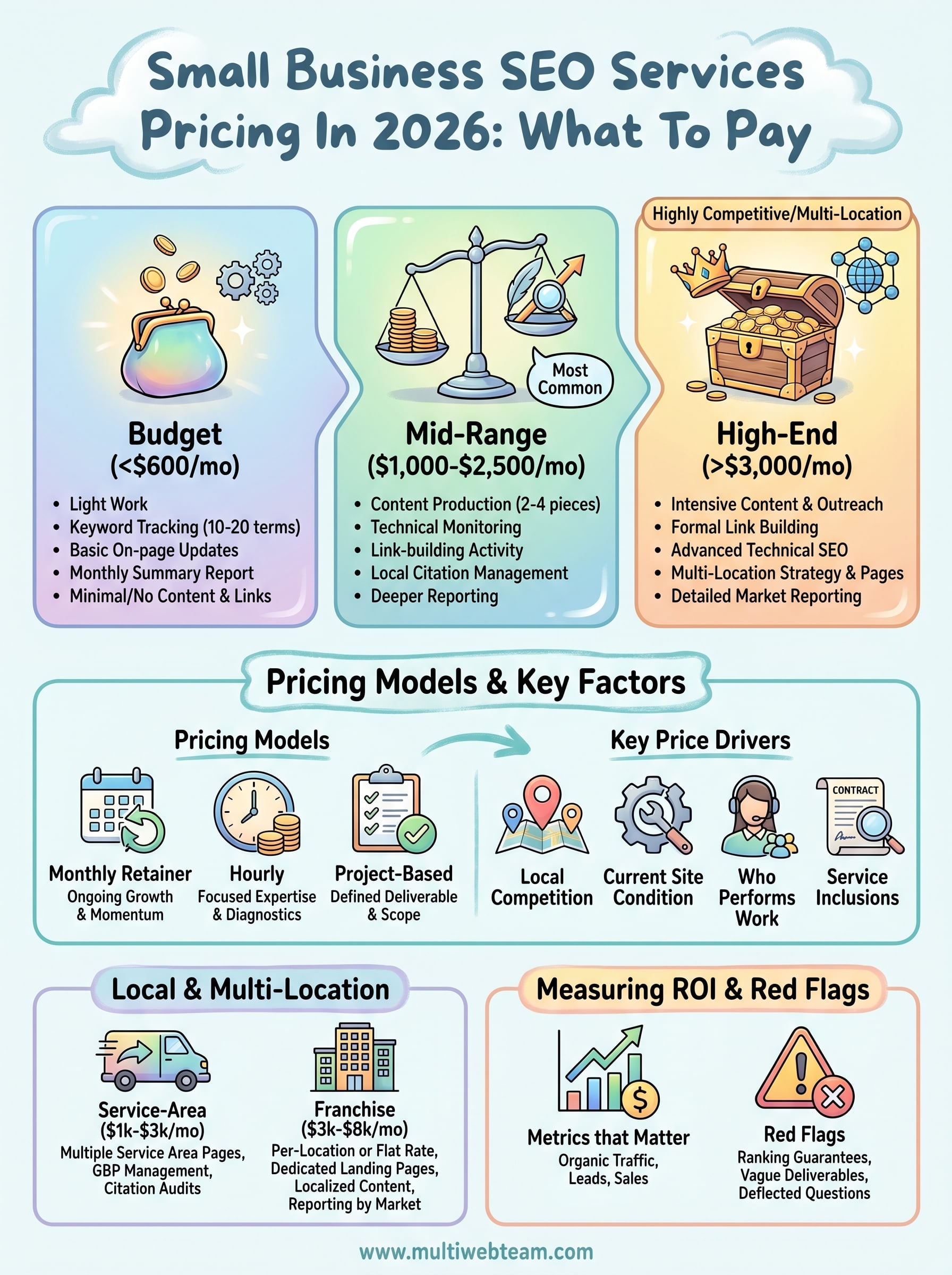
Monthly retainers are the most common arrangement for ongoing SEO work, and the price tier you fall into typically reflects the scope of what is covered. Budget-tier providers charging $300 to $600 per month usually offer limited deliverables: a handful of keywords tracked, light on-page adjustments, and a monthly report with minimal analysis. At this level, you are unlikely to see meaningful movement in competitive markets.
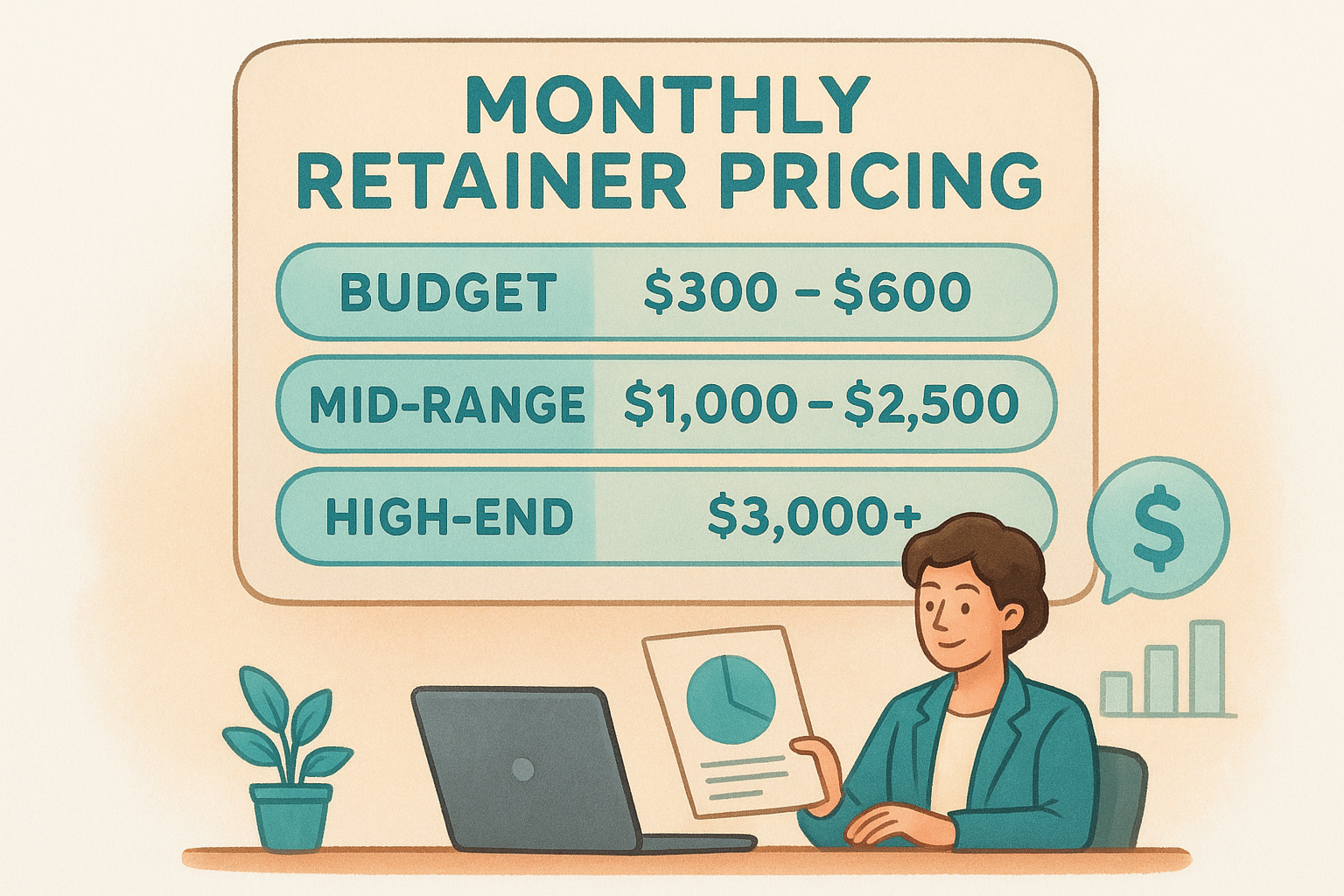
Mid-range retainers between $1,000 and $2,500 per month cover more ground. You can expect regular content production, technical monitoring, local citation management, and more meaningful link-building activity. For most small businesses targeting a single metro area, this range delivers the combination of volume and quality needed to move rankings over a sustained period.
If a provider is charging less than $500 per month and promising significant results in a competitive market, treat that claim with real skepticism.
High-end retainers above $3,000 per month are common for businesses in highly competitive niches or those managing multiple locations , where the volume of content, pages, and reporting demands more labor every month.
Hourly and project-based rates
When you hire an SEO consultant on an hourly basis, rates typically run between $75 and $200 per hour , depending on the consultant's experience and area of specialization. Project-based pricing for defined scopes, like a technical audit or a site migration, usually falls in the $1,000 to $5,000 range for small business engagements. These options work well when you need targeted help for a specific problem rather than ongoing monthly management.
| Pricing Type | Typical Range |
|---|---|
| Monthly retainer (budget) | $300 to $600/month |
| Monthly retainer (mid-range) | $1,000 to $2,500/month |
| Monthly retainer (high-end) | $3,000+/month |
| Hourly consulting | $75 to $200/hour |
| Project or one-time work | $1,000 to $5,000 |
SEO pricing models and when to use each
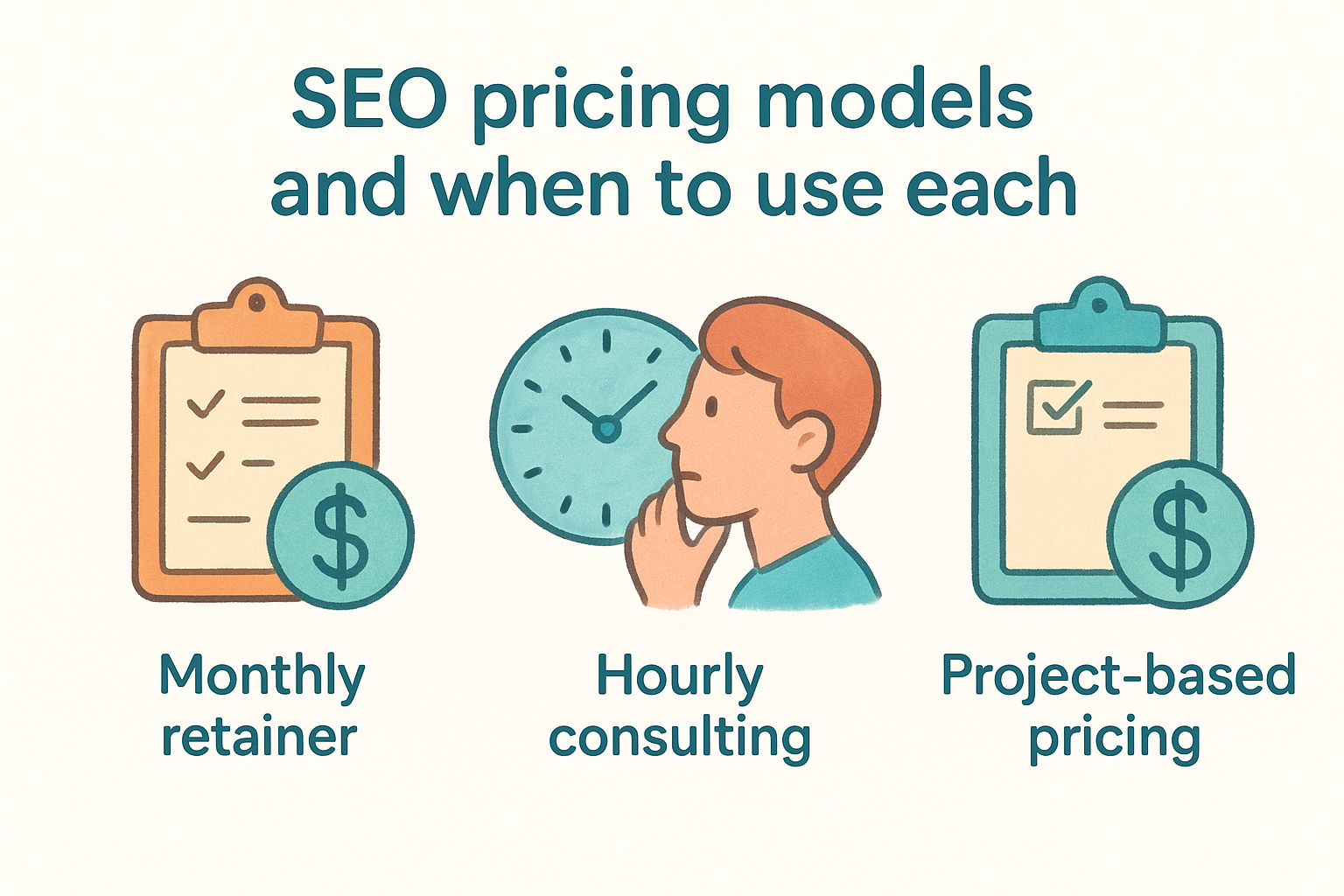
Choosing the right pricing model matters as much as choosing the right provider. When you evaluate small business SEO services pricing , the structure of the engagement often determines whether you get consistent, compounding results or sporadic effort that stalls between sessions. Each model fits a different situation, and picking the wrong one can burn budget or leave critical work unfinished.
Monthly retainer
A monthly retainer is the most practical model for businesses that treat SEO as an ongoing growth channel rather than a one-time fix. Search rankings shift constantly, competitors update their strategies, and Google's algorithm evolves, so sustained effort consistently outperforms a burst-and-pause approach. With a retainer, your provider maintains a regular workflow covering content updates, technical monitoring, and link-building activity every month without you having to re-scope or renegotiate.
This model works best when you have a defined set of target keywords, a stable website, and realistic expectations about timeline. Results typically compound over six to twelve months , so the retainer structure keeps momentum going instead of letting progress stall after a single push.
Hourly consulting
Hourly consulting suits situations where you need focused expertise on a specific problem rather than end-to-end management. If your site has a technical issue dragging down rankings, or you want a second opinion on a strategy your internal team put together, paying by the hour gives you access to a specialist without a long-term commitment.
Hourly arrangements work well for diagnostics and strategy sessions, but they rarely produce the sustained output needed to move rankings over time in a competitive market.
The main risk with hourly work is scope expansion : a project that looks like a few hours of work can grow once the consultant starts digging. Get a clear written estimate before any work begins, and agree on a cap if the scope is uncertain.
Project-based pricing
Project-based engagements cover a defined deliverable at a fixed price, such as a full technical audit, a set of location landing pages, or a site migration. This model gives you predictable costs and clear deliverables , which makes it easier to justify the spend internally.
Use project-based pricing when you have a specific, bounded problem that does not require ongoing maintenance after it is resolved. It is not the right fit if you need continuous ranking growth , since one-time projects do not sustain results without follow-up work.
What you get at common price points
Knowing the price ranges is useful, but knowing what those dollars actually buy is what lets you evaluate a proposal intelligently. When you compare small business SEO services pricing side by side, the deliverables at each tier tell you more than the number on the invoice does.
Under $600 per month
At this price point, you are typically getting light, foundational work rather than a full growth strategy. Most providers in this range will track a limited set of keywords, make basic on-page adjustments to existing pages, and send a monthly performance report. Content production is usually minimal or nonexistent, and link building is rarely included.
This tier works for businesses with very little competition, a site that is already in decent shape, and no urgency around growth.
Here is what to realistically expect at the budget tier:
- Keyword tracking for 10 to 20 terms
- Basic title tag and meta description updates
- Google Business Profile monitoring
- A monthly summary report with limited analysis
- No consistent content creation or link acquisition
$1,000 to $2,500 per month
This range is where most small businesses find a sustainable balance between cost and output. At $1,000 to $1,500 per month, providers typically cover keyword research, two to four pieces of new content, technical monitoring, and local citation management. At $2,000 to $2,500, you start seeing more aggressive link-building activity and deeper reporting that connects rankings to actual traffic and lead generation.
For a single-location business targeting a mid-size metro area, the $1,500 range hits a workload threshold where results actually compound over six to twelve months. You get enough consistent output to build domain authority, improve rankings, and see measurable traffic growth without paying for enterprise-level overhead.
$3,000 and above
At this level, providers are handling high-volume, high-complexity SEO work . For a single-location business in a highly competitive niche, this budget funds intensive content production, a formal link-building outreach program, and detailed technical maintenance. For multi-location businesses and franchises , this tier is where you start seeing providers build and manage individual location pages, run location-specific keyword strategies, and produce reporting broken down by each market.
The jump to $3,000 or more is justified when your business generates significant revenue per customer and ranking near the top of local search has a direct, measurable impact on your bottom line.
Local SEO pricing for service-area businesses
Service-area businesses operate differently from businesses with a single storefront, and that difference affects what you pay for local SEO. A plumber, HVAC company, or cleaning service does not have customers walking in the front door, so the entire SEO strategy focuses on ranking in multiple ZIP codes or neighborhoods rather than just one address. That expanded geographic footprint increases the scope of work and typically pushes pricing above what a single brick-and-mortar location would pay.
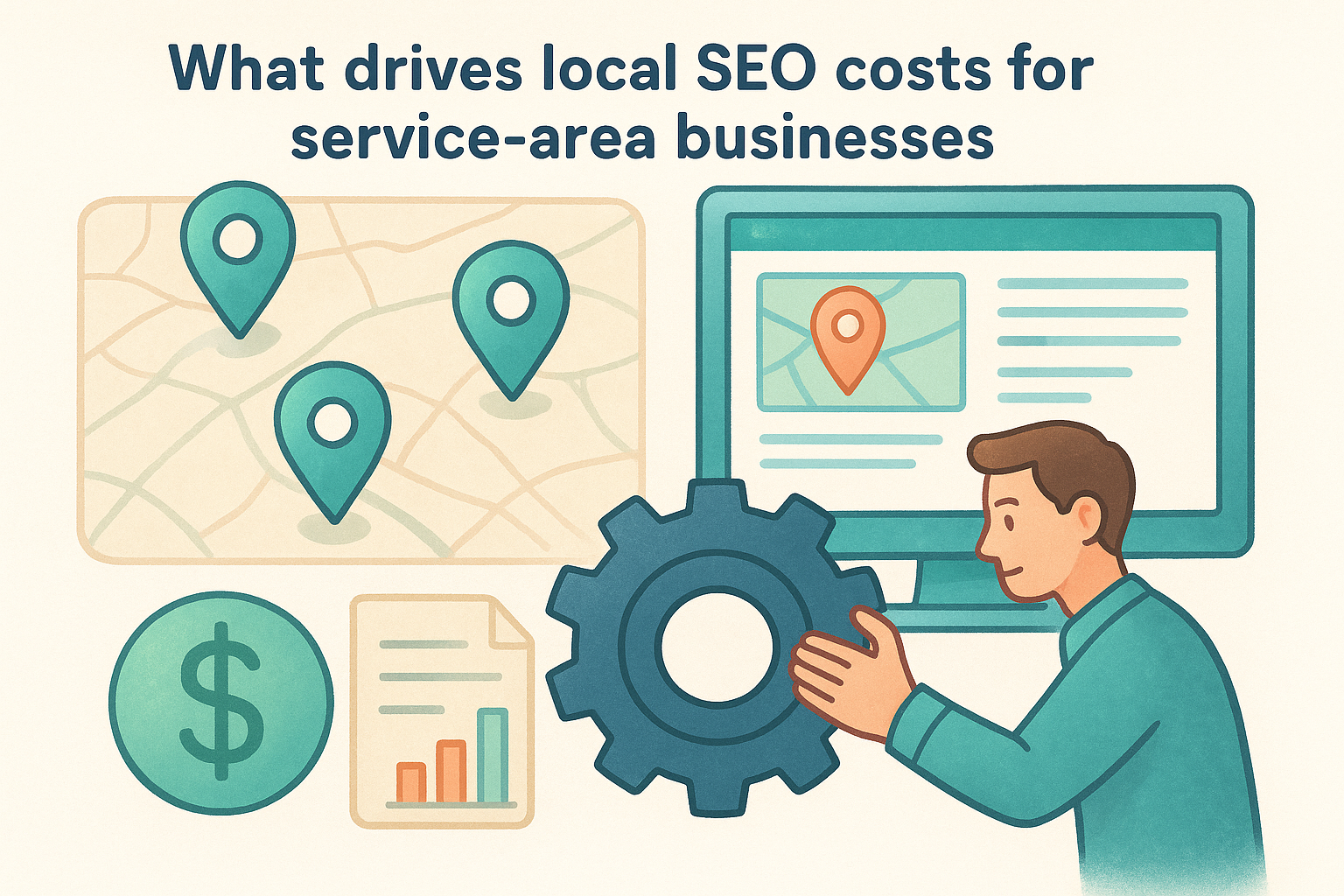
What drives local SEO costs for service-area businesses
Ranking across multiple service areas requires more content and more technical structure than targeting a single location. Rather than optimizing one page for one city, your provider needs to build and maintain individual service-area landing pages for each market you want to appear in. Each page requires unique, relevant content tied to that specific geography, and thin or duplicated pages will not rank. The more service areas you cover, the more pages need to be created and kept current.
Google Business Profile management also adds to the cost. For service-area businesses, the profile requires accurate service-area settings, regular posts, and consistent review management across every market. Providers who handle this correctly spend real time maintaining the profile, which shows up in your monthly bill.
If your business serves five or more distinct ZIP codes or towns, expect to pay more than a single-location business pays for the same tier of service.
What local SEO actually costs for service-area businesses
When you evaluate small business SEO services pricing for a service-area model, the realistic range sits between $1,000 and $3,000 per month for a business covering a regional service area. A provider handling two to three service-area landing pages per month, local citation management, and Google Business Profile maintenance typically prices this scope between $1,200 and $1,800 monthly for a competitive market.
Here is what a solid local SEO package for a service-area business typically covers:
- Five to ten service-area landing pages built or optimized per quarter
- Monthly Google Business Profile updates and review response support
- Local citation audits to ensure consistent name, address, and phone data
- Keyword tracking broken down by city or service area
- Monthly reporting that shows ranking movement by geographic market
At the higher end of the range, providers add link-building outreach and more frequent content production, which compounds results faster in markets where competitors are already investing heavily in local SEO.
Multi-location SEO pricing for franchises
Franchise businesses and multi-location operators face a different pricing reality than single-location businesses. Each location needs its own optimized presence in local search, which means your provider is managing multiple sets of landing pages, Google Business Profiles, and keyword strategies simultaneously. When you evaluate small business SEO services pricing for a franchise model, you are not just multiplying the cost of a single-location plan; you are paying for the additional infrastructure, coordination, and content volume required to make each location rank in its own market.
Per-location pricing vs. flat-rate models
Per-location pricing is the most common structure you will encounter when shopping for multi-location SEO. Under this model, providers charge a base management fee plus an incremental rate for each location, typically between $150 and $400 per location per month depending on the level of service included. A franchise with 10 locations, for example, might pay a $1,500 base retainer plus $200 per location, landing at $3,500 per month total.

Flat-rate models can look more appealing upfront, but per-location pricing often scales more fairly as your franchise grows and your provider's workload increases proportionally.
Flat-rate multi-location plans bundle all locations into a single monthly fee, which simplifies billing but can create problems if your franchise expands. Ask any provider offering a flat rate exactly how many locations that rate covers before you sign anything, and get the overage cost in writing.
What multi-location SEO typically costs
For a franchise operating between 5 and 20 locations , realistic monthly costs land between $3,000 and $8,000 per month when the work is done properly. That range covers location-specific landing page management, individual Google Business Profile maintenance, localized content production, and reporting that breaks down performance by market rather than just at the domain level.
Smaller franchise systems with fewer than five locations can often work in the $2,000 to $3,500 range with a provider that specializes in multi-location structure. Here is what a solid multi-location SEO engagement typically includes at that scale:
- Dedicated landing pages optimized for each location's city and target keywords
- Separate Google Business Profile management per location
- Consistent NAP data (name, address, phone) across all directories
- Localized content updates reflecting each market's promotions or offerings
- Reporting segmented by location showing rankings, traffic, and lead volume
One-time SEO projects and audit costs
Not every SEO engagement runs on a monthly retainer. Sometimes you need a defined deliverable with a fixed price , whether that is a full technical audit, a set of new landing pages, or a structured recovery from a Google penalty. One-time projects let you address a specific problem without committing to ongoing management fees, and they fit neatly into situations where you have internal resources to handle execution but need outside expertise to define the strategy. When you are comparing small business SEO services pricing across different providers, understanding what these project-based engagements actually cost helps you budget more accurately.
Technical SEO audits
A technical SEO audit is the most common one-time project small businesses purchase. A quality audit covers crawlability, site speed, indexing issues, duplicate content, broken links, and structured data gaps, then delivers a prioritized list of fixes with clear explanations of why each issue matters. Pricing for a small business audit typically falls between $500 and $2,500 , depending on the size of the site and the depth of analysis.
A good audit does not just list problems; it tells you which ones to fix first based on the likely impact on your rankings and traffic.
Here is what audit deliverables at each price tier generally include:
- $500 to $900: Automated crawl report with basic annotations, limited manual review, and a prioritized fix list
- $1,000 to $1,500: Full manual and automated analysis, content gap identification, local SEO review, and written recommendations
- $1,500 to $2,500: Comprehensive audit covering technical, content, and link profile analysis with an implementation roadmap and a follow-up consultation
Content and on-page optimization projects
Project-based content work is another common one-time purchase. Building a set of location landing pages, rewriting service pages for better keyword targeting, or creating a batch of supporting blog posts can all be priced as fixed-scope projects. Providers typically charge $300 to $800 per page for thoroughly researched, well-structured content that meets current search quality standards.
If your site needs multiple pages, some providers offer volume pricing that reduces the per-page rate when you commission five or more pieces at once. Always confirm whether the project price includes keyword research and internal linking recommendations, or if those are billed separately.
Site migration and penalty recovery
Site migrations and penalty recovery projects carry the highest one-time price tags because they require intensive diagnostic work and careful execution. A structured URL migration to avoid traffic loss typically costs $2,000 to $5,000 for a small business site. Penalty recovery from a manual action or algorithm hit can run a similar range, depending on how many low-quality links need to be audited, disavowed, or replaced with legitimate alternatives.
How to set a budget and measure ROI
Setting a realistic SEO budget starts before you talk to a single provider. If you go into conversations without a number in mind, you risk either overspending on services you do not need yet or getting pulled toward cheap options that produce nothing. Treat your SEO budget the same way you would treat any other operating expense: tie it to what the business can sustain monthly and what a reasonable return looks like over 12 months.
Start with what you can spend consistently
SEO compounds over time, which means consistent monthly investment produces better results than a large one-time spend followed by inactivity. Before comparing small business SEO services pricing across providers, calculate a number you can commit to for at least six months without pulling back. For most small businesses, that floor sits around $1,000 per month , though service-area businesses and franchises typically need more to cover the geographic scope of their work.
One useful starting point is to reverse-engineer the math. If your average customer is worth $2,000 in lifetime revenue and SEO generates 10 additional customers per month, the channel produces $20,000 in monthly revenue. An investment of $1,500 to $2,500 per month becomes easy to justify once you frame the spend against that output. Work from value to budget , not the other way around.
If you cannot sustain the investment for at least six months, you will likely abandon the effort before results materialize, which wastes everything you spent in the early months.
Metrics that actually tell you if SEO is working
Keyword ranking movement is the most visible metric, but it is not the one that tells you whether SEO is paying off. Rankings matter only when they drive traffic, and traffic matters only when it converts into leads or sales. Ask your provider to report on organic traffic volume, lead form submissions, and phone calls attributed to organic search alongside keyword positions so you can connect ranking improvements to actual business outcomes.
Set a clear benchmark before the engagement starts. Document your current monthly organic traffic, conversion rate from that traffic, and average lead volume from search. Revisit those numbers at the 90-day and 180-day marks. Consistent upward movement across all three signals tells you the work is producing real value, not just higher rankings for terms that nobody searches.
Red flags and questions to ask providers
Evaluating small business SEO services pricing is not just about finding the lowest number; it is about identifying whether a provider can actually deliver what they are selling. The SEO industry has a higher-than-average concentration of providers who make big promises backed by little substance, so knowing what to watch for before you sign a contract protects your budget and your time.
Warning signs in SEO proposals
Guaranteed ranking positions are the clearest red flag you will encounter. No legitimate SEO provider can guarantee a specific rank on Google because rankings depend on algorithm decisions that no agency controls. A provider who promises "Page 1 in 30 days" is either misrepresenting how search works or planning to use tactics that can trigger a penalty and damage your site's long-term authority.
Watch for vague deliverables that describe activity rather than output. Phrases like "ongoing optimization" or "regular content updates" without specifying volume, frequency, or scope tell you nothing about what you are actually paying for each month. A trustworthy provider gives you a clear list of what they produce, how often, and how they measure success. If you cannot verify what you are getting, you cannot hold anyone accountable when results fall short.
If a provider deflects when you ask for specifics on deliverables, treat that as a direct signal to walk away.
Questions to ask before you sign
Ask every provider these questions before committing to any engagement:
- What specific deliverables will I receive each month, and what is the volume? Get the answer in writing, not just a verbal summary during a sales call.
- How do you measure and report results? Look for providers who report on organic traffic and lead attribution, not just keyword rankings in isolation.
- Who will actually do the work? Some agencies sell the pitch and then outsource the execution to low-cost contractors. Know whether your account gets a dedicated person or gets passed down a chain.
- What happens to my assets if I cancel? Content, backlinks, and technical improvements should belong to your business, not the agency.
- Can you share examples of results you have produced for businesses similar to mine? A provider with relevant, verifiable case studies in your industry or at your business scale is a far safer bet than one who speaks only in generalities.
Next steps
You now have a clear picture of small business SEO services pricing across every major model, from budget retainers to full multi-location franchise programs. The most important takeaway is that price and value only align when you know exactly what a provider delivers each month and how they connect that work to measurable business outcomes like traffic, leads, and revenue.
Before you contact any provider, document your current organic traffic numbers and your average customer value. Those two figures give you a baseline to evaluate any proposal against real math instead of hope. Then ask every candidate the deliverable and reporting questions from the previous section before you commit to anything.
If you run a multi-location business or franchise and want a web team that builds your site and handles ongoing SEO management under one subscription, see how Multi Web Team works and whether the model fits what your business needs right now.