Landing Page Design Pricing: What You Should Expect To Pay
You need a landing page that converts, but the quotes you're getting range from $200 to $20,000. That spread makes it nearly impossible to know if you're overpaying or cutting corners. Understanding landing page design pricing starts with knowing what actually drives the cost, and what you're getting at each price point. Without that context, you're essentially guessing with your marketing budget .
The pricing depends on several factors: who builds it, how custom the design is, what conversion features are included, and whether you need ongoing optimization after launch. A template-based page from a freelancer and a fully custom, conversion-optimized page from an agency are fundamentally different products, and they should carry different price tags . The problem is that most pricing breakdowns online skip the nuance.
At Multi Web Team, we design and manage custom websites for multi-location businesses and franchises, and landing pages are a core part of that work. We build pages meant to drive local conversions across multiple markets , so we understand what goes into pricing them fairly, whether you're working with us or evaluating other options. This article breaks down current market rates , what influences cost at every level, and how to match your budget to the results you actually need.
Why landing page design pricing varies so much
Landing page design pricing doesn't follow a single standard because no two landing pages are the same product . One business needs a simple, one-section page that captures email addresses. Another needs a multi-section, mobile-optimized page with custom graphics, a lead form, video integration, and A/B testing support. Those two projects have almost nothing in common , so it makes little sense that they'd carry the same price. The wide range you see in quotes reflects real differences in scope, expertise, and what's actually included.
Who builds it sets the baseline
The most immediate factor in pricing is who you hire. A freelancer on a gig marketplace can build a basic landing page using a pre-made template for a few hundred dollars. A mid-tier freelancer with a portfolio and a process typically charges more because they bring real design judgment to the project. A full-service agency brings a team, which means strategy, copywriting, design, development, and quality review are all handled under one roof, and that carries a higher cost.
Experience and accountability also shift the price. A newer freelancer prices low to build a portfolio, while an agency with a track record of measurable results prices based on the value they deliver. You're not just paying for the design file itself - you're paying for the knowledge behind every decision, the revision process, and the confidence that the page will actually perform.
The single biggest pricing variable is not the platform or the tools - it's who's making the decisions about your page and what experience they bring to those decisions.
Scope determines most of the work
The actual scope of the project drives cost more than almost anything else. A one-page layout with a headline, some body copy, and a button takes a few hours to build. A page with custom illustrations, animated sections, trust-building testimonials, a multi-step form, and localized content for different audiences takes days. Beyond the visual design, the technical requirements add significant time : Does the page need to connect to a CRM? Does it require tracking pixels, conversion events, and platform integrations?
Copywriting is another scope variable that often goes overlooked. Some designers expect you to supply the copy; others include it. The gap in outcome between professionally written conversion copy and text a business owner drafted in ten minutes is real, and the gap in price reflects that.
Revisions, testing, and post-launch work add up
Many quotes look affordable until you look at what happens after the first draft. Unlimited or generous revision rounds cost the designer time, so they either charge separately for changes or build that cost into the base price upfront. If your quote includes only one revision round, expect additional charges when the page needs meaningful edits beyond minor tweaks.
Post-launch work like A/B testing, heat map analysis, and conversion rate optimization is often sold separately from the initial design. If you need ongoing improvements based on real traffic data, that's a recurring cost that sits on top of the initial build fee. Knowing whether a quote covers just the build or the full optimization cycle is one of the most important questions you can ask before signing anything .
Average landing page design price ranges in the US
When you look at landing page design pricing across the US market, three distinct tiers emerge. Each tier reflects a different level of customization, expertise, and deliverables. Knowing where each tier starts and stops helps you set realistic expectations before you talk to any designer or agency.
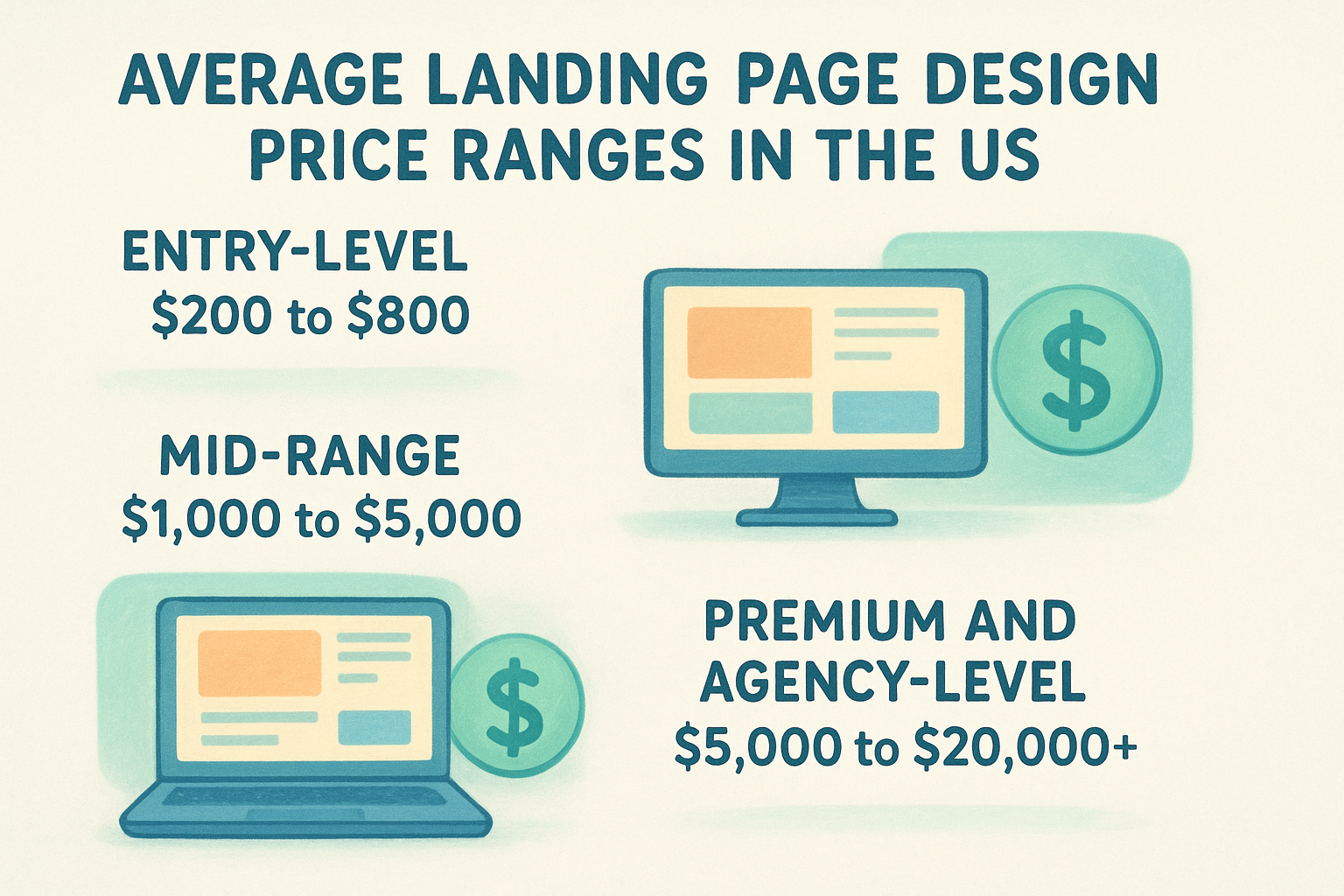
Entry-level: $200 to $800
At this price point, you're working with template-based designs built on platforms like WordPress or Squarespace . The designer customizes an existing layout with your colors, copy, and images rather than building from scratch. Turnaround is fast, often two to five business days, but the output is limited. You get a functional page , not a strategically designed one, and copy is almost always on you to provide.
If your goal is to test a basic offer quickly without committing serious budget, entry-level pages can work, but they rarely include conversion-focused design decisions.
Mid-range: $1,000 to $5,000
This is where the majority of professional freelancers and small agencies operate . At this tier, you get a custom layout built around your specific offer, a thoughtful structure informed by conversion principles, and at least one round of meaningful revisions. Many mid-range providers include basic copywriting or copy editing as part of the package, and they often handle integrations with your email platform or CRM.
The difference from entry-level is significant in terms of strategic input and original design work . A designer in this range is making deliberate choices about hierarchy, trust signals, and call-to-action placement rather than swapping content into a pre-built frame.
Premium and agency-level: $5,000 to $20,000 and up
Full-service agencies and senior specialists charge in this range for a reason . At the high end, you get a cross-functional team handling strategy, copywriting, UX design, development, and post-launch optimization. These projects typically involve custom visual systems, A/B test frameworks, and detailed performance tracking from day one.
Businesses with high traffic volumes or paid ad spend that justifies the investment are the right fit for this tier. Paying $10,000 for a landing page makes sense when a one-percent improvement in conversion rate translates to thousands of dollars in additional monthly revenue .
What drives the price: scope, design, and tech
Three core factors drive landing page design pricing more than anything else: the scope of the project, the level of design customization, and the technical requirements. When you get a quote that feels confusing, it's almost always because one of these three dimensions is either unclear or misaligned with your actual needs. Breaking them down separately gives you a much cleaner way to evaluate what you're paying for.
Scope: how much the page needs to do
Scope covers the total amount of work involved in building your page. A short-form page with a single offer, one call-to-action, and minimal copy is a fundamentally different project from a long-form page with multiple sections, testimonials, comparison tables, and localized content variations. More sections mean more design decisions, more copy, and more time spent on layout and hierarchy.
Copywriting is often the hidden scope item that blows up a budget, especially when it's assumed to be included but isn't listed explicitly in the quote.
Integrations also live under scope. If your page needs to connect to a CRM, trigger an email sequence, or fire specific conversion events in Google Analytics , that work adds hours to the project. Ask every potential vendor to specify exactly what integrations are included before you agree to anything.
Design: custom vs. template
The design approach directly determines both the cost and the outcome. Template-based pages use pre-built frameworks that a designer populates with your content, which is faster and cheaper but limits how much the final page reflects your brand and offer. Custom design starts from scratch based on your goals, audience, and conversion strategy.
Custom work costs more because every visual decision requires active judgment . The designer is choosing type scales, spacing, color contrast, and section flow based on how real users read and respond, not just slotting content into a preset grid.
Tech: platform and build environment
Where your page lives and how it's built affects the final cost in ways that are easy to overlook. Building on a proprietary page builder like a specific marketing platform is usually faster than a fully coded build, but it introduces limitations. A custom-coded page gives you complete control over performance, load speed, and flexibility for future changes, but it takes longer and requires more technical expertise to maintain.
Common pricing models: flat fee, hourly, retainer
How a designer or agency charges you matters almost as much as the total number on the quote. Landing page design pricing gets structured in three main ways: a flat project fee, an hourly rate, or a monthly retainer. Each model suits a different situation, and choosing the wrong one for your project can create friction, unexpected costs, or misaligned incentives.
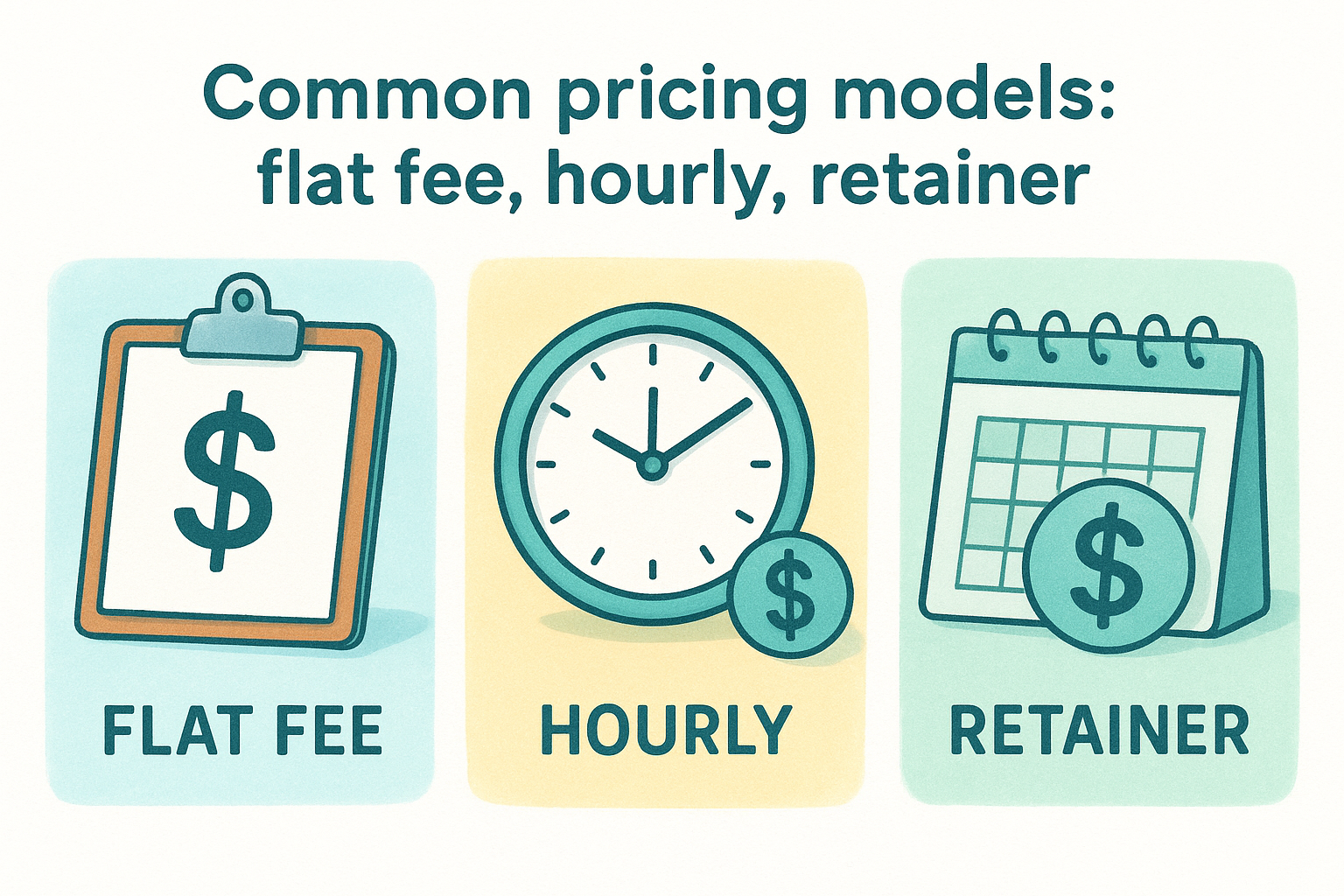
Flat fee
A flat fee means you agree on a fixed price for a defined scope of work before the project starts. This is the most common model for one-time landing page builds because it gives both sides clarity. You know exactly what you're spending, and the designer knows exactly what they're delivering. The risk is scope creep. If your project expands beyond the original agreement , expect a change order that adds to the total. Before signing a flat-fee contract, make sure the scope is written out in specific terms, including the number of sections, revision rounds, and any integrations.
A flat fee only protects your budget when the scope is documented precisely, not just described in general terms.
Hourly rate
Hourly pricing is common among freelancers and designers who work on varied or exploratory projects . Rates in the US range from $50 per hour at the entry level to $200 or more for senior designers and strategists. The hourly model works well when you're not sure how complex your project will get, but it transfers budget risk to you. A project estimated at 20 hours can easily reach 30 if the direction shifts, the copy needs multiple rounds of edits, or technical issues come up during the build.
Retainer
A retainer is a monthly fee that covers ongoing design and optimization work across a set period. This model makes the most sense when you plan to test multiple versions of a page, run paid traffic that requires regular updates, or need continuous conversion improvements based on performance data. Retainers typically run from $1,000 to $5,000 per month depending on the volume of work included. For businesses running active campaigns, the retainer structure keeps your page aligned with what the data is telling you without negotiating a new contract each time a change is needed.
What a landing page quote should include
Before you compare landing page design pricing across vendors, you need to know what a complete quote actually looks like. A quote that only lists a total price with no breakdown is a liability. Vague quotes lead to disputes over scope , unexpected change orders, and a final invoice that looks nothing like the number you originally approved. A well-structured quote protects your budget and sets clear expectations for both sides.
Deliverables, scope, and timeline
Every quote should spell out exactly what you're receiving when the project is complete. That means a specific list of page sections, the number of design concepts you'll see, how many revision rounds are included, and whether copywriting is part of the service or your responsibility. If integrations are involved, such as connecting to a CRM or setting up conversion tracking, those should appear as line items with explicit descriptions , not vague language like "technical setup."
The timeline matters just as much as the scope. A quote should state when each phase is expected to finish , including the first draft, revision windows, and the final delivery date. Without a timeline, you have no leverage when a project drags past the point where it's useful to you.
A quote without a defined revision limit is an open invitation for a project to expand without any adjustment to the price.
What's not included
A strong quote is just as clear about what falls outside the engagement as what's inside it. Ongoing maintenance, post-launch edits, and conversion optimization are often excluded from a standard build fee but left unmentioned until you ask. If hosting, domain management, or platform fees apply, those should appear separately so you understand the full cost of keeping the page live .
Make sure you also confirm who owns the final files. Some vendors retain design assets or restrict access to the page builder account unless you pay an additional fee. Ownership terms belong in the quote , not in a back-and-forth email conversation after work is complete. Asking for this level of clarity upfront is not excessive; it's the only way to make an accurate comparison between the options in front of you.
How to estimate your landing page budget
Estimating your budget before you talk to any vendor puts you in a much stronger position. Landing page design pricing becomes easier to navigate when you start from what you need the page to accomplish rather than a number you found somewhere else. Working backward from your business goal is the most reliable method because it ties your spend directly to a measurable outcome, which makes every conversation with a vendor more focused and productive.
Start with your conversion goal
Your conversion goal determines how much the page design needs to do. A simple email capture page for a low-cost offer needs far less strategic investment than a page designed to close a high-ticket service or drive appointment bookings at a physical location. Think carefully about what a single conversion is worth to your business in real dollar terms. If one qualified lead is worth $5,000 in potential revenue, spending $2,500 to $3,500 on a professionally designed page that converts consistently is not a cost; it's a straightforward business decision.
The return on your page investment depends entirely on how much one conversion is actually worth to you.
Factor in your traffic source
Where your traffic comes from directly changes how much you should invest in the design. Paid traffic from Google or Meta ads amplifies every conversion rate gain or loss because you're paying for every single visit. A one-percent improvement in conversion rate lowers your cost per acquisition across every campaign you run. If you're sending significant paid traffic to a page, underinvesting in the design costs you real money continuously, not just at launch.
Organic or referral traffic carries a lower cost per visit, so the urgency of high-converting design is slightly less acute in purely financial terms. That said, any traffic source benefits from a well-structured page , and even lower-stakes situations warrant more than a minimum-effort build. Use your current or planned monthly ad spend as a rough guide for where your page investment should land. A page supporting $5,000 in monthly ad spend deserves a meaningfully higher design budget than a page you're testing with a small organic audience.
Special considerations for multi-location businesses
If you run a franchise or operate across multiple markets, landing page design pricing works differently for you than it does for a single-location business. You are not just buying one page; you are deciding how to build a scalable system that serves each location's audience while staying consistent with your brand. That distinction changes both the scope of the work and how you should evaluate vendor quotes.

Each location needs its own conversion path
A location in Chicago and a location in Phoenix may offer the same service, but the local search terms, neighborhood references, and customer expectations differ. A single generic landing page tries to speak to everyone and ends up resonating with no one in particular. Localized pages that reference the specific city, address, and regional context convert better than centralized pages because visitors immediately recognize that the content is relevant to where they are.
Building localized pages at scale requires a system, not just a designer who can copy-paste an address into a template.
The cost implication is real. If you have ten locations, you need ten distinct pages, each treated as its own project with location-specific copy, geographic signals, and local calls-to-action . Some vendors price each location page at a reduced rate when you commit to a full batch, which is worth negotiating before you sign any agreement.
Template reuse vs. custom builds at scale
For multi-location businesses, the most practical approach is a hybrid model that uses a single custom design framework applied consistently across all locations. You invest in a strong custom design once, then your vendor populates that framework with location-specific details for each market. This keeps design quality consistent without charging full custom rates for every individual page.
Ask any vendor you evaluate whether they offer this kind of tiered production model for multi-location clients . Some agencies specialize in exactly this structure, which is what Multi Web Team does for franchises and growing multi-location brands. The initial investment in the master template costs more than a single page build, but your per-location cost drops significantly as you scale, and every page in your network maintains the same conversion-focused design standards.
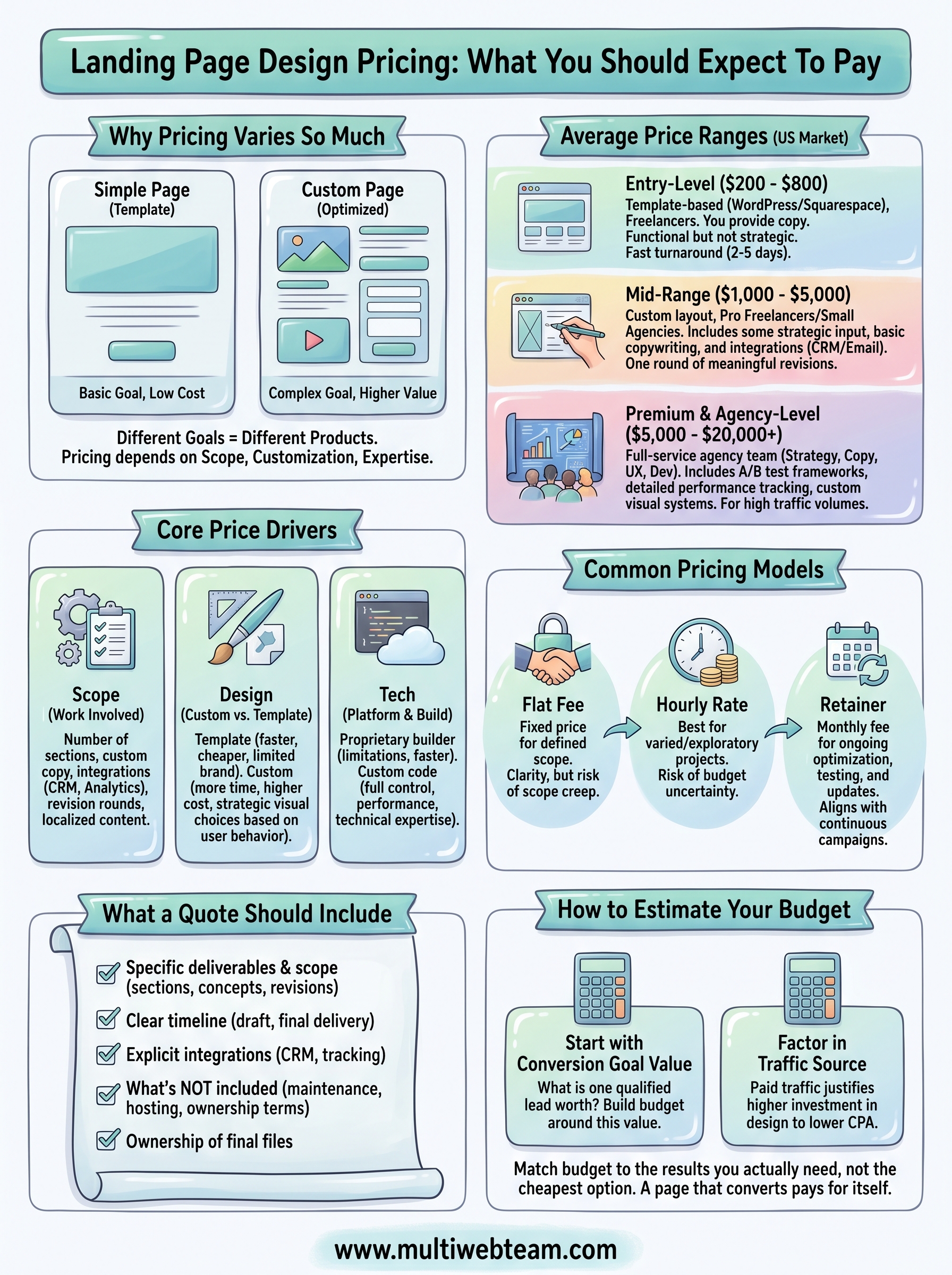
A simple way to decide what to pay
Landing page design pricing makes more sense when you connect your budget to your goal rather than shopping for the lowest number. Start with what a single conversion is worth , then work backward to what a well-built page is reasonably worth spending. If your page supports paid traffic, invest more. If you run multiple locations, look for a vendor who builds scalable systems rather than one-off pages .
The range from $200 to $20,000 exists because those are genuinely different products. Your job is to match your budget to the level of work your business situation actually requires, not to the cheapest available option. A page that converts consistently pays for itself ; one that doesn't costs you far more than the design fee over time.
If you manage a franchise or multi-location business and want pages built to perform across every market, see what Multi Web Team offers.