What Is Website Conversion Optimization? CRO Explained
Your website gets traffic. People land on your pages, browse around, and leave. But how many of them actually do the thing you want them to do, fill out a form, call your business, or book an appointment? That gap between visitors and actual customers is exactly what website conversion optimization addresses. It's the practice of making deliberate, data-driven changes to your site so that more visitors take meaningful action instead of bouncing.
For multi-location businesses and franchises, the stakes are even higher. Each location needs its website pages to pull weight locally, turning searchers into walk-ins, phone calls, and online orders. A site that looks good but doesn't convert is just an expensive digital brochure. At Multi Web Team, we build and manage websites for multi-location businesses with conversion as a core objective , not an afterthought. Every design decision, content update, and SEO adjustment we make ties back to one question: is this helping locations turn visitors into customers?
This article breaks down what CRO actually means, how the process works from start to finish, and the specific strategies you can apply to improve your website's performance. Whether you're running five locations or fifty, you'll walk away with a clear understanding of how to get more from the traffic you already have .
Why website conversion optimization matters
Most businesses pour money into driving traffic through paid ads, SEO, social media, and local listings. But traffic without conversion is wasted spend . If a hundred people visit your location page and only two of them call or fill out a form, you've effectively overlooked 98 potential customers. Understanding what is website conversion optimization starts with recognizing this gap and deciding it's worth closing.
A 1% improvement in your conversion rate can deliver the same revenue impact as doubling your traffic, at a fraction of the cost.
More traffic is not the same as more customers
When you focus purely on getting visitors to your site, you're solving only half the problem. Traffic is a means to an end , not the end itself. A page that ranks on the first page of Google but fails to compel visitors to act is generating cost, not customers.
Think about your own browsing behavior. You land on a page, scan for what you need, and if something feels off, like slow loading, a confusing layout, or no clear next step, you leave. Your visitors do the same thing , and every person who leaves without converting represents a missed opportunity that your competitors might capture instead.
Your current traffic is already worth more
You don't always need more visitors to grow your business. Improving how your current traffic converts often produces faster, cheaper results than running another ad campaign. Consider the math: if your site gets 2,000 visitors a month and converts at 2%, that's 40 leads. Push that rate to 4% through targeted CRO work, and you get 80 leads from the exact same traffic .
The cost to acquire that traffic stays the same, but your revenue outcome doubles. That's the core argument for prioritizing conversion optimization over simply buying more visibility. Every dollar you've already spent on SEO or ads works harder the moment your pages do a better job of turning visitors into action-takers.
Multi-location businesses carry extra risk
For businesses with multiple locations, a weak conversion rate is not one problem. It multiplies across every location page on your site. Each city or neighborhood page that fails to convert is leaving local customers on the table. A visitor searching for your service in a specific area expects to land on a page that speaks directly to that location, shows relevant information, and makes it simple to take the next step.
When your location pages don't deliver that experience, visitors bounce and find a competitor who does. Every underperforming location page compounds your overall revenue loss , which makes conversion optimization particularly high-stakes for multi-location operators who need each page to carry its own weight.
The long-term case for optimization
Conversion optimization is not a one-time fix. The businesses that win over time treat their website as a living asset and continuously test, measure, and refine it based on real visitor behavior. Markets shift, customer expectations change, and what worked two years ago may not work today.
Building a habit of ongoing CRO also protects the investment you make in other marketing channels. Every dollar you spend on SEO, paid ads, or local listings goes further when the pages those channels send traffic to are built to convert. Without that foundation in place, you're putting resources into a leaky system where most of the value drains away before it ever reaches your bottom line.
Key terms and metrics to know
Before you can improve your conversion performance, you need to speak the language. Understanding what is website conversion optimization requires getting familiar with a handful of terms and numbers you'll encounter constantly. These aren't academic definitions. Each one connects directly to decisions you'll make about your site and whether those decisions are producing results.
Conversions, CTAs, and micro vs. macro actions
A conversion is any action a visitor takes that moves them closer to becoming a customer. That could mean submitting a contact form, clicking a phone number, booking an appointment, or making a purchase. Macro conversions are your primary goals, the actions that directly generate revenue or leads. Micro conversions are smaller steps along the way, like watching a video, downloading a menu, or clicking through to a location page.
The call to action (CTA) is the prompt that tells visitors what to do next. "Book a Free Estimate," "Find Your Nearest Location," and "Call Us Now" are all CTAs. The strength and placement of your CTAs have a direct impact on how many visitors actually convert, which makes them one of the first elements to examine when you start optimization work.
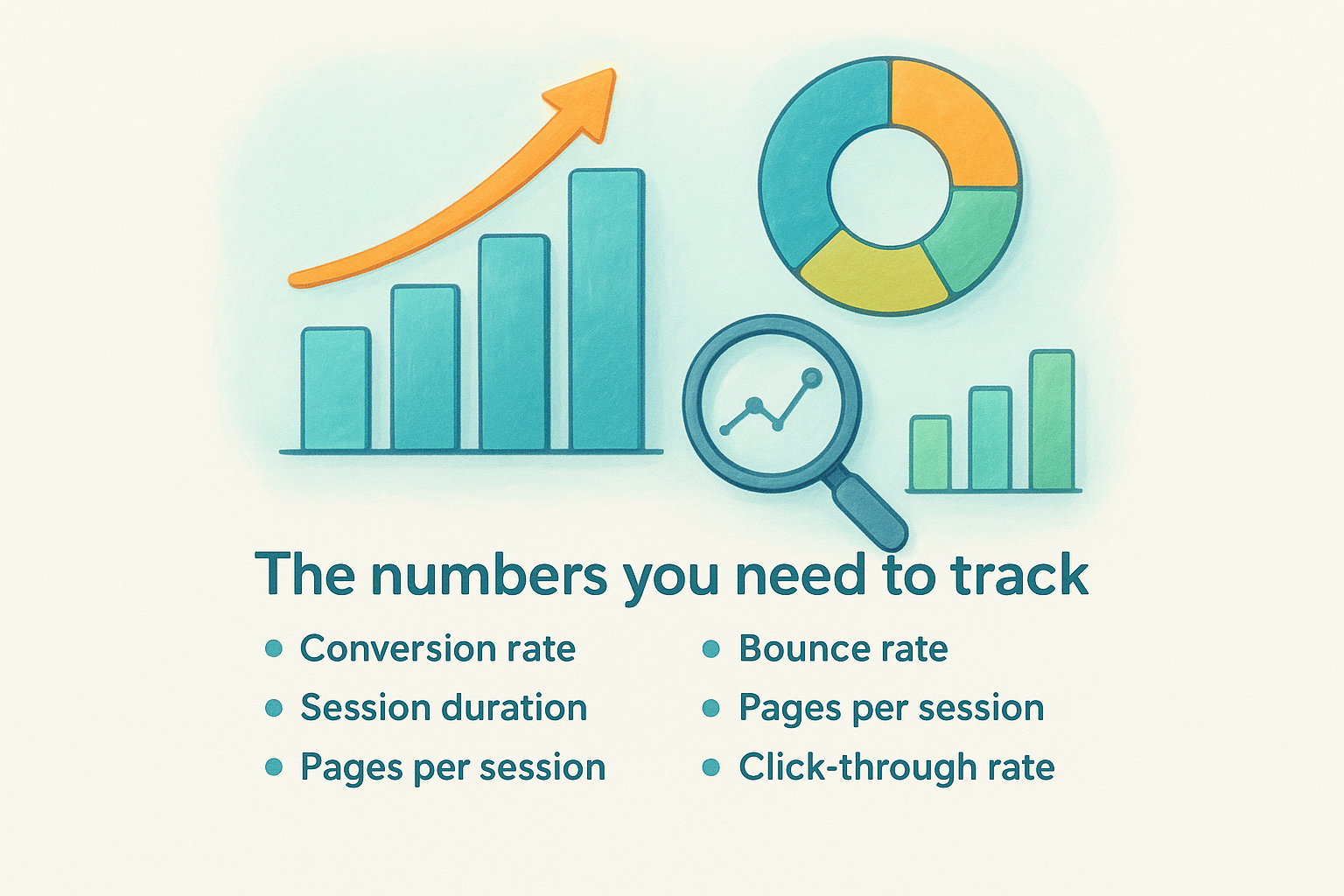
The numbers you need to track
Your conversion rate is the most important metric in CRO. You calculate it by dividing the number of conversions by total visitors, then multiplying by 100. If 1,500 people visit your location page and 45 of them call, your conversion rate is 3% , which gives you a clear baseline to improve from.
Industry conversion rates vary widely by sector, but most local service businesses should target a minimum of 3-5% on their core location pages.
Bounce rate tells you the percentage of visitors who land on a page and leave without clicking anything else. A high bounce rate on a location page often signals a mismatch between what the visitor expected and what the page delivered. Session duration measures how long visitors spend on your site on average, and short sessions paired with low conversion rates usually point to content or layout problems worth investigating.
Here are the core metrics worth tracking from day one:
- Conversion rate - percentage of visitors who complete a goal
- Bounce rate - percentage who leave without interacting further
- Session duration - average time a visitor spends on your site
- Pages per session - how many pages a visitor views before leaving
- Click-through rate (CTR) - percentage of visitors who click a specific link or CTA
How website conversion optimization works
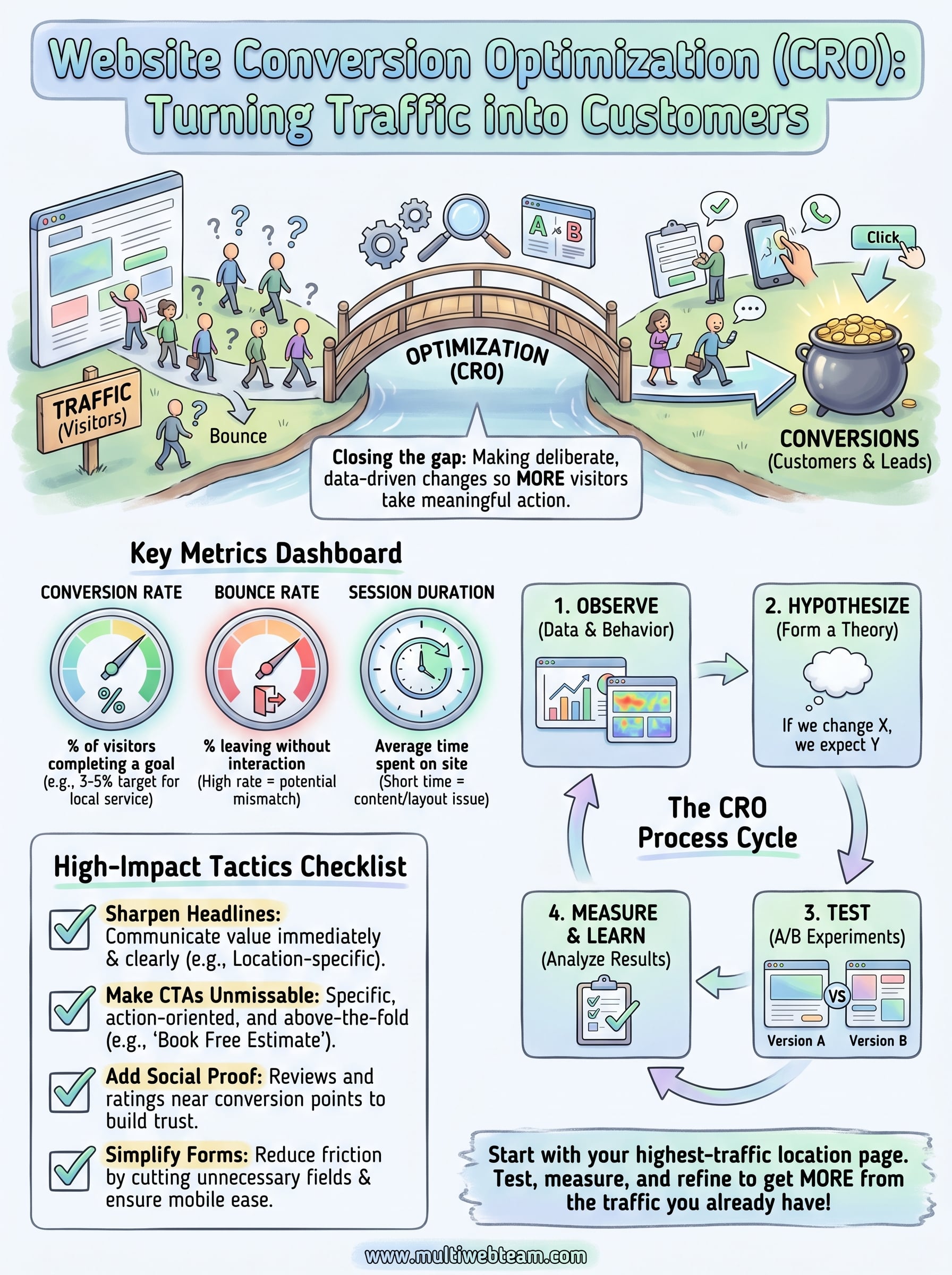
Understanding what is website conversion optimization is one thing; knowing how to actually run it is another. The process follows a clear, repeatable cycle that moves from observation to hypothesis to testing to measurement. You don't make changes based on gut feeling or what looks good to you. Instead, every change you make is grounded in data about how real visitors behave on your site, which keeps your decisions tied to evidence rather than assumptions.
Start with data, not guesses
The first step is collecting information about what your visitors actually do. Analytics tools show you where people enter your site, where they drop off, and which pages generate the most action. Heatmaps and session recordings go deeper, revealing where visitors click, how far they scroll, and which elements they ignore entirely.
You're looking for patterns that signal friction. A location page with a high bounce rate and short session duration tells you something isn't connecting with visitors. Combining quantitative data (numbers) with qualitative data (behavior recordings and user feedback) gives you a complete picture of where your site is losing people and why. Without this foundation, you're guessing, and guessing wastes time and budget.
The goal of this research phase is not to confirm what you already believe, but to let real visitor behavior reveal problems you haven't noticed yet.
Form a hypothesis and run a test
Once you identify a problem area, you build a hypothesis. A hypothesis follows a simple structure: "If we change [specific element], we expect [specific outcome] because [reason drawn from data]." For example: if you move the phone number to the top of the page, you expect more calls because your heatmap shows most visitors never scroll past the first screen.

From there, you run a test. A/B testing is the most common method , where you show one version of a page to half your visitors and a different version to the other half. After enough traffic passes through both versions, you measure which produced more conversions. The winning version becomes your new baseline, and the cycle begins again with a new problem to investigate.
Measure, learn, and repeat
CRO is not a project you finish and move on from. It's an ongoing process of incremental improvement where each test teaches you something specific about your visitors. Some tests will confirm your hypothesis. Others will surprise you. Both outcomes have value because they sharpen your understanding of what your audience actually responds to.
Building this loop into your regular website management means your site compounds its effectiveness over time rather than staying static after launch.
Where to focus your optimization efforts
Not every page on your site deserves equal attention when you're starting CRO work. Focusing your energy on high-impact pages first produces faster results than trying to optimize everything at once. The question of what is website conversion optimization often gets abstract, but in practice it starts with a simple priority: fix the pages where the most visitors are dropping off before taking action .
Location pages first
For multi-location businesses, your individual location pages are the highest-priority targets. These pages are where local search traffic lands , and they carry the full burden of convincing a nearby visitor to call, book, or walk in. If your location pages load slowly, lack a clear CTA, or fail to show address and hours prominently, you're losing customers who were already close to choosing you.
A location page that doesn't answer the visitor's immediate questions, where you are, what you offer, and how they contact you, will not convert regardless of how much traffic you send to it.
Start by auditing every location page for load speed, CTA visibility, contact information, and mobile responsiveness . Fix the weakest performers first, since those represent the largest immediate opportunity.
High-traffic entry pages
Beyond location pages, look at which pages receive the most organic or paid traffic. These pages function as front doors to your business , and even small conversion improvements there produce outsized results because of the volume of visitors they see. Use your analytics data to identify the top five or ten entry pages by session count, then rank them by conversion rate.
Pages with high traffic and low conversion rates are your most valuable optimization targets. They already have an audience. Your job is to fix what's stopping that audience from taking action, whether that's a weak headline, a buried phone number, or a form that asks for too much information upfront.
Forms and contact triggers
Forms and click-to-call buttons are the actual mechanisms through which visitors become leads. Reducing friction in these elements often delivers the fastest conversion lifts of any optimization work you do. If your contact form asks for eight fields when three would do the job, visitors will abandon it. If your phone number isn't clickable on mobile, you're losing calls from people who were ready to reach out.
Audit your forms for field count, label clarity, and mobile functionality . Cut anything that isn't necessary for your team to follow up effectively, and make sure every contact trigger is visible without scrolling on a phone screen.
Proven CRO tactics that usually move the needle
When people ask what is website conversion optimization in practical terms, the answer often comes down to a short list of changes that consistently produce results across industries and business types . Not every tactic works equally well in every situation, but the ones below have a strong track record because they target the core reasons visitors hesitate before taking action rather than surface-level cosmetic improvements.
Sharpen your headlines and above-the-fold content
The first screen a visitor sees when they land on your page determines whether they stay or leave. Your headline needs to communicate your value clearly and immediately , without making the visitor work to understand what you offer. If your location page opens with your company name and a vague tagline, you're wasting the most valuable space on your site.
Replace generic openers with specific, benefit-driven language that tells visitors exactly what they get and why they should act now rather than browse elsewhere. For multi-location businesses, this means calling out the city or neighborhood directly in the headline so visitors feel they've landed in the right place before they read another word.
Make your calls to action impossible to miss
A CTA that blends into the page or uses weak language like "Submit" costs you conversions every day. Specific, action-oriented CTAs consistently outperform vague ones in tests across virtually every industry. "Book Your Free Estimate" or "Call Our [City] Location Now" gives visitors a clear next step and sets expectations about what happens when they click.

Visitors who have to search for a way to contact you will often give up before they find it.
Place your primary CTA above the fold so visitors see it without scrolling, then repeat it at logical points as they move down the page. On mobile, your phone number should be a tap-to-call link every time it appears, not plain text that forces visitors to manually dial.
Add social proof near your conversion points
Most visitors arrive with some degree of skepticism. Reviews, star ratings, and customer counts reduce that skepticism by showing that other people have already made the same choice and been satisfied. For multi-location businesses, location-specific reviews carry more weight than generic testimonials because they directly apply to the area the visitor is searching in.
Place reviews close to your CTAs rather than buried at the bottom of the page. A single strong testimonial positioned directly above a contact form can measurably lift submission rates because it addresses hesitation at the exact moment a visitor is deciding whether to take action .
A simple testing and prioritization workflow
Knowing what is website conversion optimization matters, but without a clear process for deciding what to test and in what order, most businesses end up with scattered efforts and inconclusive results. A structured workflow keeps your CRO work focused and ensures you spend time on changes with the highest potential to move your numbers rather than acting on random ideas that feel right in the moment.
Score every idea before you commit to it
Not every optimization idea deserves equal attention or equal urgency. Prioritizing your test queue based on three factors, potential impact, evidence confidence, and implementation effort, gives you a rational way to decide what to tackle first. Assign each idea a score from 1 to 5 in each category, add the scores together, and rank your ideas from highest to lowest. Start at the top and work your way down.
This approach stops you from burning hours on low-value changes while high-impact problems sit untouched on your list. Treat your prioritization list as a living document that you revisit and reorder after every completed test as new behavioral data comes in and your understanding of your visitors sharpens.
Define success before you touch the page
Before you modify any element on your site, write down exactly what you're testing, what result you expect, and what number will tell you the test succeeded. Committing to your success criteria upfront prevents you from moving goalposts when early results don't go the direction you hoped.
Run each test for a minimum of two full weeks regardless of how quickly the numbers start moving, since day-of-week variation in visitor behavior will skew results if you cut the test short.
Set a minimum sample size threshold before you declare a winner , and stick to it even when one version looks like it's pulling ahead early. Calling a test too soon is one of the most common mistakes that leads to bad decisions and wasted follow-up effort.
Record the outcome and feed it forward
Once a test reaches statistical significance, apply the winning version as your new baseline and close the experiment. Avoid running multiple tests simultaneously on the same page , since overlapping changes contaminate your data and make it impossible to identify which variable actually drove the result.
Log your hypothesis, your test setup, and your findings in a shared document so every person involved in your site can see what has been tried, what worked, and what didn't. That record becomes one of the most valuable assets in your ongoing CRO work.
CRO measurement and tool stack basics
Understanding what is website conversion optimization in theory is straightforward, but executing it well requires the right tools feeding you the right data. Without a reliable measurement setup, you're making decisions based on incomplete information , and even well-reasoned hypotheses will produce results you can't fully trust. Before you run a single test, get your measurement foundation in place so every number you track reflects actual visitor behavior rather than gaps in your tracking setup.
The analytics layer
Your analytics platform is the starting point for all CRO measurement. Google Analytics 4 gives you access to session data, conversion event tracking, and traffic source breakdowns that help you understand where visitors come from and which pages they interact with before converting. Set up goal tracking for every meaningful action on your site including form submissions, phone number clicks, and appointment bookings, so your conversion data reflects real business outcomes rather than generic page views.
Tracking page views alone tells you little. What you need is event-level data that shows exactly when and where visitors take action or abandon the page.
Connecting your analytics to Google Search Console adds another dimension by revealing which search queries bring people to your site, so you can tie keyword intent directly to conversion behavior and identify pages where strong search traffic isn't translating into leads.
Behavior and testing tools
Behavioral tools fill the gap between what your analytics numbers show and why those numbers look the way they do. Heatmapping tools let you see where visitors click and how far they scroll , which surfaces layout problems that raw session data never reveals on its own. If your CTA sits below the point where most visitors stop scrolling, heatmaps will show you that clearly. Session recording tools go further by letting you watch individual visitor sessions, exposing moments of confusion, hesitation, or friction that you can address directly in your next test.
A/B testing platforms give you the infrastructure to run controlled experiments without requiring changes to your core site code. You can test alternate headlines, CTA button colors, form lengths, and page layouts against your existing versions and measure which produces more conversions with statistical confidence. Most platforms let you set a minimum confidence threshold before declaring a winner, which removes guesswork from your decision-making process. Pair behavioral data with your testing tool so every experiment you run starts from a clear behavioral insight rather than a random idea, and your test queue stays focused on changes that have real evidence behind them.
Next steps to improve conversions
Now that you understand what is website conversion optimization and how it works end to end, the most important move is to start. Pick one high-traffic location page, pull your analytics data, and identify the single biggest drop-off point you can address this week. Run one test, measure the result, and build from there. You don't need a full CRO program running on day one. You need a first test that teaches you something real about your visitors.
If you run a multi-location business and want a website built to convert from the ground up, including location-specific pages, clear CTAs, and ongoing performance management , that's exactly what we handle at Multi Web Team. Every site we build and manage is designed to turn local search traffic into actual customers, not just visitors. See how Multi Web Team helps multi-location businesses grow and find out if it's the right fit for your locations.